
Seventy dollars a day. Since 1 July 2026, that is the most a long-term care home anywhere in Ontario may charge a long-stay resident for a basic room, and the ceiling is identical in every home in the province, for-profit or not-for-profit.
A retirement home works under no ceiling of that kind. Your own house has no price list at all. A family comparing the three is setting a government co-payment beside a private rent and a property tax bill, and the totals will not line up.
This page sets each price beside what it pays for, with every figure dated and its public source listed at the end. Bedford Medical Alert® sells home monitoring to families and nurse call systems to care homes, so we have an interest in more than one of these options. That is the reason no figure on this page comes from us. Rates change and the official pages govern. This page is general information, and not financial advice.
Ontario’s Ministry of Long-Term Care sets maximum co-payment fees once a year, and they are standard across all long-term care homes. The co-payment is the resident’s contribution toward accommodation and meals. Room type changes the price. According to ontario.ca, it does not change the care: every resident is entitled to the same level of care, whatever the room.
The maximums in effect since 1 July 2026, as published on the ontario.ca page Paying for long-term care (updated 10 July 2026):
| Room type (long-stay) | Daily maximum | Monthly maximum |
|---|---|---|
| Basic | $70.00 | $2,129.17 |
| Semi-private | $84.40 | $2,567.17 |
| Private | $100.01 | $3,041.97 |
A short-stay bed, the kind used for respite, carries a daily maximum of $45.31.
Two details from the Ministry’s Spring 2026 bulletin to residents sit behind that table. First, the semi-private and private figures apply to residents admitted to newer beds on or after 1 July 2015. Older beds carry smaller premiums, so a private room in an older bed can have a maximum as low as $91.58 a day. Second, the basic rate is tied to inflation by formula: last year’s rate multiplied by one plus the Consumer Price Index rate, with the increase capped at 2.5 per cent. This year that took $68.56 up 2.1 per cent to $70.00. The monthly figure is the daily rate multiplied by 30.4167.
Homes may also charge for optional extras on top of the co-payment, such as hairdressing or cable TV.
For residents in a basic room who cannot afford the basic co-payment, Ontario runs the Long-Term Care Rate Reduction Program, explained on the same ontario.ca page. Regular semi-private and private rooms are not eligible for it, which a family weighing room types should know before it applies.
The co-payment is predictable. Getting in is not.
Every application and admission to a long-term care home in Ontario is arranged through Ontario Health atHome, and the applicant chooses up to five homes in order of preference. The ontario.ca page Apply for long-term care (updated 5 May 2026) says only that wait times vary, but it is precise about the end of the wait, and several of its rules carry a cost:
Put those four rules together and a family can find itself paying for two places at once. A parent renting a retirement suite, or still carrying a house, when the call comes will find the old costs running on after the new ones begin. Read the notice terms in the lease, or think through the timeline for a sale, while the wait is still long.
People on the waitlist, or already assessed as eligible, can also get help at home while they wait through Ontario’s Community Paramedicine for Long-Term Care program. Ontario Health atHome can tell you what runs locally.
Working out whether your parent can stay home a while longer? Our complimentary consultations happen by phone, at 1-888-755-3055. Tell us what the home care plan covers and which hours it leaves empty, and we will say whether a monitored button would change anything about those hours. Sometimes it would not, and we will tell you that too.
Ontario Health atHome describes retirement homes in four plain statements. They are privately owned and operated. They are regulated and licensed, but they receive no government funding. Residents live in them as tenants under the Residential Tenancies Act, 2006. And residents pay directly for the care services they choose to receive.
That fourth statement is why a retirement home’s monthly figure is a starting point. The same page lists what homes can provide, from meals and housekeeping to nursing and wound care, and adds that each home offers different services at different costs.
The most recent official figure for that rent is five years old. The Canada Mortgage and Housing Corporation’s Seniors’ Housing Survey for 2021 put the average monthly rent for a studio or private room with meals included at $3,354 across Ontario. Among the census metropolitan areas CMHC reported, the average ran from $2,899 in St. Catharines-Niagara up to $4,016 in Toronto. CMHC has since discontinued the survey’s rent data collection, and its data page states that the data will no longer be available going forward.
So any 2026 average quoted for Ontario retirement homes comes from somewhere other than CMHC. Ask each home for its current rent and for the price of each care item, in writing, and ask what happens to the bill if care needs grow.
Before a tour, check the home against the public registry kept by the Retirement Homes Regulatory Authority, which lists every licensed retirement home in Ontario along with its inspection reports.
Aging at home has no official monthly figure, because most of what it costs is already on the household’s books. Mortgage or rent. Property tax. Heat and groceries. What changes is the care.
Ontario Health atHome provides home care services covered through OHIP, and an assessment with a care coordinator decides what a person receives, nursing and personal support among them. Its own list notes that some fees may apply to medical supplies and equipment. Our guide to home care after a hospital stay in Ontario walks through how that assessment works and what an approved plan includes, so we will not repeat it here.
How far does the public plan stretch in practice? A national answer comes from the National Institute on Ageing’s 2025 Ageing in Canada Survey, which asked 6,001 Canadians aged 50 and older in June and July 2025. Of respondents who needed home care, 51 per cent said they were able to get it all or most of the time, up from 48 per cent in 2024, and people with adequate incomes were the most likely to be able to get home and community care. Sixty-two per cent had made no modifications or plans to get their home ready for aging in place, and 18 per cent could not afford an unexpected $500 expense.
If the family fills the hours an assessed plan leaves uncovered with paid help, that is where staying home gets its real price. No public source we could find publishes a province-wide rate for private home help, so this page does not quote one. Get written quotes from agencies near your parent, priced against the hours you actually need.
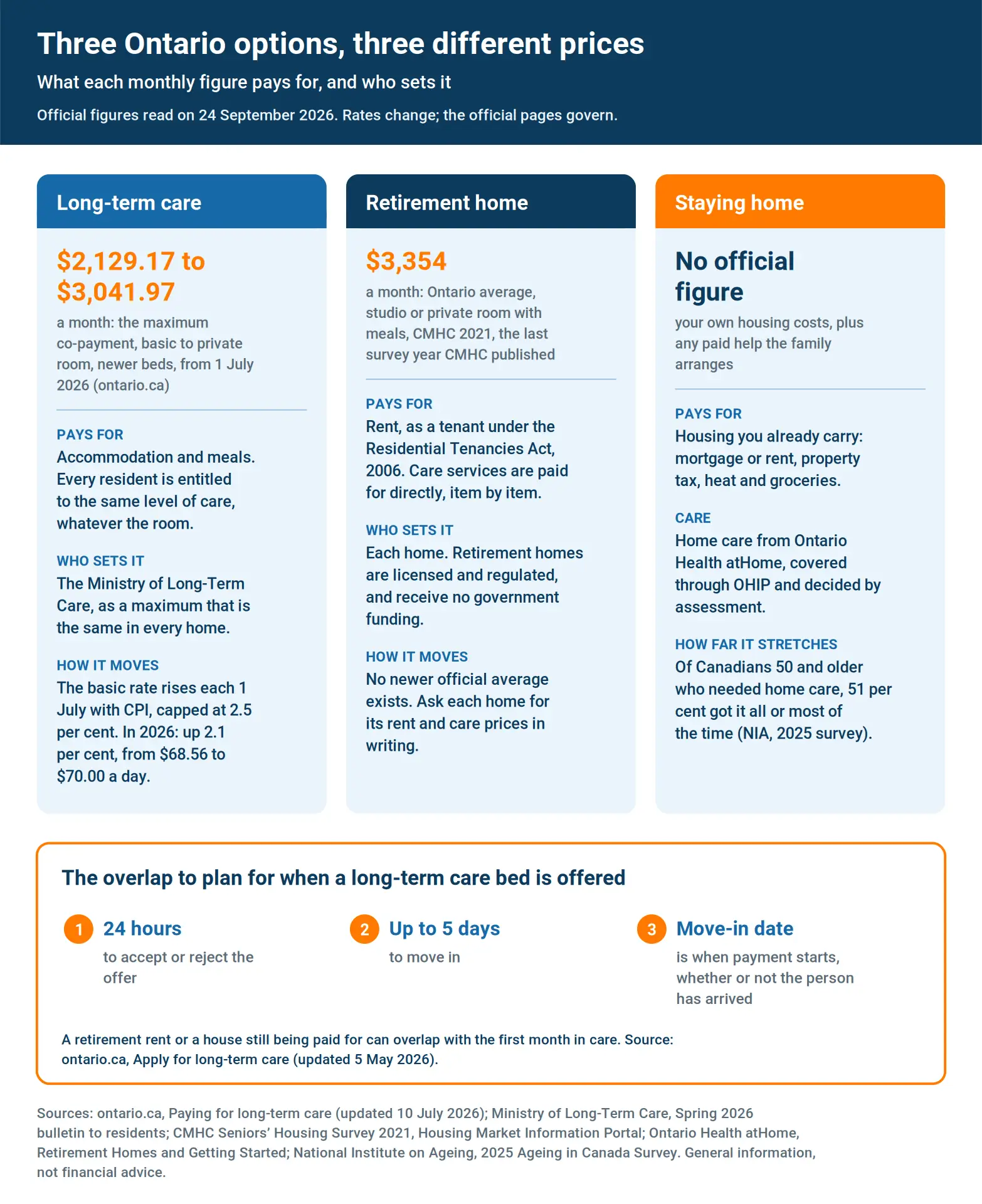
| Long-term care | Retirement home | Staying home | |
|---|---|---|---|
| What the monthly figure pays for | Accommodation and meals, as a co-payment | Rent under a tenancy, with care bought separately | The household’s own housing costs |
| Who sets the price | The Ministry of Long-Term Care, as a maximum that is the same in every home | Each home | Your own mortgage or rent and bills |
| Care | The same level of care whatever the room | Paid for directly by the resident | Home care covered through OHIP by assessment, plus anything bought privately |
| Latest official figure | $2,129.17 to $3,041.97 a month for newer beds, from 1 July 2026 | $3,354 a month, Ontario average, CMHC 2021 (the last survey year) | None published |
| How it changes | Basic rate indexed to CPI every 1 July, capped at 2.5 per cent | Set by each home | With your own bills and your parent’s needs |
One more question has nothing to do with money. Is your parent choosing, or being told? For who pays in what order, and how siblings can share the bill without a standing argument, see our post on the cost of caring for elderly parents.
This short section is about us.
For a parent at home, including one waiting for a long-term care bed, monitoring covers the hours between scheduled visits. Home Freedom, our in-home system, pairs a base unit with a pendant. A press reaches an operator at our monitoring centre in Canada, around the clock, who works from the response plan your family set with us: who is called, in what order, and who has a key. Plans typically run month to month after a three-month minimum at the start, with optional six or twelve month initial terms if the savings suit you. Service reverts to month to month afterwards, and there are no cancellation fees.
If a parent later moves into long-term care or a retirement home, our post on cancelling a medical alert service in Canada explains what happens next. For the fee questions worth asking any provider, us included, see medical alert costs and coverage in Canada.
Bedford also provides nurse call systems for long-term care homes, retirement residences and other senior living settings, which the home buys for its own building. When comparing homes, ask each one how a resident calls for help from their own room, and who answers.
Bedford is a member of the Ontario Community Support Association, has supported hospital education programs and research initiatives from UHN Toronto Rehab to Trillium Health, and brings three generations of experience to these conversations.
Staying home, or waiting at home for a long-term care bed? The Home Freedom system connects a press of the pendant to an operator in Canada, day and night. It comes with the equipment included, Easy Setup and no long-term contract. Talk through the hours you are trying to cover at 1-888-755-3055.
Each was read on 24 September 2026. None of the organizations above is affiliated with Bedford, and none reviewed this page.