
The same question reaches our Canadian care team from very different lives. A retired navy veteran in Halifax wants to know if his service earns him any help. A daughter in Ontario, already managing her mother’s ODSP, asks whether a device can be added. A couple near Red Deer with a workplace health plan just want to know if the plan will reimburse anything. One question, three completely different answers, because funding for a medical alert system in Canada depends almost entirely on who you are and where you live. Bedford Medical Alert® has walked families through this for three generations, so this page lays out the real landscape: the kinds of help that exist, who each one is for, and the first step to take.
There is no single national program that buys a medical alert system for every Canadian senior. Provincial health plans do not cover it as a standard benefit, and there is no federal cheque that arrives for it.
What exists instead is a patchwork. Some of it is federal, some provincial, some private, and some runs through community organizations that rarely appear on any official list. Whether any of it applies to you comes down to your situation, and the real work is matching that situation to the right door. Any site that promises a free system to everyone is selling something. We would rather map the routes that are actually there.
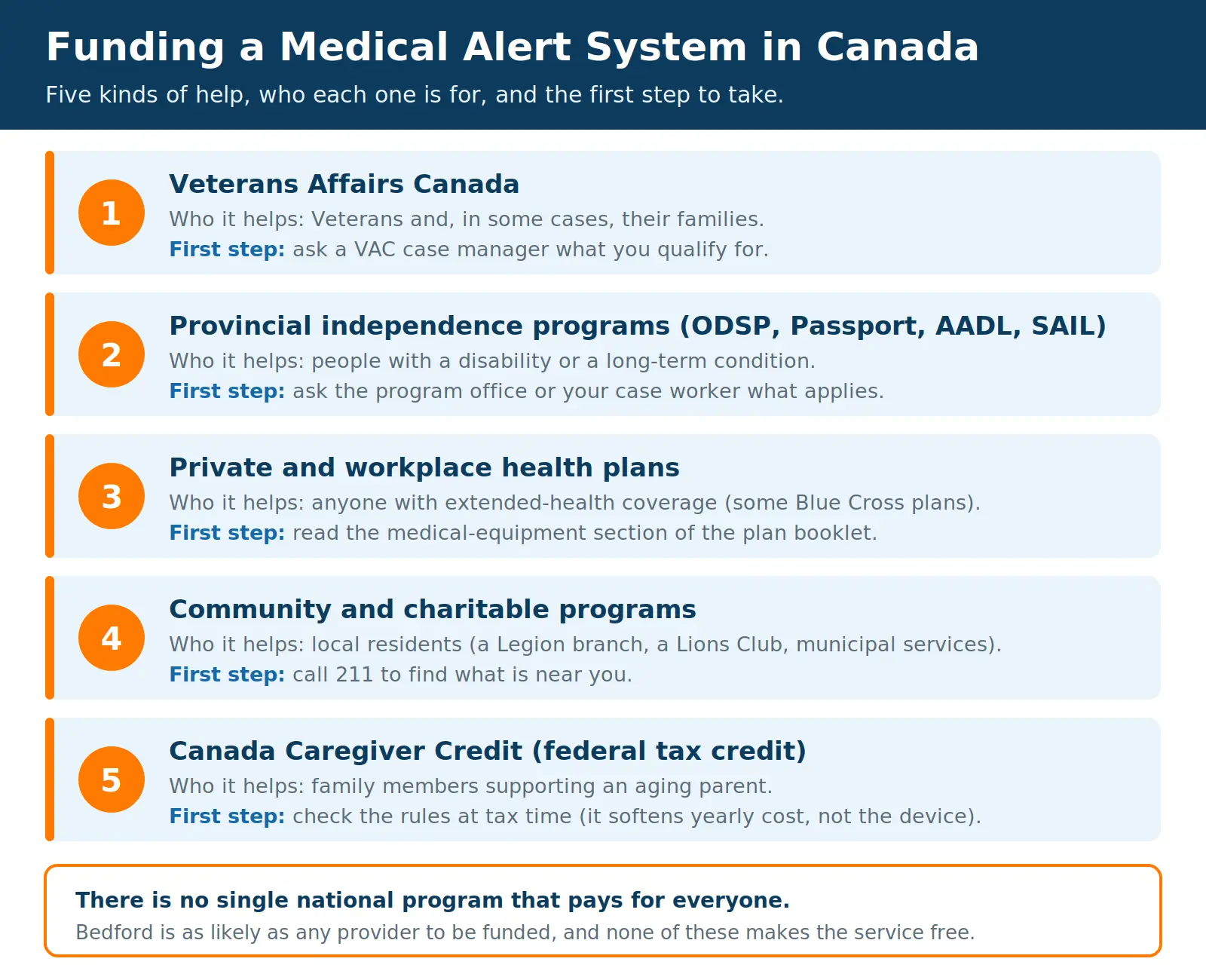
The programs sort into five groups. You will usually only qualify for one or two, so read for the one that fits your household.
If there is a Veteran in the family, this is the first call to make. Veterans Affairs Canada runs the Veterans Independence Program, which helps eligible Veterans stay safely in their own homes by funding home support and related services. What it will cover in any individual case is decided by an assessment, so the right move is to ask a VAC case manager directly what a specific person qualifies for, rather than assuming it is automatic. For a Veteran who does qualify, the support can be meaningful, and it is the route we most often have to point families toward because they did not know to ask. Confirming eligibility costs nothing, so the call is worth making even when a family is unsure it applies to them.
Not sure which route fits your family? Bedford’s Canadian care team can talk it through with you, with no pressure and no obligation. Call 1-888-755-3055 and we will help you understand the service, what it would cost, and where to start, with Easy Setup.
Every province runs some version of a program that helps people with disabilities or long-term conditions get the equipment and supports they need to live independently. In Ontario, the two most familiar are the Ontario Disability Support Program and the Passport Program, and Bedford is recognized under both. Alberta has Aids to Daily Living. Saskatchewan has Aids to Independent Living. Other provinces have their own equivalents.
Here is the careful part. These programs are built around approved equipment and assessed need, and what each one covers varies. Some may help with a device or a safety support for a person who qualifies; some will not stretch to a monitoring service at all. Because the rules differ by program and by person, the reliable step is to ask the program office or your case worker what applies before you count on it. One thread runs through most of them: an assessment by a health professional, or a referral from the case worker who already knows the file, is usually what starts things off.
If the person who needs the device has extended-health coverage, the plan booklet is worth ten minutes. Some private and workplace benefit plans, including certain Blue Cross plans, may reimburse part of the monthly cost of a medical alert service. Coverage runs the full range from generous to nothing, and it changes from one plan to the next, so read the section on medical equipment and home care rather than guessing. If you would like a second set of eyes on the wording, our team is glad to help you find the relevant lines.
This is the group families miss most often. Local seniors’ organizations, service clubs such as a Royal Canadian Legion branch or a Lions Club, and some municipal and regional programs quietly help older residents with safety costs, and the offerings differ from one town to the next. The help might be a one-time subsidy, a reduced monthly rate, or a referral to something you had not found on your own. The simplest way to see what exists near you is to call 211, the free Canada-wide service that connects people to local community and government support. It costs nothing to ask, and it often surfaces help that no national list would show.
One more avenue is worth knowing about. Families supporting an aging parent can sometimes recover part of their care costs at tax time through the Canada Caregiver Credit. It will not pay for a device up front, and the rules are their own subject. Our note on Canada’s caregiver tax credit is where to start. Over a full year, it can take some of the edge off the overall cost of caring for someone. Renovations are a separate question: our page on paying for home safety changes covers the Home Accessibility Tax Credit and other programs for grab bars, ramps and secondary suites.
We want to be plain about our part, because it is a fair thing to ask.
We can explain exactly what the service includes and how billing works, and we can set an account up so it lines up cleanly with a program if you are approved for one. What we cannot do is complete a government program’s application for you. Those signups run through a case worker, a program office, or a benefits assessor, and that is by design. When a family tells us a program is in play, we work with how that program pays rather than getting in the middle of it.
One more thing, and it is the honest core of this page. Bedford is as likely as any other provider to be funded under these programs, and no more. None of them makes the service free, and we are never going to pretend otherwise.
You cannot control which program approves you. You can control how steady the cost is once you have a device, and on a fixed income that is often what matters most.
With Bedford, the equipment is included with the subscription, so there is no separate device to buy. There is no long-term contract. Plans typically run month-to-month after a three-month minimum at the start, with optional savings if you pick a longer initial term, after which service reverts to month-to-month with no cancellation fees. A steady monthly cost you can stop if circumstances change is easier to live with than a large purchase you cannot undo. If you want to see plainly what is included and what coverage should mean, our Home Freedom system page and our costs and coverage guide spell it out, and the no-contract terms are laid out in our note on medical alert with no long-term contract.
Sorting out funding takes a few phone calls. Knowing help is one button away, at a cost you can plan for, is worth the effort of making them. When you are ready to match a device to your situation, the short which device is right for you guide is a good place to narrow it down.
If home is where the protection needs to live, start with the Home Freedom systems page, or call a Bedford care consultant at 1-888-755-3055 and describe your setup. Equipment is included, and Easy Setup does the rest.