
Before anyone moves into a licensed retirement home in Ontario, the home has to hand them a package of information. The Retirement Homes Act, 2010 sets out what goes in it, and most of the list is paperwork: the residents’ bill of rights, the complaints procedure, an itemized list of care services and their prices. Two items near the end are not paperwork at all.
One is information about staffing, including night-time staffing levels and the qualifications of staff. The other is a statement of whether the home has a resident-staff communication and response system and, if it has one, the details. The law asks the question rather than assuming the answer.
So the question families bring to us before a move has no single answer. Does a parent still need their own medical alert once they live in a retirement residence? This page sets out what an Ontario retirement home is required to be, where a building’s call system can stop, and the questions that settle it for one particular suite.
A disclosure first. We are Bedford Medical Alert®, Canadian-owned and operated, with 24/7 monitoring based in Canada. We sell personal medical alerts to people who live on their own. We also sell nurse call systems that residences install in their own buildings. With a commercial interest on both sides of this question, we name no residence here and recommend neither answer by default.
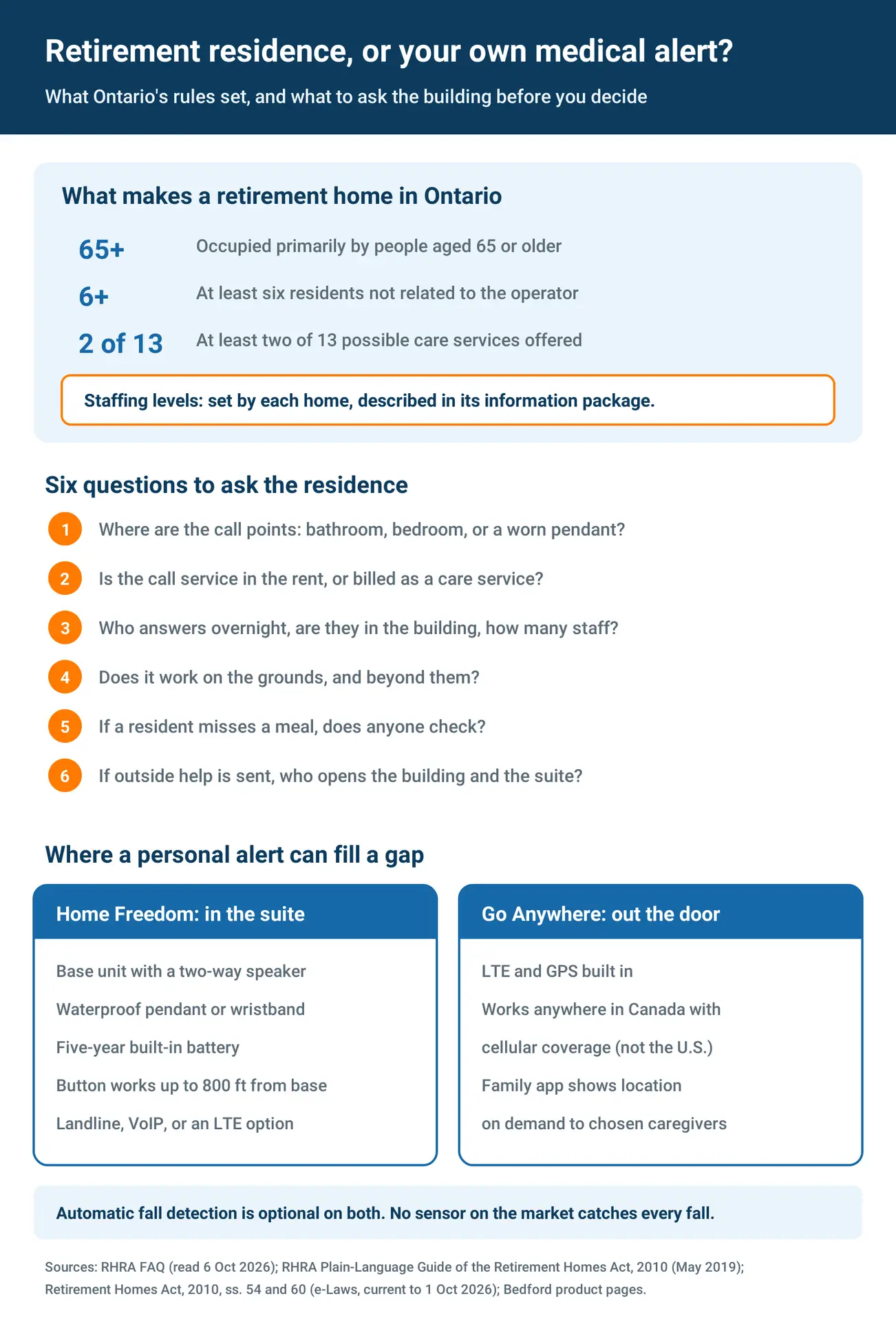
Ontario licenses retirement homes under the Retirement Homes Act, 2010, and the Retirement Homes Regulatory Authority (RHRA) oversees them. The RHRA’s definition has three parts: a building occupied primarily by people aged 65 or older, by at least six people who are not related to the operator, where the operator makes at least two of 13 possible care services available.
Two of 13. That is the floor.
The 13 care services, as the RHRA’s plain-language guide to the Act lists them, include provision of a meal, assistance with bathing, dressing and ambulation, administration of a drug, dementia care, skin and wound care, and nursing service. A home that offers meals and help with bathing meets the definition. So does a home that offers all 13. Both are called retirement homes, and they are very different places to live.
Residents pay for their accommodation and for any care services they buy from the home, according to the RHRA. They can also arrange care from outside providers such as Ontario Health atHome. Long-term care homes, often called nursing homes, are a separate system: government funded and regulated by the province’s long-term care ministry. This page does not cover them, and our comparison of long-term care, retirement home and at-home costs in Ontario covers the money side so we do not repeat it here.
Other provinces regulate retirement and supportive living under their own rules. Ontario is the example on this page; the questions further down work anywhere.
One answer in the RHRA’s public FAQ surprises families who assumed otherwise: “The RHRA does not have authority to set minimum staffing levels in retirement homes, but information about the home’s staffing levels must be included in the home’s information package and provided to residents.”
That does not mean a home is short of staff. It means staffing, including who is in the building overnight and what training they hold, is decided home by home, and the information package is where each home writes it down. Ask for the package before a move, not after. The Act also lets family members see it when the resident consents.
Size varies as widely. The Ontario Retirement Communities Association (ORCA), whose member homes account for over 90 per cent of the suites in the sector, describes those homes as ranging from 10 to more than 300 residents (ORCA quick facts, last updated January 2023). A call answered from a desk down the hall in a ten-suite house is a different service from a call answered across a 300-resident campus, even if both brochures use the same words.
Before a tour, look the home up on the RHRA’s public register. It lists the care services each licensed home offers, its inspection findings, and summaries of any enforcement action.
A call system built into a residence is designed around the building. That is its strength. The people who answer are in the same building, and they know it.
The design also sets the edges. Picture your parent’s actual day and walk through it:
Time on the floor after a fall is worth weighing in all of this. Our page on the long lie after a fall explains why.
The home’s information package has to cover its call system, its night staffing and its prices, so start there, then ask for the rest in writing. A residence that answers all six clearly has thought about them.
Have the residence’s answers and still not sure they cover the places and hours your parent actually spends their day? Talk it through with a Bedford advisor in a complimentary consultation by phone at 1-888-755-3055. We will tell you plainly if the building already covers it.
Say the residence gives your parent a worn pendant, staff on site answer it day and night, and your parent rarely goes out alone. A second device on top of that may add little. We would rather write that here than sell a duplicate.
A personal medical alert tends to earn its place in other situations. The suite has fixed call points only. Overnight coverage is thin, or still unclear after you have asked. Your parent goes out on their own. Or the family wants the response plan, the order of calls and the people on it, to be one they set themselves.
There is also an in-between option: keep a personal device for the first months after a move, while you learn how the building runs at night, and decide afterwards. If your parent later moves to a setting where the device is no longer needed, our post on cancelling a medical alert service explains how that works.
Home Freedom is our in-home system. A base unit with a two-way speaker pairs with a pendant or wristband that is fully waterproof, so it stays on in the shower, and carries a five-year built-in battery. The button works up to 800 feet from the base. The base connects through a traditional landline or a VoIP line, and an LTE option exists when neither is available, which can matter in a building where the phone service belongs to the residence. A backup battery keeps the base running through a power outage.
Go Anywhere devices carry LTE and GPS. A press reaches our monitoring centre from the garden path or a city bus, anywhere in Canada with cellular coverage. Our devices are not for use in the United States. A family app for iOS and Android lets the caregivers you choose check the wearer’s location on demand.
Both can add automatic fall detection, which calls the monitoring centre when it senses the movement of a hard fall. No sensor on the market catches every fall, so the button remains the main way to call.
A press reaches an operator in Canada who works from the response plan your family set with us: medical information, medications, where a spare key is kept, the emergency contacts and the order to call them. If your parent cannot answer, the operator does not assume a false alarm and follows a set procedure for a silent call. In a residence, decide in advance whether the front desk belongs on that contact list and who unlocks the suite. Then tell the residence the device is there, so nobody is surprised when help arrives. Our page on what happens when you press a medical alert button follows a call from start to finish.
Bedford also supplies nurse call systems that residences buy for their own buildings, including independent living and retirement residences. Those systems combine wearable pendants, wall-mounted radar sensors and nurse call stations, with alerts going to the residence’s own staff. Residence operators can find them on our senior living solutions page.
We are a member of the Ontario Community Support Association, we have supported hospital education programs and research initiatives from UHN Toronto Rehab to Trillium Health, and we bring three generations of experience. Having built call systems for buildings and for people who live alone, our advice is the same either way: ask the building first, then fill only the gaps it leaves.
Moving into a suite with fixed call points only? The Home Freedom system puts a waterproof button on the wrist or around the neck, answered around the clock by operators in Canada. Equipment is included, with Easy Setup and no long-term contract. Call 1-888-755-3055 to talk through the suite.