
Most home-safety advice treats every room the same. The injury data does not. Year after year, two settings account for a large share of the falls that send older adults to hospital: the bathroom, and the route to it in the dark.
The bathroom earns that reputation honestly. In the United States, an estimated 234,000 people are treated in emergency rooms each year for injuries that happened in the bathroom, and more than eight in ten of those injuries are falls, according to the U.S. Centers for Disease Control and Prevention. The rate climbs steeply with age. Closer to home, the Public Health Agency of Canada reports that falls are the leading cause of injury-related hospitalization among seniors, and that between 20 and 30 percent of seniors fall each year.
This guide is for older adults who want to stay independent at home, and for the families who worry about them. Good bathroom safety for seniors comes down to two questions: what makes a room dangerous, and what to do when a fall happens anyway. We will cover the bathroom and the night-time trip to it, with specific changes you can make this week and a clear look at how a help button and 24/7 monitoring from Bedford Medical Alert® fit in. It is practical safety information, not medical advice. For anything involving balance, medication, or a recent fall, your healthcare team is the right place to start.
Small space, hard surfaces, water, and a lot of standing up and sitting down. The bathroom combines almost every ingredient of a fall. The CDC found that about two-thirds of bathroom injuries happen in or around the tub or shower, where wet tile and a high step over the tub wall meet bare feet.
The most hazardous moment is not the one people expect. Getting out of the tub or shower causes far more injuries than getting in, when the surfaces are still dry and the body is steadier.
The toilet is the second hot spot, and its share of injuries grows with age. Among the oldest adults in the CDC data, more than half of bathroom injuries happened on or near the toilet, usually while lowering down or standing back up. Part of the reason is mechanical: a deep, low movement with little to hold onto. Part of it is physiological. Standing up after sitting can trigger a brief drop in blood pressure, called postural hypotension, that leaves a person light-headed for a few seconds. It is a recognized fall risk, and it is often worse first thing in the morning and in the middle of the night.
A bathroom can be made safe at noon and still be dangerous at three in the morning, because the night adds its own hazards.
Waking at night to urinate, known medically as nocturia, is common. More than half of adults over 60 get up at least once a night, and by their eighties the large majority do. Every trip means standing quickly from a warm bed, often half asleep, then walking a dim hallway to a hard-surfaced room.
That pattern is not harmless. In one study of older adults living in the community, frequent night-time trips, three or more in a night, were linked to roughly a 28 percent higher risk of falling. Add the postural blood-pressure dip described above, and a route that may include a loose rug, a phone cord, or an unlit doorway, and the overnight hours become a safety problem of their own, separate from anything that happens during the day. If someone in the house wakes often at night, that is worth planning for directly. Some families also consider a bed alarm for those overnight hours; our guide to bed alarms for seniors covers where one helps and where it stops.
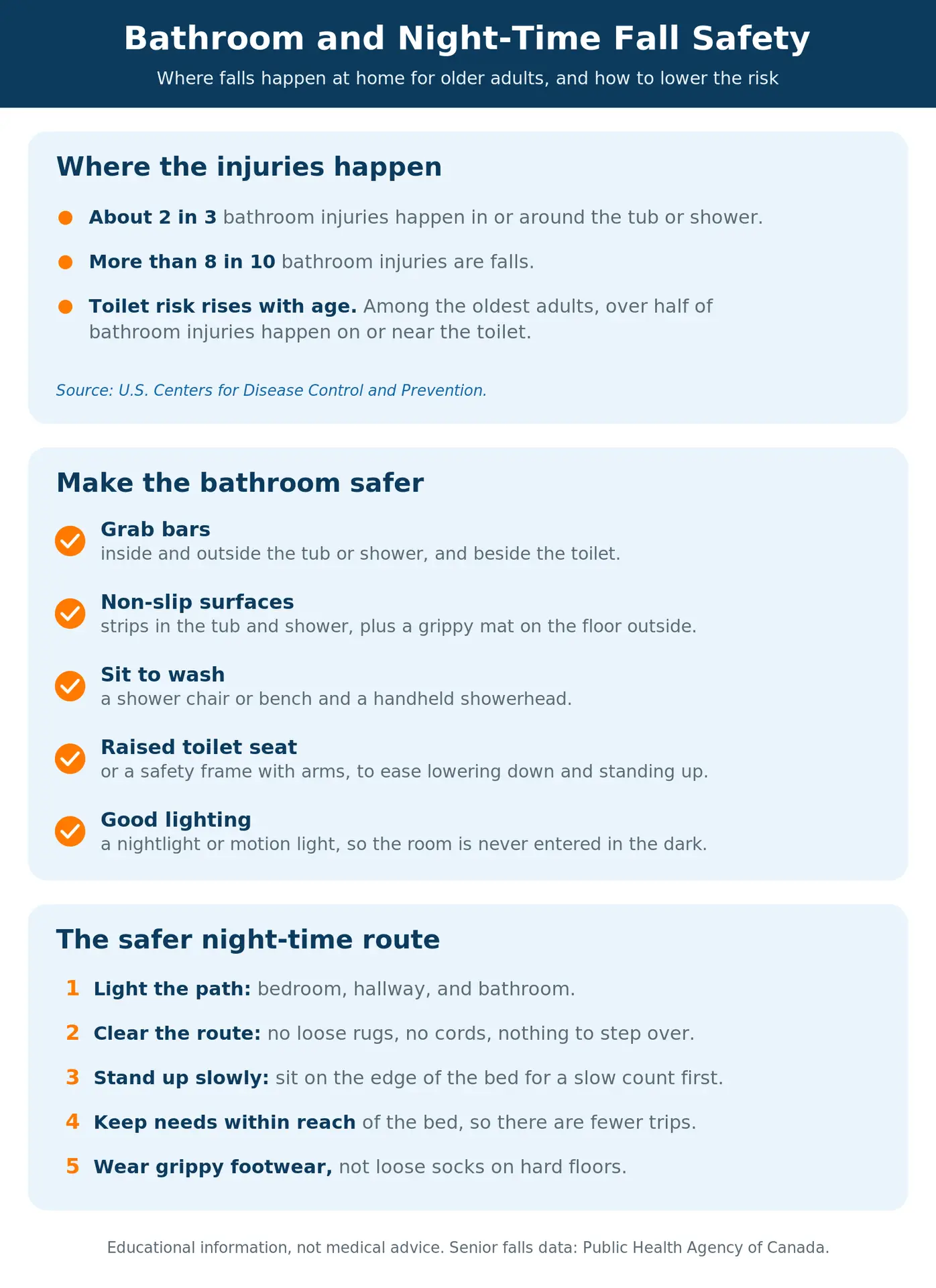
If there is one upgrade worth making first, it is grab bars, and the CDC is specific about where to put them: inside and outside the tub or shower, and beside the toilet. The same research showed how rare they still are. In a national home-safety survey, about 63 percent of homes had a tub mat or non-slip strips, but only 19 percent had installed grab bars. A towel rack is not a substitute. It is not built to hold a person’s weight.
A short, bathroom-only checklist:
None of this has to make a bathroom look clinical. Most of these fixtures come in finishes that pass for ordinary hardware, and they protect everyone in the household, not only the oldest person in it.
The night-time fixes mostly live outside the bathroom, on the way to it.
For anyone who already wakes often at night, it is worth raising nocturia with a doctor, because it is frequently treatable, and fewer trips mean fewer chances to fall. We look at how wearing a help button to bed changes the overnight picture in our guide to medical alerts and better sleep.
Not sure which device makes sense for a bathroom and bedroom at night? Talk it through with a Canadian care consultant, with no pressure and no obligation. Call 1-888-755-3055 and we will help you find the right fit.
Even a well-set-up bathroom cannot prevent every fall, and the bathroom is one place where being able to call for help matters most. A person may be alone, on the floor, and out of reach of a phone. That is why a wearable help button is worth more here than almost anywhere else.
Bedford help buttons are water resistant and made to be worn in the shower. That is the point: the device stays on for the riskiest minutes instead of sitting on the nightstand. One press connects to a monitoring centre in Canada through a two-way speaker, and our operators follow a personalized response plan, the contacts and notes set up in advance, rather than a generic script. For a fall at three in the morning, that means a real person who already knows the situation.
There are also two ways to cover the moments a button is not being worn. Some Bedford devices offer automatic fall detection, which, in general terms, uses motion sensors to recognize patterns that may indicate a fall and can begin a call on its own. No system detects every fall or guarantees an outcome, so it works as one layer rather than a promise. And for rooms where a person would rather not wear anything at all, Bedford also offers Silver Shield, a non-wearable sensor that watches a room for falls without a camera and without anything to put on. Our explainer on how automatic fall detection works covers the mechanics, and which medical alert device is right for you helps match a device to the home and the person.
Securing the bathroom and the night-time route addresses where falls actually happen. Balance, strength, footwear, and medication shape whether a stumble becomes a fall in the first place, and those belong to a wider plan, which we cover in our guide to preventing falls for seniors at home. Treat the bathroom as the first and highest-yield project, then work outward from there. If there is a surgery date already on the calendar, a hip or knee replacement makes this room the first one to sort out, and our Sunnybrook discharge resource covers how to use the weeks beforehand.
Bedford Medical Alert is Canadian owned and operated, with 24/7 monitoring based in Canada. Equipment is included with the subscription, so there is no separate device to buy, and there is no long-term contract, which means a family can start during a worrying stretch and adjust later without a penalty. We are an OCSA member, our service is recognized by UHN Toronto Rehab, and we are approved under ODSP and the Passport Program for those who qualify. Canadian families have given us a 4.9-star Google rating. Easy Setup means a system is ready to use quickly, often the same day it arrives.
For protection that covers the bathroom, the bedroom, and every room in between, the Home Freedom system pairs a base station with a water-resistant help button you can wear in the shower, with optional fall detection.
Ready to make the most dangerous room a safer one? The Home Freedom system protects throughout the house with a water-resistant help button and a Canadian monitoring team on call 24/7, equipment included and no long-term contract. Call 1-888-755-3055 and we will help you set it up.
Tell us a little about your situation and a Bedford specialist will call you back, usually the same day. No pressure, no obligation.