Black Friday to Cyber Monday: six months of service for the price of four.Black Friday to Cyber Monday: six months for the price of four. See the offer
Thirty minutes, or an hour and more.
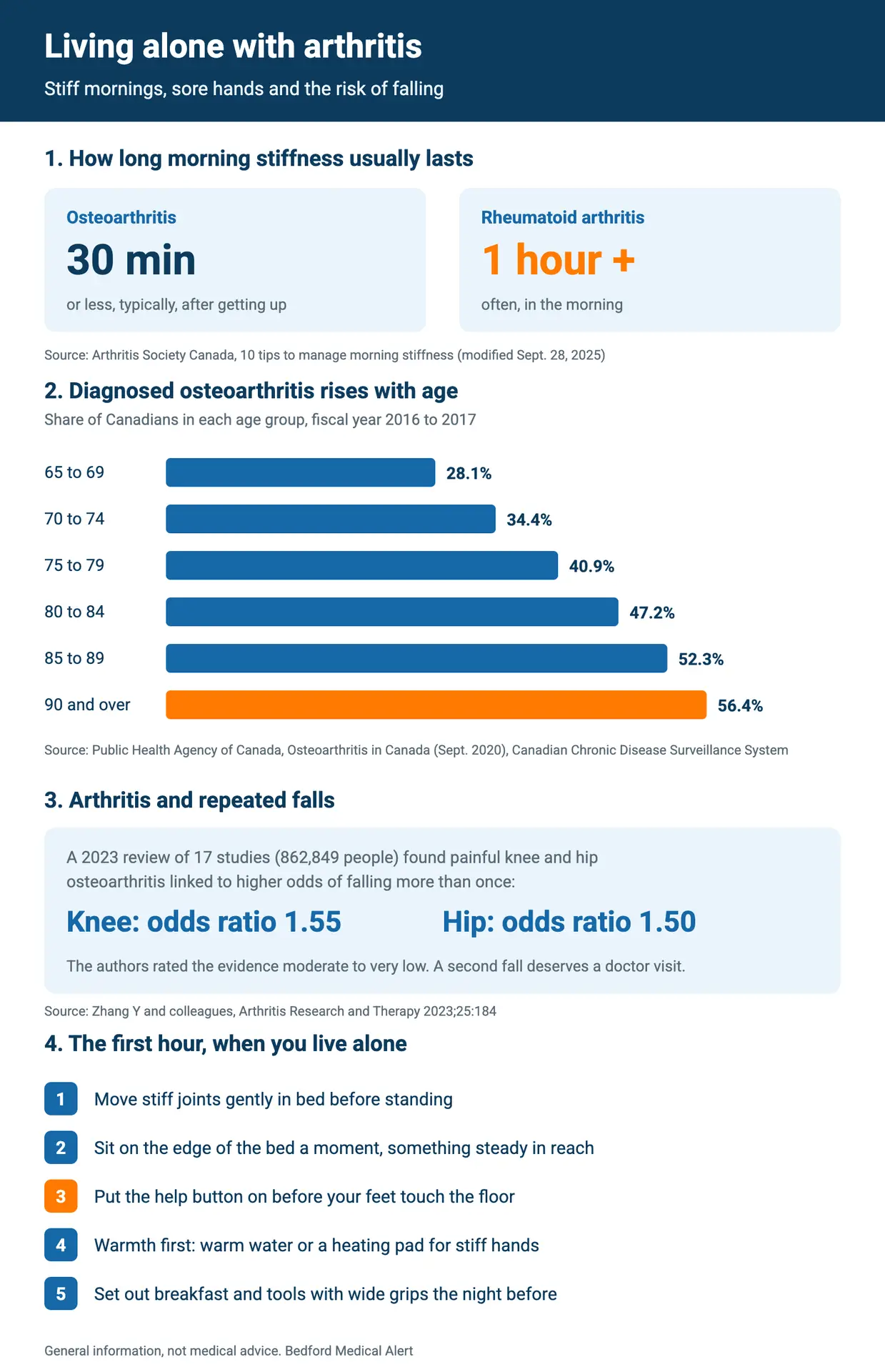
That is roughly the difference the Arthritis Society describes between two kinds of morning. With osteoarthritis, stiffness typically eases within 30 minutes or less of getting up. With rheumatoid arthritis, it often lasts an hour or more. For someone who lives alone, that first stretch of the day is when the knees are least willing, the hands least able to grip a rail, and nobody else is in the house.
This page is for older adults with arthritis who live on their own, and for the families who check in on them. It covers how common arthritis is at older ages, what research says about arthritis and falls, the practical advice Canadian arthritis and health organizations give for mornings, hands and the house, and how a help button fits in. It is general information, not medical advice. Treatment and medication questions belong with your doctor, pharmacist or physiotherapist.
The Public Health Agency of Canada tracks diagnosed osteoarthritis through the Canadian Chronic Disease Surveillance System. In its report on osteoarthritis (September 2020, data for fiscal year 2016 to 2017), about 3.9 million Canadians aged 20 and older, or 13.6%, were living with diagnosed osteoarthritis. The share climbs steeply with age: 28.1% at ages 65 to 69, 47.2% at 80 to 84, and 56.4% at 90 and over. The agency’s data tool shows nearly the same shares for fiscal year 2023 to 2024: 27.7%, 47.0% and 55.9%.
Osteoarthritis is one type. Arthritis Society Canada, drawing on 2019 to 2021 Canadian Community Health Survey data, puts the total for all types at more than 6 million people in Canada, or 1 in 5 adults. It also reports that more people in Canada say they live with arthritis than with diabetes, heart disease, cancer, stroke and dementia combined, and that about 4 out of 5 people with arthritis have at least one other chronic condition.
For more than 40% of people with arthritis, the Society reports, pain is severe enough to limit their activities. In a house with one person in it, a limited activity is a job that waits, or a job done anyway on a bad day.
Mornings are where the Arthritis Society’s own occupational therapists start. A few of the tips in its guide to morning stiffness (last updated September 2025), among them:
Read that list as someone alone in the house and one more step suggests itself. Sit on the edge of the bed for a moment before you stand, with something steady within reach. The bathroom trip at 6 a.m., on stiff knees, on a hard floor, is the trip we would most want a help button to be part of.
That leads to a habit worth building from day one. The button goes on before the feet hit the floor, not after the shower or after breakfast. On a Bedford Home Freedom system it is waterproof, so it can stay on through the night and in the shower, and nothing has to be taken off and remembered later.
Does arthritis make a fall more likely? A systematic review and meta-analysis published in Arthritis Research & Therapy in 2023 (Zhang and colleagues) pooled 17 studies covering 862,849 people to look at knee and hip osteoarthritis.
What it found depended on the joint and on how the arthritis was defined. Among its findings:
The authors rated the quality of the evidence as moderate to very low, and noted that some pooled results rested on only one or two studies and that falls were mostly self-reported. So the review does not settle the question. In this evidence, the clearer signal was for repeated falls rather than a single one, which matches what families tend to notice: a second fall is not a fluke.
If falls are repeating, that is reason enough for an appointment, whatever caused the first one. Our page on grip strength by age looks at what a weak grip means for falls.
Living alone with arthritis, or worried about someone who is? Call us at 1-888-755-3055 for a complimentary consultation by phone. Tell us how the hands and knees are on a bad day, and we will walk through how a help button and a personalized response plan would work in that home.
Arthritis in the hands turns small jobs into negotiations. A jar lid. A key in a stiff lock. A phone held long enough to dial.
The Arthritis Society’s advice on sore hands, given by one of its occupational therapists, includes adding heat, pacing activities, using assistive devices, letting bigger joints take the strain, and changing the grip itself: a grip with curved fingers is easier on the joints than the pinch between thumb and fingertip.
A help button has to work for those same hands. Bedford Medical Alert® has buttons for those with more advanced arthritis, which are easier to trigger. Arthritis varies a great deal, so tell us at setup how the hands are at their worst, not on an average day, and we will match the equipment to that. Our page on accessible medical alert devices covers that fitting conversation, along with options for hearing, vision and memory.
Vancouver Coastal Health’s page on modifying activities for arthritis comes at the house from a different angle: let the larger, stronger muscles do the work, and change the furniture before asking the body to change. For example, it suggests:
Stairs deserve their own look, because rails you cannot grip well are rails you cannot fully trust. Our page on stair safety for seniors covers rails, lighting and when to stop using the stairs every day.
Then there is getting up from the floor. With stiff hips and knees it can be slow or impossible without help, and our page on the long lie after a fall explains why the hours spent waiting matter.
Inflammatory arthritis can flare, and even osteoarthritis has weeks that are worse than others. Settle these before the bad week arrives:
The second item on that list goes straight into a Bedford response plan, which brings us to the call itself.
The signal goes to our monitoring centre, staffed 24/7 in Canada. An operator answers through the base unit’s two-way speaker. If you say “my knee went and I can’t get up,” the operator works from the personalized response plan on file, which can include who to call first and where the key is, and can dispatch emergency services. If you cannot answer, the operator does not assume it was a false alarm and follows a set procedure for a silent or unclear call.
On a Bedford Home Freedom system, as the live product page describes it:
An optional fall detection pendant, worn as a necklace, can call for help when it senses a fall, which matters on the days when pressing is hard. It adds a layer, and no sensor on the market catches every fall, so the habit stays the same: press after any fall, even one that seems minor.
Bedford Medical Alert is Canadian owned and operated, with 24/7 monitoring based in Canada, and our operators follow a personalized response plan for every client. We are a member of the Ontario Community Support Association. We are trusted by clinicians across Canada and have supported hospital education programs and research initiatives from UHN Toronto Rehab to Trillium Health. Canadian families have given us a 4.9-star Google rating, and Bedford brings three generations of experience to this work.
Equipment is included with the subscription, so there is no device to buy. Plans typically run month to month after a three-month minimum at the start, with optional six or twelve month initial terms if the savings suit you. Service reverts to month to month afterwards, and there are no cancellation fees. Easy Setup means the system is ready to use quickly.
Stiff mornings are easier with help one press away. Bedford’s Home Freedom system puts a waterproof help button on your wrist or around your neck and connects you to our Canadian monitoring centre 24/7, with no long-term contract. See how Home Freedom works or call 1-888-755-3055.
