Black Friday to Cyber Monday: six months of service for the price of four.Black Friday to Cyber Monday: six months for the price of four. See the offer
No more than 180 millimetres up and at least 280 millimetres deep. Those are the step dimensions Canada Mortgage and Housing Corporation suggests as best practice in its guide Preventing Falls on Stairs (2016). Most of us have never measured our own stairs. The same guide notes that the National Building Code (2015) permits a rise of up to 200 mm and a run as short as 255 mm, so a staircase can meet code and still be steeper than that, especially the narrow one down to the laundry.
You probably cannot rebuild a staircase. You can change almost everything around it, and that is what this page is about: the rails, the light, the tread under your foot, the way you carry the laundry basket, and when it makes sense to stop using the stairs every day. It is general information drawn from Canadian public sources, not a personal assessment. An occupational therapist can look at your actual stairs, and CMHC recommends doing exactly that for changes tied to your own health or mobility.
The Public Health Agency of Canada’s surveillance report on falls among older adults (the canada.ca edition is dated February 2024) draws on the Canadian Community Health Survey for 2017 to 2018. Among adults 65 and over who reported a fall-related injury, slipping while walking was the most common activity, at 61%. Going up or down stairs or steps came next, at 12%.
One injury in eight, then, on stairs. PHAC’s earlier Seniors’ Falls in Canada: Second Report (2014) found almost the same share, 13%, using the 2009 to 2010 survey.
Two more lines from the 2024 report help explain why families worry about the home in particular. About half (52%) of fall-related hospitalizations among older adults happened in a household residence. And in 2019 to 2020, 34% of fall-related hospitalizations involved a hip fracture.
Those hospital figures are not broken out by stairs, and the report does not rank stairs by severity, so neither do we. In both survey periods, stairs came right after walking among the activities behind a fall-related injury.
PHAC’s Safe Living Guide calls the bathroom and stairs “particularly hazardous”, and CMHC notes that the physical consequences of a stair fall can be serious, including broken bones, especially hips.
For the wider picture, our page on fall prevention for seniors at home covers exercise, medication reviews, vision and footwear. This page stays on the stairs.
If you change one thing, change the rail.
The Public Health Agency of Canada’s Safe Living Guide says a stairway should have firmly anchored handrails on both sides, extending beyond the top and bottom steps, mounted far enough from the wall to allow a solid grip. CMHC goes further on the details:
That last point gets missed. A rail that has worked loose over the years is worse than none, because you trust it.
CMHC also suggests a small tactile cue at the end of the rail, such as a strip of Velcro, so your hand knows the last step is coming without looking down.
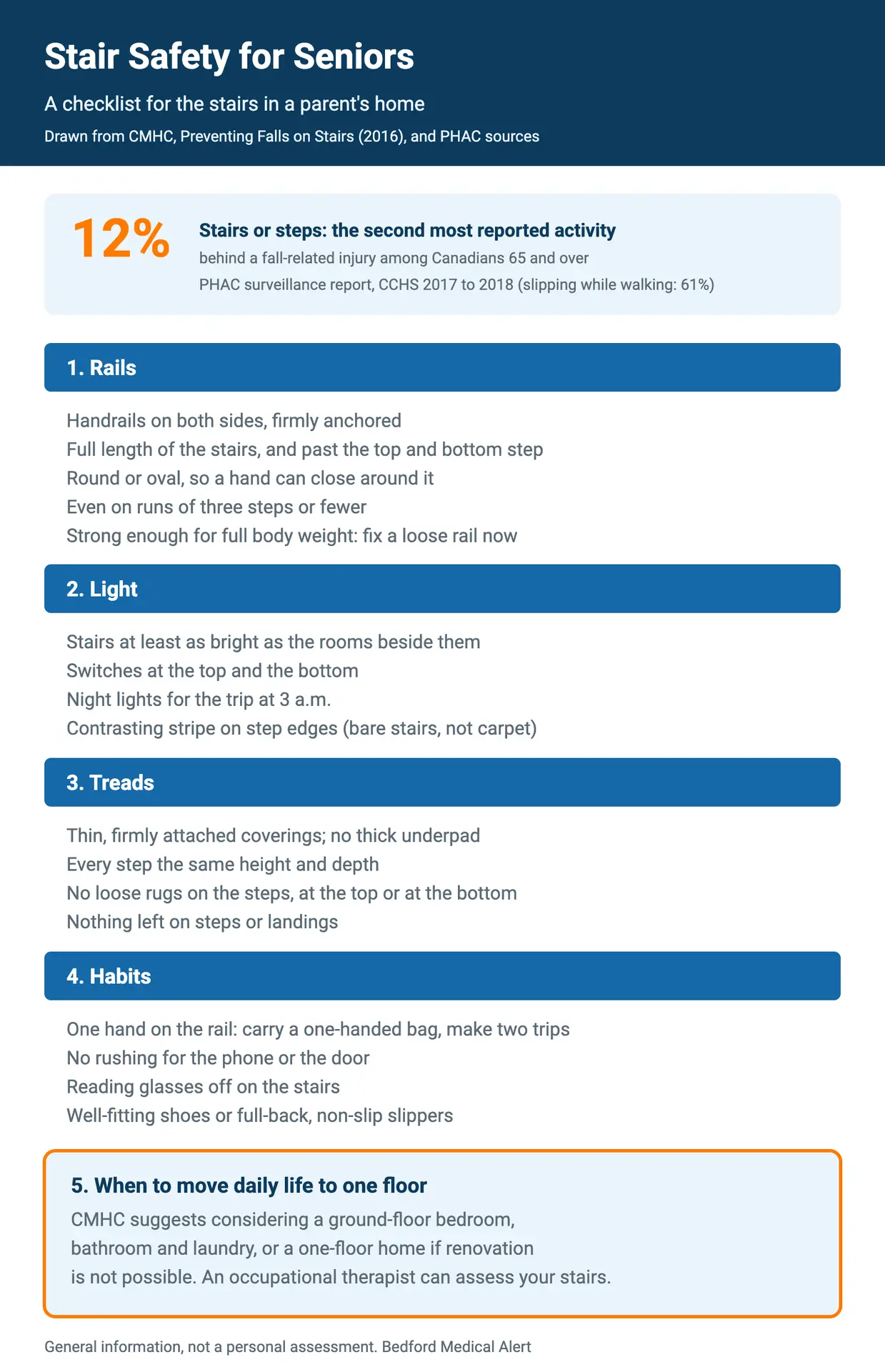
CMHC’s rule is plain: stairs should not be dimmer than the areas beside them. A bright kitchen at the top and a dim stairwell below is the setup it warns against.
What helps, according to CMHC and the Safe Living Guide:
Busy patterned carpet makes edges harder to see. CMHC recommends avoiding it on treads.
Thick cushioning under stair carpet makes the edge of each step soft and hard to judge. CMHC suggests keeping tread coverings thin and firmly attached, removing underpad from stair carpet, and avoiding soft, heavily rounded treads where the edge is hard to judge. The Safe Living Guide prefers hard flooring or tight pile carpet, with a non-skid surface.
A few other points from the CMHC guide:
The open-backed basement staircase is worth its own mention. The Safe Living Guide says the backs of stairs should be closed in.
Does your parent still go down to the basement laundry on their own? Call us at 1-888-755-3055 for a complimentary consultation by phone. We can talk through where in the house help would need to reach and who should get the call first.
Most of CMHC’s second list is about habits rather than hardware. These are the ones that come up most around a parent’s home:
Keep a hand free. CMHC advises against carrying anything bulky that blocks your view or needs both hands. A bag you can carry in one hand, and two trips instead of one, keeps a hand on the rail.
Do not rush for the phone or the door. CMHC suggests a phone on each floor, a bathroom on each floor if possible, or an intercom, so nobody hurries down the stairs to catch a ring.
Glasses. Reading glasses blur the steps. CMHC suggests taking them off on the stairs, and taking care with bifocals and progressives, which can make the step edge harder to judge.
Footwear. Well-fitting shoes, or slippers with a full back and a non-slip sole.
Cleaning. Light tools, one hand for the rail, and non-glare, non-skid wax on bare wood. Or let someone else do the stairs.
CMHC also lists medication side effects and alcohol as reasons for extra care. If a parent feels dizzy on standing or after a dose change, that conversation belongs with their doctor or pharmacist.
Sometimes the right change is not on the staircase at all.
CMHC suggests considering a move of the bedroom, a bathroom and the laundry to the ground floor, so the stairs become an occasional trip rather than a daily one. Simple changes it names include a second handrail and contrasting strips on step edges; larger ones include an elevator or a stairlift. If renovation is not possible or affordable, it says a one-floor home may be the better answer.
For any contractor work, CMHC recommends at least three written quotes and checking references. It also notes that seniors may qualify for renovation funding, which varies by province and territory. Our page on paying for home safety changes in Canada covers the federal Home Accessibility Tax Credit and a sample of provincial programs, so we have not repeated them here.
The bathroom often decides this question, because the night trip to the toilet is the one nobody wants on the stairs. Our guide to bathroom safety for seniors covers that route.
A fall at the bottom of the basement stairs is a lonely place to be. The base unit may be two floors up, the phone is in the kitchen, and nobody walks past.
A Bedford Home Freedom help button is worn on the body, as a pendant or a wristband, and is rated for a 600 to 800 foot line-of-sight range from the base. Test it from the laundry room to be sure. It is waterproof, and its battery is rated for five years, so it is not sitting on a charger upstairs.
When the button is pressed, the call goes to the Bedford Medical Alert® monitoring centre, staffed 24/7 in Canada. The operator speaks through the base unit’s speaker. If you are a floor away and cannot hear or answer, the operator does not stop there and can work through your personalized response plan: the neighbour with a key, a family member, paramedics, in the order you chose.
An optional fall detection pendant, worn as a necklace, can place a call automatically when it senses a fall. It is a useful layer. No sensor on the market catches every fall, though, so pressing the button whenever you can remains the habit to keep.
Why the minutes matter is covered on our page about the long lie after a fall, which walks through four decades of research on people who could not get up.
Bedford Medical Alert is Canadian owned and operated, with 24/7 monitoring based in Canada, and our operators follow a personalized response plan for every client. We are a member of the Ontario Community Support Association. We are trusted by clinicians across Canada and have supported hospital education programs and research initiatives from UHN Toronto Rehab to Trillium Health. Canadian families have given us a 4.9-star Google rating, and Bedford brings three generations of experience to this work.
Equipment is included with the subscription, so there is no device to buy. Plans typically run month to month after a three-month minimum at the start, with optional six or twelve month initial terms if the savings suit you. Service reverts to month to month afterwards, and there are no cancellation fees. Easy Setup means the system is ready to use quickly.
Make the basement trip a little less lonely. Bedford’s Home Freedom system pairs a waterproof help button you wear on every floor with a two-way voice base, answered 24/7 by our Canadian monitoring centre. There are no long-term contracts. See how Home Freedom works or call 1-888-755-3055.
