
A diagnosis of early dementia does not change a person overnight. The parent who got the news last month is still the one who makes their own tea, calls the grandchildren on Sundays, and wants to keep living in the home they have known for decades. For families, the hard question arrives quietly: how long can Mom or Dad safely stay on their own, and what makes that possible?
This guide is written for the adult children and family caregivers asking exactly that. It covers what early dementia means for living alone, the wandering risk that families most often underestimate, a room-by-room safety checklist, how GPS locating and 24/7 monitoring from Bedford Medical Alert® fit in, and what to do if a loved one goes missing. It is practical information, not medical advice. For decisions about diagnosis, care, or medication, your healthcare team is the right place to turn.
There is no single answer, because dementia is not one fixed condition. It progresses differently for each person, and the early stage can last for years. Many people in the early stage keep living independently with the right support in place. Others need more help sooner. The decision belongs with the person, their family, and their healthcare providers, who can weigh memory, judgment, and day-to-day function together.
The scale of this is larger than many families realize. As of January 1, 2025, an estimated 771,939 people in Canada were living with dementia, according to the Alzheimer Society of Canada’s Landmark Study. That number is projected to more than double by 2050, to over 1.7 million. Behind every one of those figures is a household working out the same balance between independence and safety.
One safety concern stands out in the early and middle stages, and it catches many families off guard: wandering. The Alzheimer’s Association reports that 6 in 10 people living with dementia will wander at least once, and many do so more than once. It does not only mean leaving the house. A person may set out for a familiar place and lose the thread partway, become disoriented in their own neighbourhood, or leave at night when no one expects it.
Wandering is unsettling precisely because it can happen to someone who still seems to be managing well. The aim of planning is simple: if a person becomes lost, they should be found quickly and brought home safely, without anyone having to lock a door or take away their freedom. For night-time specifically, some families add a bed sensor; our guide to bed alarms for seniors explains what one can and cannot do.
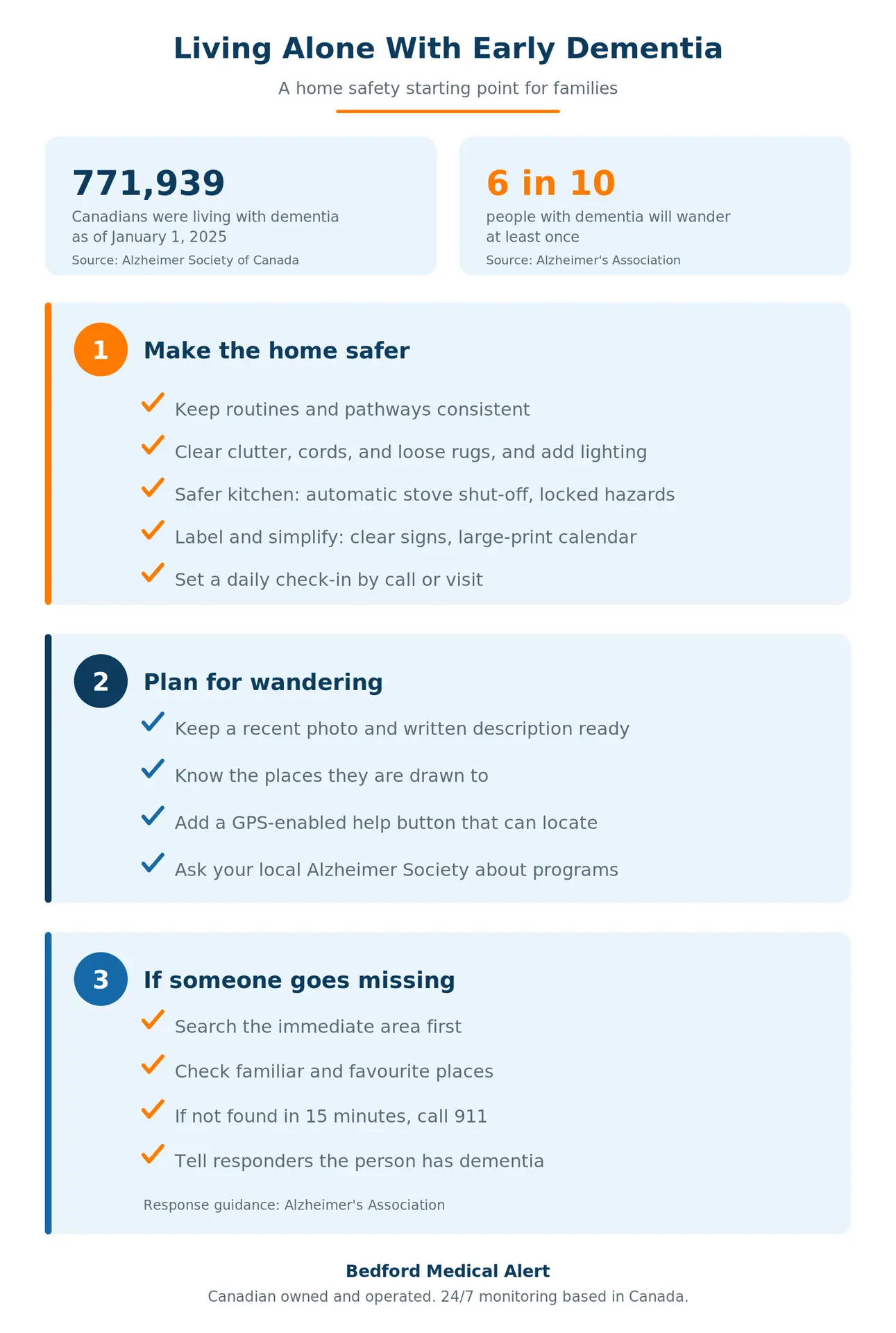
Small changes to the home can lower everyday risk without making the house feel like an institution. Walk through it once with fresh eyes, ideally alongside the person, so the changes feel shared rather than imposed.
None of this replaces the judgment of the people who know the person best. It simply removes the most common hazards before they cause harm.
If hearing, vision or hand strength are also part of the picture, our page on accessible medical alert devices sets out what can change on the device itself.
Where Parkinson’s is part of the picture instead, our page on Parkinson’s and falls covers freezing, balance and what changes about calling for help when you live alone.
For a person who is still active and goes out on their own, a mobile medical alert device adds a safety net that a home-only system cannot. Bedford’s Go Anywhere pendant works wherever there is cellular coverage, not just inside the house. It pairs a help button with GPS locating, so if the person presses for help or becomes disoriented while out, the monitoring centre can work to locate them. A companion app lets a trusted family member check the device location too.
Here is what happens behind the button. One press connects to a monitoring centre in Canada through a two-way speaker. Our operators follow a personalized response plan for each person, which means the contacts, medical notes, and wishes you set up in advance are what guide the response. That is the part families tell us matters most: a real person who already knows the situation rather than a generic call queue. It is one of the reasons families choose Bedford.
Some Go Anywhere devices also offer automatic fall detection. In general terms, the technology uses motion sensors to recognize patterns that may indicate a fall and can begin a response on its own. No device detects every fall or guarantees an outcome, so it works best as one layer alongside the habits above. If you want the mechanics, our explainer on how GPS and WiFi locating works breaks it down, and which medical alert device is right for you helps match a device to the stage and the lifestyle.
And for the stage when a pendant gets taken off or forgotten, our post on radar fall detection for dementia patients explains how room-based sensing protects without asking the person to wear anything.
Not sure whether a home system or a mobile GPS device fits your parent’s situation? Speak with a Canadian care consultant who will talk it through with no pressure and no obligation. Call 1-888-755-3055 and we will help you find the right fit.
Even with good planning, a person can still go missing, and the first minutes matter. Keep a recent photograph and a written description, including height, build, and what they usually wear, somewhere easy to grab. Know the places they are drawn to: a former home, an old workplace, a church, a favourite coffee shop.
If someone does go missing, search the immediate area and those familiar places first. The Alzheimer’s Association advises that if the person is not found within 15 minutes, call 911 and tell responders the person has dementia, so the search is treated with the urgency it needs. A GPS-enabled device can shorten that search considerably, which is one reason many families add one well before they think they need it. Your local Alzheimer Society can also point you to wandering-response and identification programs available in your area.
Raising the subject can be the hardest part. Many older adults hear “medical alert” as a sign that their independence is slipping, when the device exists to protect that independence. It often helps to frame it around staying put: this is the tool that lets you keep living in your own home, on your own terms, for longer.
Practical details make the conversation easier. Bedford equipment is included with the subscription, so there is no separate device to buy. Easy Setup means it is ready to use quickly. And there is no long-term contract, so a family can start during a worrying stretch and adjust later without penalty. Starting while the person can take part in the decision tends to go more smoothly than waiting for a crisis to force it.
No formula fits every family, but the pieces are knowable: an honest read on the stage of dementia from the care team, a home with the worst hazards removed, a plan for wandering, and a dependable way to call for help and be located. Together they let a person hold on to the independence that matters while their family worries a little less.
Bedford Medical Alert is Canadian owned and operated, with 24/7 monitoring based in Canada. We are an OCSA member, our service is recognized by UHN Toronto Rehab, and we are approved under ODSP and the Passport Program for those who qualify. Families across the country have given us a 4.9-star Google rating. For a parent with early dementia who wants to stay in their own home, that combination is built to help.
For a loved one who is still on the go, the Go Anywhere fall detection pendant pairs GPS locating and a help button with a Canadian monitoring team on call 24/7, equipment included and no long-term contract. Call 1-888-755-3055 and we will help you set it up.
Tell us a little about your situation and a Bedford specialist will call you back, usually the same day. No pressure, no obligation.