
By a quarter past eight on a school morning, a three-generation house has usually emptied out. The cars are gone and the last lunch bag is off the counter. The one person who did not leave for anything is now alone with the stairs and a bathroom door that locks, and a household that looks well supported on paper is, until somebody’s key turns in the door again, a senior living alone.
At Bedford Medical Alert®, this house is a familiar caller. A daughter phoning at lunch from her desk. Her mother has moved in, or the whole family has moved in with her, and the arrangement has solved the rent and the loneliness and left one problem standing: nobody is home between the school run and dinner.
Each number on this page was read at its official source on 19 September 2026, and the source is named beside it.
Statistics Canada counted 441,750 multigenerational households in the 2021 Census, three or more generations of one family under one roof. That was up 21.2 per cent from 364,505 in 2011, while the total number of households in the country grew 12.4 per cent. The people inside them add up to 2.4 million, or 6.5 per cent of everyone living in a private household. Half of them live in Ontario, where 8.4 per cent of residents are in one of these homes, and the Toronto census metropolitan area sits at 11.6 per cent. All of it is from Statistics Canada’s August 2025 study of the 2021 Census, “Unpacking Canada’s multigenerational households.”
The same study describes who the oldest generation in these homes actually is. Women make up 62.5 per cent of it. Among those women, 31.0 per cent were widowed, against 10.1 per cent of the men. Just over a third of the oldest generation, 35.0 per cent, were not living with a spouse at all but with relatives, which in most cases means with an adult child and grandchildren.
And this is the number that explains the empty house. Statistics Canada found that 49.1 per cent of multigenerational households had three or more members earning employment income, more than four times the 11.0 per cent among other households.
Three earners means three people who leave.
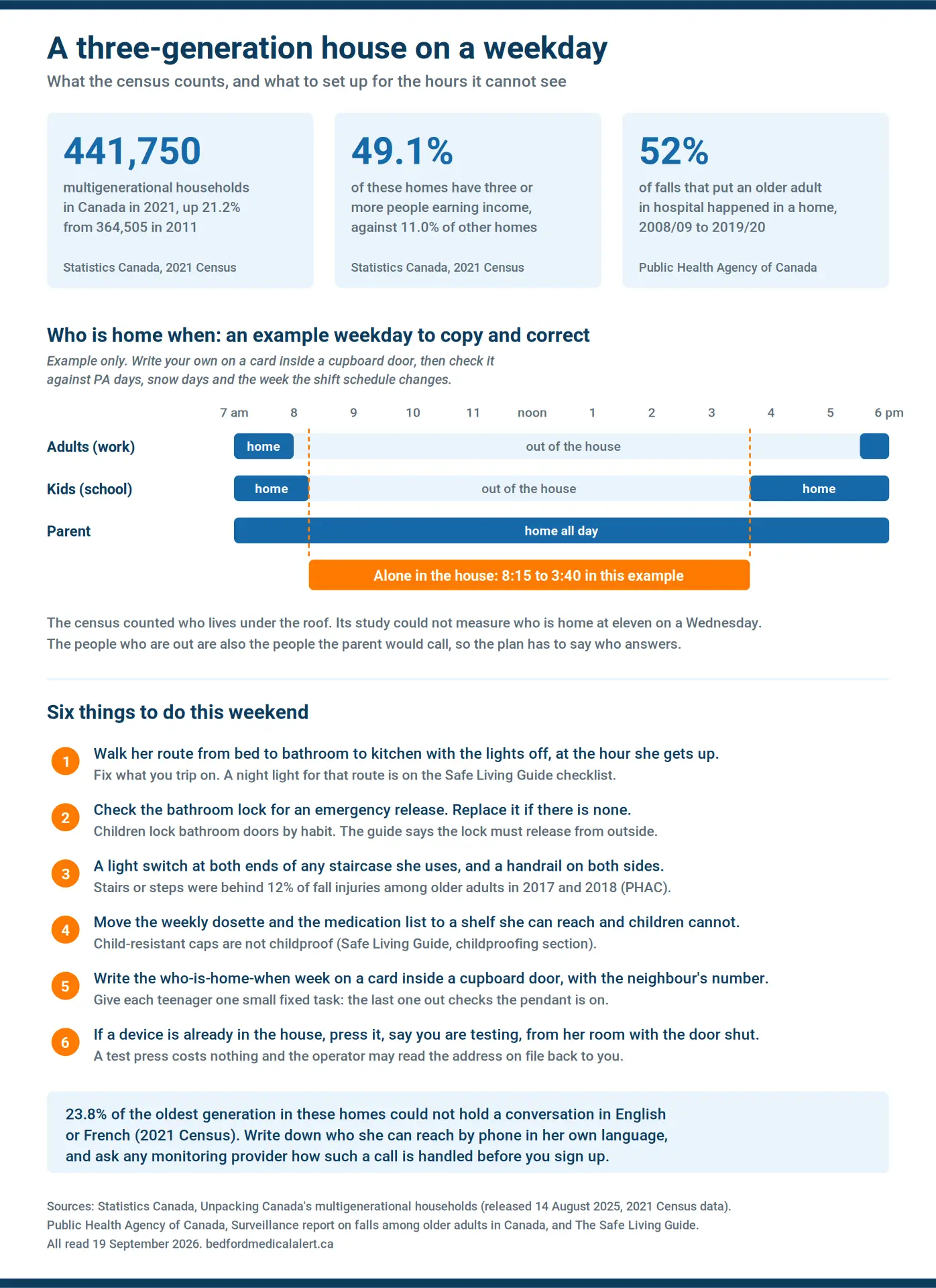
Statistics Canada says plainly that the study could not examine actual caregiving inside these homes. The census knows who sleeps under the roof. It has no idea who is standing in the kitchen at eleven on a Wednesday morning.
The Public Health Agency of Canada’s Surveillance Report on Falls Among Older Adults in Canada found that older adults living alone reported fall injuries at 6.5 per cent in 2017 and 2018, against 5.5 per cent for those living with others. Living with family helps. The same report found that about 52 per cent of falls that put an older adult in hospital happened in a household residence, and a house is a household residence whether or not anyone else is in it at the time.
Sharing a home built for one family means somebody ends up in the room nobody planned. Statistics Canada found that 28.3 per cent of multigenerational households did not have enough bedrooms for the people in them in 2021, compared with 4.7 per cent of other households. The most common shortfall was one bedroom, in 18.5 per cent of these homes.
In practice that means the finished basement or the bedroom at the top of the stairs that used to be an office, and both involve a staircase every day.
The Public Health Agency of Canada’s 2017 and 2018 survey data put going up or down stairs or steps behind 12 per cent of fall injuries among older adults, the second most common activity after walking. Its Safe Living Guide, the home-safety checklist it publishes for seniors, is specific about what a staircase should have: a light switch at both the top and the bottom, solid handrails on both sides that extend past the first and last step, a non-skid surface on the treads, and no scatter mat anywhere near the top.
A basement suite adds two things the guide does not mention. The laundry is usually down there too, so the parent has a reason to carry a full basket on those stairs. And the side door that gives the suite its independence puts a fall near it out of earshot of the rest of the house even when the house is not empty.
For the whole-home list, rugs and lighting and grab bars, our post on fall prevention for seniors at home covers it with the evidence graded. The rest of this page is about what changes when three generations share an address.
We have a full guide to bathroom safety for seniors, so only the lock gets space here. The Safe Living Guide says a bathroom door lock must have an emergency release. Children lock bathroom doors by habit, and a parent who slips behind a locked door with nobody home has two problems instead of one. Check the lock this week, add a night light for the route from her room, and make sure the grab bars are anchored into the wall studs rather than hung where a towel rack was.
The Safe Living Guide has a childproofing section written for grandparents, and its first warning is the one families miss: child-resistant caps are not childproof. Medications and pill boxes belong out of the reach of children, behind a cupboard catch if there are small ones in the house.
That cuts against the habit of leaving a weekly dosette on the kitchen counter where the parent will see it. Pick a shelf she can reach and they cannot, and keep the written list of what she takes with it. The guide asks whether the family knows that list. In a house where a teenager might be the one home when a paramedic asks, the answer should be yes.
Setting up a parent’s room in a house that is empty during the day? Call us at 1-888-755-3055 for a complimentary consultation by phone. Tell us which floor the room is on, where the bathroom is, and who is usually home when, and we will tell you what a monitored setup would and would not cover in that layout. No obligation either way.
Write the week down on paper and stick it inside a cupboard door.
Who leaves first. Who is back first. Which two hours nobody covers on a normal day, and what happens to those hours on a PA day, a snow day, or the week the shift schedule flips. The plan only needs to exist, so that the parent knows the house is empty from 8:15 to 3:40 and can decide for herself to leave the laundry until then.
Give the teenagers one fixed task that is theirs, and keep it small, because asking a fifteen-year-old to supervise a grandparent is unfair to both of them. The last one out of the house checks that the pendant is on and the walker is beside the chair. One of them knows what a test call sounds like because they were in the room when it was made. Somebody has the neighbour’s number, and the neighbour has a key.
Then there is language, which the census makes hard to ignore. Statistics Canada found that 23.8 per cent of the oldest generation in multigenerational households could not carry on a conversation in English or French, and it suggests the middle generation often acts as the bridge in those homes. The plan should say who the parent can reach by phone in her own language during the day. Before signing up with any monitoring provider, ourselves included, ask how a call from someone who does not speak English or French is handled, and what to write into the response plan so that the first person called can talk to her.
A monitored device does not prevent a fall and does not replace the people in the house. It gives the parent a way to reach a person when the house is empty, and gives the family a way to be that person from work.
With our Home Freedom setup, a base station sits in the house and the parent wears a pendant. A press reaches our monitoring centre in Canada, staffed around the clock, and the operator works from a personalized response plan held on file for that household. For a multigenerational home, that plan is where the daytime question gets answered in advance: who to call and in what order, and who holds a key. The Home Freedom Mini Pendant is listed at 800 feet of range from its base. Two-way voice through a closed bathroom door is the harder test, so we have written up how to test a medical alert system from the rooms that actually worry you. A test press costs nothing, and the operator may read your address back to you.
Some parents will not wear anything. For that household Silver Shield takes a different route: a non-wearable millimetre-wave radar sensor with no camera, running on protocols the family sets, that alerts family members and caregivers automatically. It is not monitored by Bedford staff, and a home can run more than one sensor under the same family-set protocols, so the basement suite and the main-floor bathroom can each have one. It senses movement in the room rather than relying on anything worn, and no sensor on the market catches every fall.
If your parent walks to the plaza or the temple on her own while everyone is out, the in-home base is the wrong tool for that hour. Our Go Anywhere pendant and watch use GPS and cellular networks, where signal allows, so the button and an approximate location travel with her.
Equipment is included with the subscription. Plans typically run month to month after a three-month minimum at the start, with optional six or twelve month initial terms. Service reverts to month to month afterwards, and there are no cancellation fees. Bedford is Canadian-owned and operated, a member of the Ontario Community Support Association, and has supported hospital education programs and research initiatives from UHN Toronto Rehab to Trillium Health.
None of these takes a contractor. Together they turn a house that happens to contain three generations into one that was set up for them.
If your parent lives with you and the house is empty for most of the day, our Home Freedom system puts a base station in the house and a help button on her, with 24/7 monitoring in Canada, a response plan the family writes with us, equipment included, Easy Setup, and no long-term contract. Call 1-888-755-3055 and we will work through your floor plan with you.
All four were read on 19 September 2026. Statistics Canada and the Public Health Agency of Canada publish these documents for public use, and neither has any connection to Bedford Medical Alert.