
A grab bar installed beside the tub by a contractor, with an invoice in a parent’s name and a prescription on file, can appear on two separate lines of a Canadian tax return. The Canada Revenue Agency says so on its own page for the Home Accessibility Tax Credit: an expense that also qualifies as a medical expense can be claimed as both. A ramp built by a son who is not registered for GST/HST, on the other hand, may not count at all.
Rules like these decide whether a home safety change costs a family its full price or something less. This page sets out the federal credits, a sample of provincial ones and one Ontario grant program, as each official page described them when we read it on 6 October 2026. We are Bedford Medical Alert®, a Canadian monitoring company and an OCSA member. We are not accountants, and nothing here is tax or financial advice. Rules change every budget, and the official page always governs.
Before any credit, there is the list of what to change. Our guide to fall prevention at home covers which changes the evidence supports, and our bathroom and night-time safety page goes fixture by fixture. This page picks up at the next question: once you know what you want to install, who helps pay for it?
The credits below share a common idea. The work has to help an older person or a person with a disability get into the home, move or function inside it, or face less risk of harm there. Routine maintenance and work done mainly to raise the value of the house sit outside every one of them.
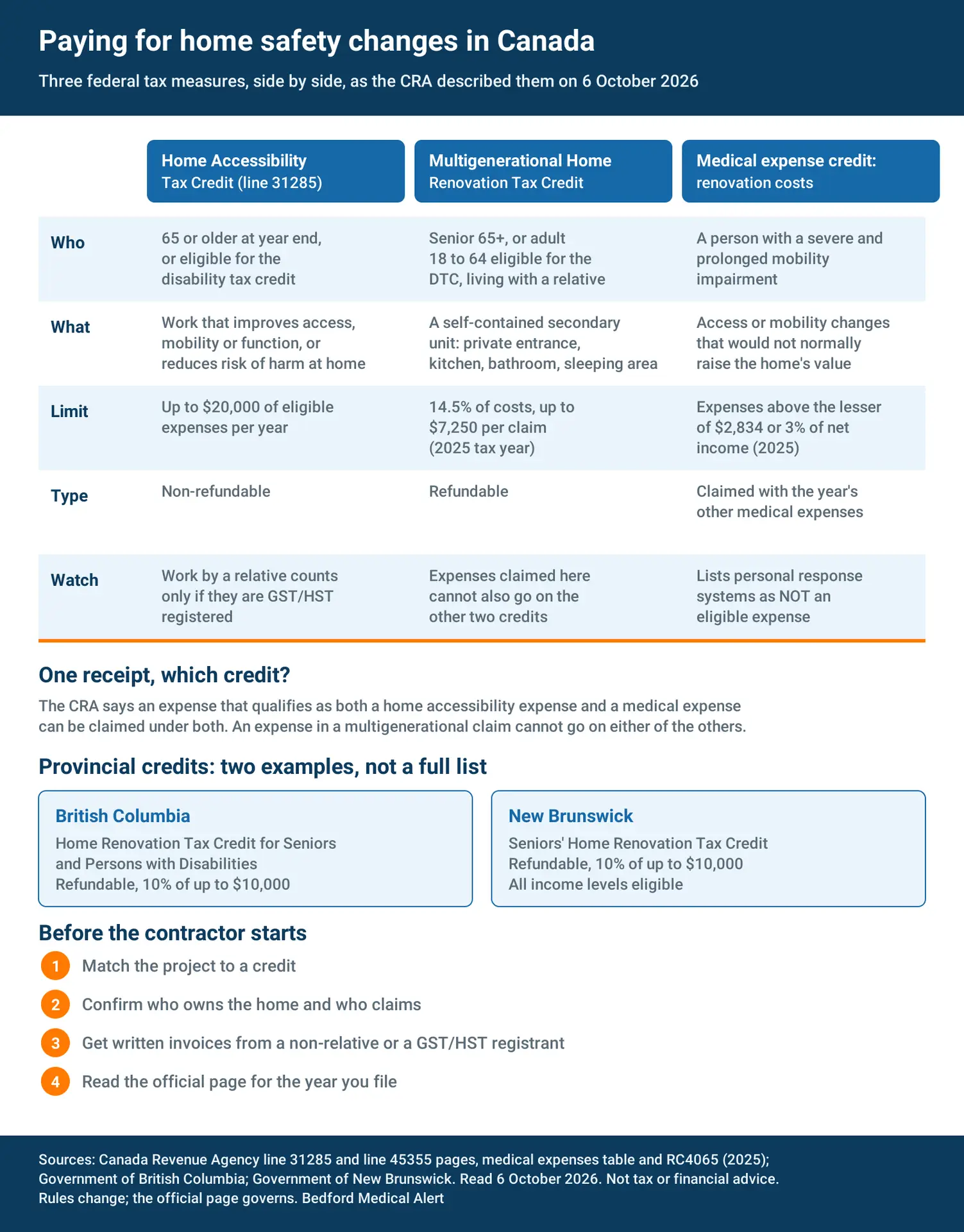
Of the three federal measures on this page, this is the one built for accessibility work on an existing home. The CRA describes it as a non-refundable credit, claimed on line 31285 of the return.
The family member rule is easy to miss. The CRA states that expenses are not eligible when the goods or services come from someone related to the qualifying individual, unless that person is registered for GST/HST. Work you do yourself is treated differently: the materials, fixtures, equipment rentals, plans and permits count, but the value of your own labour or tools does not.
Keep the receipts. The CRA asks you not to send them with the return, only to have them ready if it asks.
This one is for a bigger project: building a self-contained secondary unit so that a senior, or an adult eligible for the disability tax credit, can live with a relative. The CRA defines that unit as having its own private entrance, kitchen, bathroom and sleeping area.
For the 2025 tax year, the CRA page describes the credit as refundable, at 14.5% of costs to a maximum of $7,250 for each eligible claim. A January 2025 CRA tax tip, written for 2024 returns, gave 15% and $7,500, so check the page for the year you file. The qualifying individual must be 65 or older at the end of the tax year in which the renovation period ends, or aged 18 to 64 and eligible for the disability tax credit. The relative must be 18 or older.
One rule cuts across the other two credits on this page. The CRA says an expense included in a multigenerational claim cannot also be claimed for the medical expense tax credit or the Home Accessibility Tax Credit.
If you are weighing a secondary suite against other options, our page on long-term care, retirement home and staying home costs sets out how those three settings compare in Ontario.
The medical expense tax credit is older than either credit above, and it has its own test. The CRA’s 2025 guide to medical expenses (RC4065) allows renovation or construction costs for a person with “a severe and prolonged mobility impairment” or who lacks normal physical development. The work has to give that person access to the home, or greater mobility or functioning within it. It also has to be the kind of cost that would not normally raise the home’s value and would not normally be paid by someone without the impairment.
The CRA’s list of eligible medical expenses for lines 33099 and 33199 shows bathroom aids such as grab bars, grips and rails as eligible, with a prescription. The guide sets the claim at eligible expenses above the lesser of $2,834 or 3% of net income for 2025.
There is a line in that list we think families should see plainly. The CRA lists personal response systems, the category medical alert services belong to, as not eligible. Its Home Accessibility Tax Credit page likewise excludes the cost of housekeeping, security monitoring and similar services. Medical alert services, ours included, are not a medical expense under the CRA’s current list, and we do not suggest otherwise. If you are budgeting for a monitored device as well as renovations, our funding help page covers the programs that do sometimes help with that cost, for those who qualify.
Planning changes to a parent’s home after a fall or a hospital stay? Our complimentary consultations happen by phone, at 1-888-755-3055, and we can talk through where a medical alert fits alongside the grab bars and the ramp.
Some provinces run their own credits on top of the federal ones. Two that were active on their official pages when we checked:
British Columbia. The Home Renovation Tax Credit for Seniors and Persons with Disabilities is refundable, at 10% of up to $10,000 in qualifying expenses, for a maximum of $1,000 a year. The B.C. government page, last updated 29 April 2025, lists walk-in bathtubs, grab bars, wheelchair ramps, raised toilets, lever handles and stair lifts among its examples.
New Brunswick. The Seniors’ Home Renovation Tax Credit is also refundable, at 10% of up to $10,000 in eligible home improvements, for a senior aged 65 or older or a family member living with them. The province’s page says all income levels are eligible.
Ontario’s Seniors’ Home Safety Tax Credit was temporary. The province announced it in the 2020 Budget for the 2021 tax year, and its 2021 fall economic statement extended it by one year to 2022. Its ontario.ca page now redirects to the Archives of Ontario’s archived pages, so do not count on it for a current return without checking ontario.ca. Other provinces and territories have their own rules, and some past credits have ended. A credit that existed three budgets ago may not be on this year’s form.
A tax credit only helps after the money is spent and a return is filed. Some programs pay toward the work itself. In Ontario, for example, March of Dimes Canada runs the Home and Vehicle Modification Program, funded by the provincial Ministry for Seniors and Accessibility, for Ontario residents with disabilities and mobility restrictions. Its own pages set out eligibility and the application process.
Municipal housing programs, Veterans Affairs Canada and community agencies offer other options in some regions. Ask the occupational therapist or care coordinator involved in a discharge which ones apply locally; they hear about these programs before we do. For families who are also covering a parent’s other costs, the Canada Caregiver Credit is a separate credit with its own rules.
A short checklist, drawn from the rules above:
A grab bar is there when someone reaches for it. A fall in the hallway at 3 a.m., with nobody else in the house, is a different problem. That is the gap a medical alert is built for. With Bedford, a press of the button reaches our monitoring centre in Canada, and the operator works from the response plan your family set up: who to call and in what order, who holds a key, and which medications a paramedic should know about. Plans typically run month to month after a three-month minimum at the start, with optional six or twelve month initial terms if the savings suit you. Service reverts to month to month afterwards, and there are no cancellation fees.
Making a parent’s home safer this year? The Home Freedom system connects a press of the pendant to an operator in Canada, day and night, working from the response plan your family sets. The equipment is included, with Easy Setup and no long-term contract. Call 1-888-755-3055 to talk it through.
All pages read on 6 October 2026.