
The County of Simcoe Paramedic Service gives out a small magnetized pocket with one instruction attached: put it on your refrigerator door.
There is a reason for the fridge. When paramedics walk into a home and the person they came for cannot speak clearly, is confused, or is on the floor and in pain, they need a few facts fast. Which medications? Any allergies? Who is the doctor, and who should be called? The kitchen is where most homes have a fridge, and the fridge is the one appliance every responder knows to check. Several paramedic services in Ontario have built small programs around exactly that habit.
This page is the household’s side of the job. It covers what goes on the sheet, where some services hand out the kit, how to keep it current, and how it sits next to a help button. We are Bedford Medical Alert®, a Canadian owned and operated company running 24/7 monitoring based in Canada, and the person who presses one of our buttons is often the same person whose fridge this sheet belongs on.
The names vary. The idea does not.
A few examples, read on each service’s own page in October 2026:
Other services run their own versions, and some run none. If you live outside these three areas, call the non-emergency line of your local paramedic service or your municipality and ask whether they have one. If they do, use their kit, because their crews are trained to look for it. If they do not, a single printed sheet in a clear sleeve on the fridge door does the same work.
Keep it to one page. A paramedic should be able to read it standing up in thirty seconds.
Put the date at the top. It sounds small. A dated sheet tells a paramedic whether to trust it.
If a hospital stay is behind you, the discharge team’s written medication list is the best starting point for item 4. Our coming home from the hospital checklist covers what to ask for before leaving.
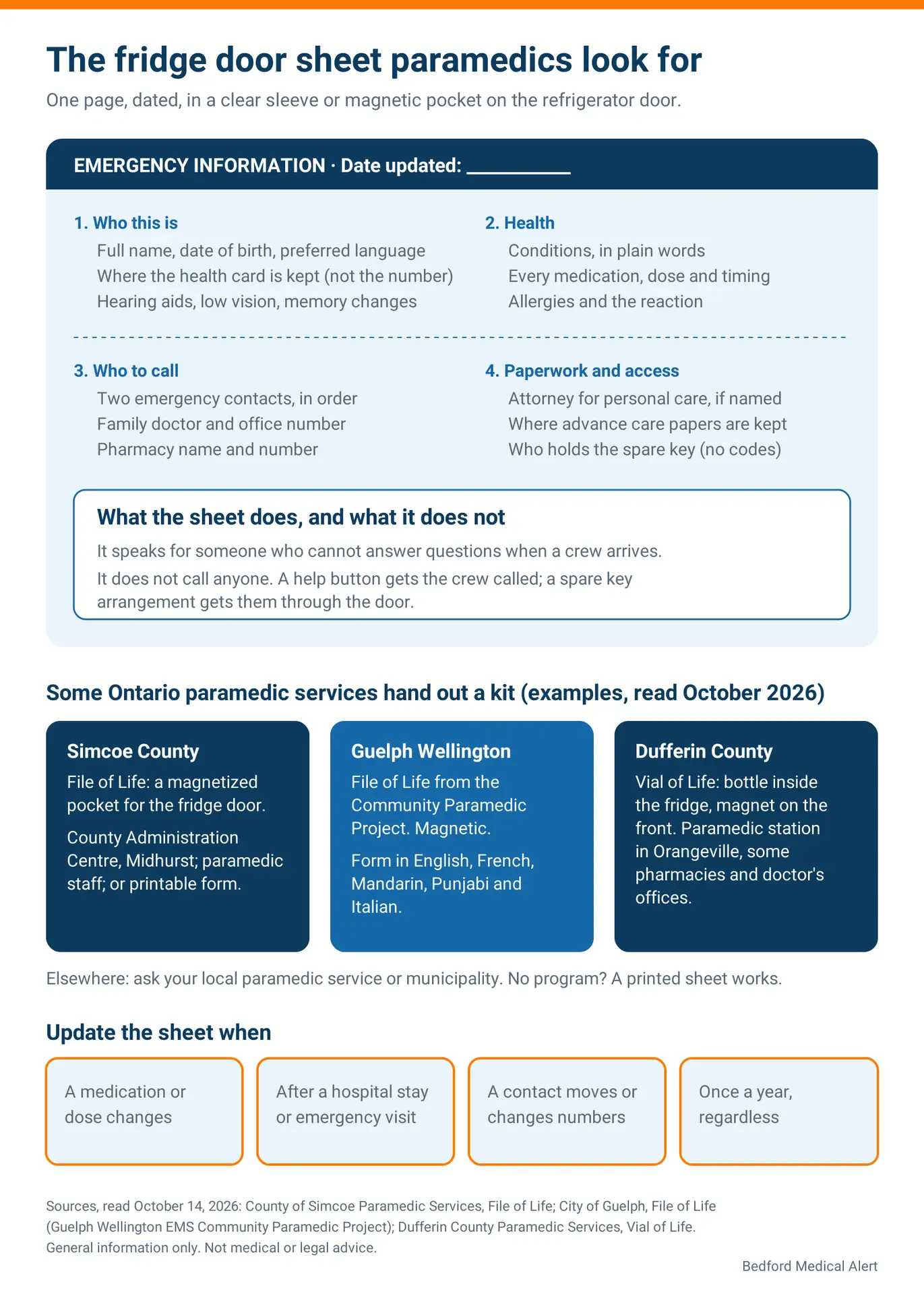
Items 10 and 11 make some families stop. They should not stop the sheet.
Ontario’s own page on making a power of attorney explains that an attorney for personal care can make decisions about health care and housing, and that without one, “your family can make some decisions, but not all.” Other provinces have their own rules and their own forms. We are not lawyers, and this page does not tell anyone which documents to sign. Our page on planning ahead for aging parents walks through the arrangements families usually make while there is time to make them calmly.
What belongs on the fridge is simpler: whether those papers exist, and where they are. If a doctor has completed a do not resuscitate form, ask that doctor where the original should be kept at home and whether a copy belongs with the sheet. In Ontario the document itself is the Do Not Resuscitate Confirmation Form, listed in the province’s Central Forms Repository (form 014-4519-45) for use by health care facility staff and regulated health care providers rather than as a form families download, which is one more reason the question of where to keep it goes to the doctor who completed it. Dufferin’s program, for one, asks families to place the DNR certificate with the Vial of Life form.
A plain statement of our own limits: a medical alert service is not a place to record a do not resuscitate decision or any other advance care wish, and nothing on this page is legal or medical advice about those documents. The people to ask are the doctor who completed the form, a lawyer, and the official sources: Ontario’s page on making a power of attorney, linked above, and the province’s forms listing for the Do Not Resuscitate Confirmation Form. Other provinces publish their own.
Putting a plan together for a parent who lives alone? Call the Bedford team at 1-888-755-3055 for a complimentary consultation by phone. We will talk through who should be called, in what order, and how help gets to the door. No obligation.
A perfect sheet is no use to a crew standing on the porch.
This part has nothing to do with paper. Who has a spare key? A neighbour two doors down is worth more than a son forty minutes away. Some households use a key lockbox mounted near the door; if you do, make sure the people on the contact list know the code, and change it when someone leaves the list. A visible house number and a working porch light help a crew find the right door at night, especially on rural routes and in townhouse rows where numbers are hard to read.
Write the key arrangement on the sheet as well. Not the lockbox code itself on the fridge. Just “spare key with the neighbour at number 14” or “lockbox, code held by both daughters.”
A sheet written once and never touched again can do harm, because a paramedic will believe it. Dufferin’s page puts it in four words: “Keep the information current.” Update the sheet:
Guelph notes that future prints of its File of Life will include information on returning unused and expired medications to a pharmacy. Clearing out the old bottles is a sensible thing to do on the same afternoon you update the list.
The sheet speaks for someone who cannot. It does not call anyone.
That is the gap a medical alert closes. With the Bedford Home Freedom system, the pendant is completely waterproof and works up to 800 feet from the base, so it can be worn in the shower and in the garden. Pressing it opens a two-way voice connection from the base to our 24/7 monitoring centre in Canada, and the operator stays on the line until help arrives. What happens when you press a medical alert button walks through each step of that call.
So the button gets a crew to the door, the key arrangement gets them inside, and the sheet tells them what they are walking into. Three separate jobs, done by three separate things.
People sometimes ask whether an engraved medical ID bracelet does the same work as the fridge sheet. It carries a few lines; the sheet carries the whole picture. Our comparison of MedicAlert and medical alert systems explains how an ID that informs responders differs from a device that brings them.
Print a blank sheet, or pick up your local program’s kit. Sit at the kitchen table with the pill bottles and the phone. Fill in the eleven lines, date it, put it on the fridge door, and tell the two people on the contact list that it is there. Then put a reminder in the calendar for a year from now.
That is the whole task, and it fits comfortably into one afternoon.
The sheet on the fridge tells responders what they need to know. The Bedford Home Freedom in-home system is how they get called in the first place: a waterproof button, a two-way voice base and a Canadian monitoring centre answering 24/7. Equipment is included, Easy Setup, and plans typically run month to month after a three-month minimum at the start, with optional six or twelve month initial terms if the savings suit you. Service reverts to month to month afterwards, and there are no cancellation fees. Call 1-888-755-3055 to talk it through.