Black Friday to Cyber Monday: six months of service for the price of four.Black Friday to Cyber Monday: six months for the price of four. See the offer
A week has 168 hours. A parent with a personal support worker coming three mornings a week for two hours has six of them covered.
Those six hours matter a great deal. Someone helps with the shower, changes the bed, checks the fridge and notices that the mail has piled up. But the arithmetic is worth doing before you sign anything, because it tells you two things at once: what you are buying from a home care agency, and how much of the week your parent still spends on their own.
This page is for families in Canada who are about to hire private home care for a parent, or who have just started. It covers where private care sits next to public home care, how to check the people who will come into the house, the questions to put to an agency before you sign, and how the hours between visits can be planned. It draws on Canadian public sources, listed at the end, and on the way we set up response plans at Bedford Medical Alert®. It is general information, not legal, employment or medical advice.
In Ontario, home care is arranged through Ontario Health atHome. The province’s home care page says that if your parent qualifies, the Ontario government pays for it, and that services can include nursing, therapy, personal support with bathing, dressing, eating and toileting, and in some cases homemaking. The number on that page is 1-833-515-1234. The same page says plainly that you can also pay for your own care through private companies.
Starting with the public assessment makes sense even for families who expect to pay privately. The Ontario Caregiver Organization’s guide to home care notes that the intake process shows whether services can be covered by OHIP, and that people who do not qualify may still use private home care or community supports, which may come with fees. Knowing what is publicly funded tells you what you are actually hiring for. Our page on home care after a hospital stay in Ontario walks through the public assessment and care plan in detail.
One point holds in every province. Private care runs outside the public system. Nova Scotia Health puts it directly on its own guidance page: private care services are not funded, monitored or audited by Nova Scotia Health or the province’s Department of Seniors and Long-Term Care. In a private arrangement, the checking is up to you.
Families tend to go one of two ways.
Through an agency. The agency recruits, schedules and supervises the worker, and it is the agency you call when something goes wrong. That layer is part of what you are paying for, and unless you ask, you may see different faces from week to week.
Directly. You find a worker yourself, often through a referral, and agree on hours and pay with that person. You may get more continuity. You also take on the screening, the scheduling, the backup when they are sick and, depending on the arrangement, obligations as an employer. A question sheet that Parkinson Canada posts for families asks whether an agency handles payroll deductions, CPP, EI and income tax remittances, and whether workers are covered by WSIB if they are hurt in the client’s home. If you hire directly, those questions land on you, and an accountant is the right person to answer them for your situation.
Neither route is wrong. What matters is knowing which one you are on, because the rest of this page reads differently for each.
Nova Scotia Health’s checklist for families hiring private, unregulated home care is one of the clearest public lists we have found. Among its points:
In Ontario there is one more place to look. The Health and Supportive Care Providers Oversight Authority, set up under provincial legislation, has a mandate to register and oversee personal support workers. Its website has a “Find a Registered Personal Support Worker” search and an online complaint form. Ask the agency whether its workers are on that register, and look the names up yourself. The Authority says registration is voluntary for personal support workers at this time, so not every worker will be on it.
Accreditation is another question for the agency: is it accredited, and by whom? The Parkinson Canada question sheet asks whether an agency is accredited or certified by a recognized Canadian body, and gives Accreditation Canada as its example. Then check the accreditor’s own directory. The Canadian Accreditation Council of Human Services, for one, keeps a searchable list of the programs it accredits, including home care programs.
Working out what the rest of the week looks like? Call us at 1-888-755-3055 for a complimentary consultation by phone. We can talk through the visit schedule, who lives close enough to come over, and how that goes into a response plan.
Each agency sets its own rates, so this page gives no prices. Get every rate in writing. Beyond that, these are the questions that tend to matter most once care has started. They are drawn from the Nova Scotia Health checklist and the Parkinson Canada question sheet, and both lists are longer than this one.
There is a question for your side, too. Nova Scotia Health points out that your parent’s home becomes a workplace for the agency’s staff. Smoking rules, a dog that needs to be shut away, a parking spot: settle those on the first day.
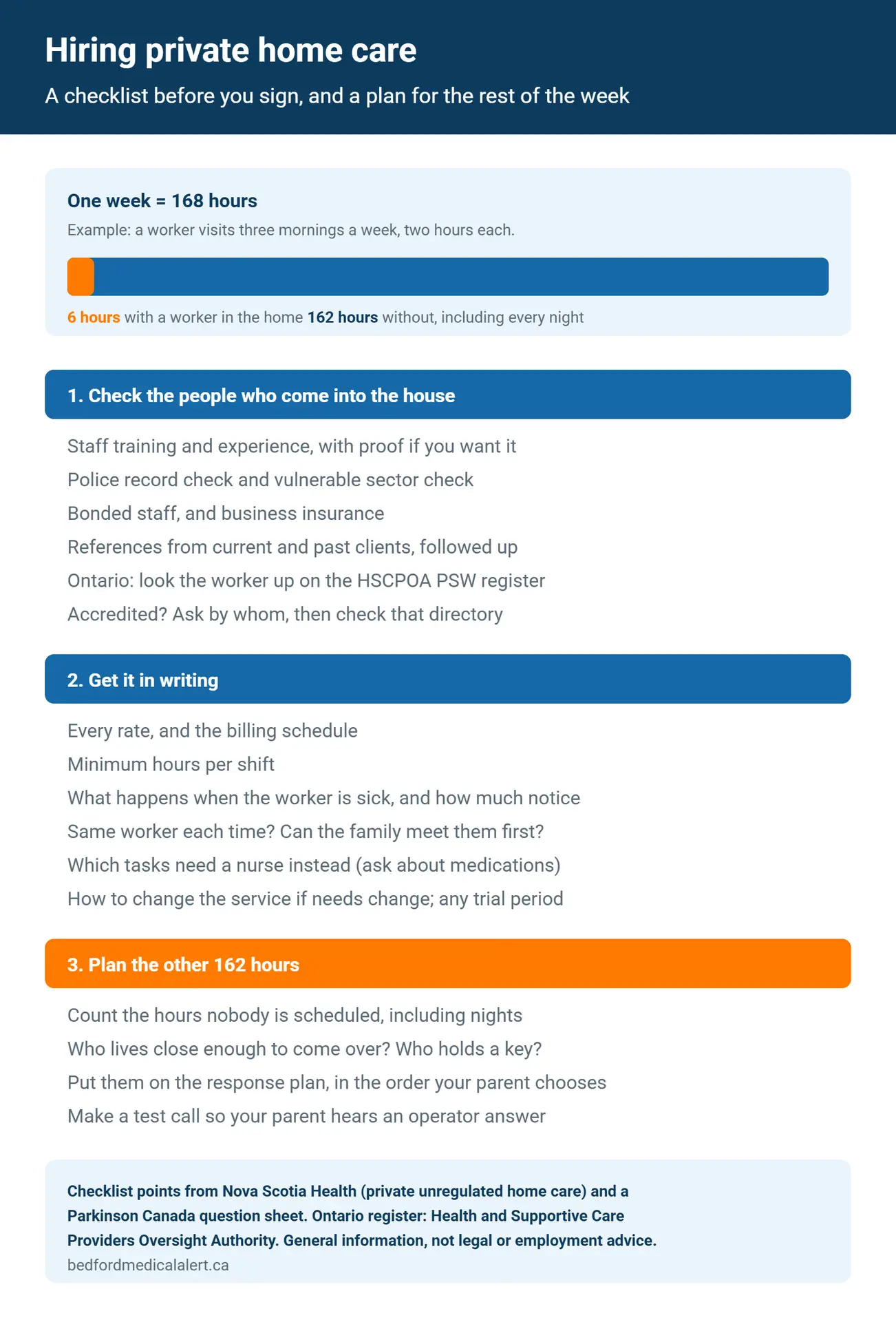
Back to the arithmetic: six hours covered, 162 not. Private care fills the hours you can afford and the hours your parent will accept. Unless you are paying for overnight shifts, it does not cover the night, and it does not cover the moment your parent slips in the hallway an hour after the worker has left.
That gap is what a monitored medical alert is for. It is not a substitute for care, and nobody should buy one expecting it to do a PSW’s job. It is a way to reach a person at any hour.
A Bedford Home Freedom help button is worn as a pendant or on the wrist. It is waterproof, so it can stay on in the shower, and it is rated for a 600 to 800 foot line-of-sight range from the base, which has two-way voice and a battery backup for power outages. The base connects by landline or VoIP, or by cellular LTE where there is no wired line, and it needs no Wi-Fi. When your parent presses the button, an operator at our 24/7 Canadian monitoring centre answers through the base, asks what is happening and works through the response plan on file. For a possible medical emergency, the operator can dispatch emergency services and pass along the information in that file, and stays on the line until help arrives. The full sequence is on our page about what happens when you press a medical alert button.
The response plan is where a family’s arrangements meet the device. It lists your parent’s emergency contacts in the order they choose, and it can record where a spare key is kept. When private care starts, look at that list again. The family member who used to drop in on Tuesdays may have stopped now that a worker comes on Tuesdays. The neighbour with the key may be the fastest person on the list on the four days nobody visits.
Private care adds people to your parent’s week. It can also leave one family member holding every arrangement: the agency’s number, the schedule, the key, the login for the visit notes. If that person is ill or away, nobody else knows how it fits together. Our page on a backup plan for caregivers covers how to write it down and who to share it with. The money side, including how families split the cost of paid help, is on our page about the cost of caring for elderly parents in Canada.
Bedford Medical Alert is Canadian owned and operated, with 24/7 monitoring based in Canada, and our operators follow a personalized response plan for every client. We are a member of the Ontario Community Support Association. We are trusted by clinicians across Canada and have supported hospital education programs and research initiatives from UHN Toronto Rehab to Trillium Health. Canadian families have given us a 4.9-star Google rating, and Bedford brings three generations of experience to this work.
Equipment is included with the subscription, so there is no device to buy. Plans typically run month to month after a three-month minimum at the start, with optional six or twelve month initial terms if the savings suit you. Service reverts to month to month afterwards, and there are no cancellation fees. Easy Setup means the system is ready to use quickly.
Cover the hours between visits. Bedford’s Home Freedom system pairs a waterproof help button with a two-way voice base, answered 24/7 by our Canadian monitoring centre, with the people your parent chooses in their response plan. There are no long-term contracts. See how Home Freedom works or call 1-888-755-3055.
