
Who has a key to your father’s house besides you?
If you had to think about it, read on. When one adult child does most of the caring, the routine tends to live in that one person’s head: which pharmacy, which day the bloodwork is booked, which neighbour actually answers the phone, where the spare key really is. It holds together until that person gets the flu, has surgery, or is stuck on the 401 when the call comes.
We are Bedford Medical Alert®, a Canadian medical alert provider. Part of our work is setting up response plans with families, and a plan that names only one person has a weak spot. This page is about building the backup before anyone needs it. It is not legal or medical advice.
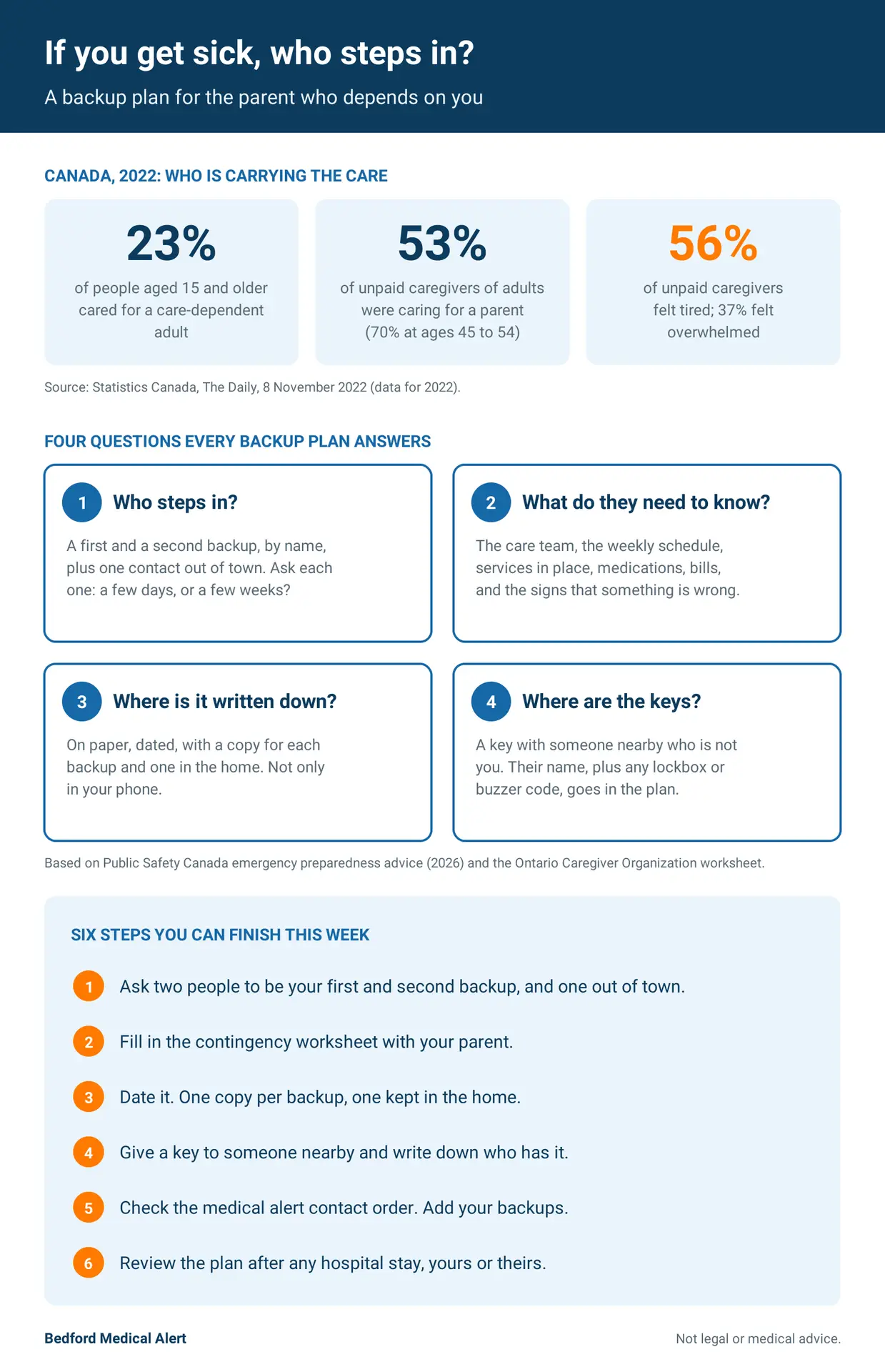
Statistics Canada’s release of 8 November 2022, More than half of women provide care to children and care-dependent adults in Canada, 2022, found that 23 per cent of people aged 15 and older cared for a care-dependent adult that year. For 53 per cent of unpaid caregivers of adults, the person they cared for was a parent. Among unpaid caregivers aged 45 to 54, the figure was 70 per cent.
The same release asked what that care did to the carer. Fifty-six per cent of unpaid caregivers said they felt tired, 44 per cent worried or anxious, and 37 per cent overwhelmed.
The Canadian Centre for Caregiving Excellence put the risk in a single line in its May 2024 report, Caring in Canada: “Many of Canada’s caregivers are just one diagnosis or accident away from sudden crisis.”
A backup plan is the practical answer to that sentence.
Name a first backup and a second, by name, and ask them. Public Safety Canada’s emergency preparedness advice for persons with disabilities suggests a personal support network of “at least three people you trust,” plus one contact who lives elsewhere and “may not be affected by the same emergency.” That advice is written for the person who needs support, which is exactly whose plan this is.
Short cover and long cover are different jobs. The neighbour who can look in for three days while you have the flu is not necessarily the brother who can take over appointments for six weeks after your knee surgery. Ask each person which one they can really do, and write down the answer.
The Ontario Caregiver Organization publishes a fillable worksheet for this job, Contingency Planning for Caregivers. It opens with the reason: “Having a backup plan in case you become ill and can’t provide care can help give you peace of mind.”
Among the things it asks you to record, for example: the care team and how to reach them, a weekly schedule of appointments and routines, the services already in place, bills that come due, medications and doses, and the warning signs of agitation, confusion or pain along with what helps.
The weekly schedule is the part that gets skipped. Tuesday physiotherapy and the Thursday grocery run are obvious to you. To a sister flying in from Calgary, they do not exist until someone writes them down.
A plan that lives in your phone goes wherever you go, including into an emergency department with you. The OCO worksheet suggests sharing the finished plan with service providers, family, friends and neighbours, and it has a line for the date the plan was last updated. Fill that line in. A plan from two years ago, with the medication list from before the last hospital stay, sends a stand-in in the wrong direction.
The information paramedics look for belongs on a separate sheet in a fixed spot. The OCO’s Emergency Information form, adapted from an Alzheimer Society of Ontario form, suggests a clear plastic bag on the fridge or on the back of the front door.
Public Safety Canada’s wording is plain: “Give one member of your personal support network a key to your home.” For your parent, that means someone other than you, close by, who knows which door it opens. Put their name in the plan. A lockbox code or a buzzer number goes in too.
Building a backup for the parent you look after? Call the Bedford team at 1-888-755-3055 for a complimentary consultation by phone. We will go through who should be called, in what order, and what should happen when the first name on the list is the person who is unwell.
When someone presses a Bedford button, the operator works from a personalized response plan recorded at setup. As our page on what happens when you press a medical alert button explains, that plan holds the emergency contacts in the order your parent wants them called, along with medical information, medications and where a spare key is kept. For a minor issue, the operator might call a family member or a neighbour. For a possible medical emergency, the operator can dispatch emergency services.
Now picture the plan with only one contact on it, and that contact in a hospital bed across town.
The fix is small. Put a second and a third person on the list, and make sure each of them knows they are on it. The contact order is your parent’s to set. If your own situation changes, tell us and we will go through the options with you. Our guide to testing a medical alert system says a household change, such as a new number for the person who holds a key, is a reason to make a test press.
One more thing makes the handover easier. The Bedford Home Freedom base runs on a landline or VoIP connection, or on LTE cellular, and needs no Wi-Fi. Your stand-in will not need a router password or an app to keep it working, and the base has a battery backup if the power goes.
A medical alert does not replace the care you give, and it does not replace the person who steps in for you. It covers the hours between visits.
If your parent has a power of attorney, your backup needs to know who holds it and where the papers are kept. The OCO worksheet has a section for exactly that, next to care directives and next of kin. Whether those documents exist, and whether they say what your parent wants, is a question for a lawyer or notary. Our page on planning ahead for aging parents covers the arrangements worth making while there is still time to talk them through.
A plan is easier to make before a crisis. It is easier still before you are exhausted. If that point has already passed, our page on caregiver burnout in Canada looks at what the research supports and what caregivers say they need.
Bedford Medical Alert is Canadian owned and operated, with 24/7 monitoring based in Canada, and our operators follow a personalized response plan for every client. We are a member of the Ontario Community Support Association. We are trusted by clinicians across Canada and have supported hospital education programs and research initiatives from UHN Toronto Rehab to Trillium Health. Canadian families have given us a 4.9-star Google rating, and Bedford brings three generations of experience to this work.
Equipment is included with the subscription, so there is no device to buy. Plans typically run month to month after a three-month minimum at the start, with optional six or twelve month initial terms if the savings suit you. Service reverts to month to month afterwards, and there are no cancellation fees. Easy Setup means the system is ready to use quickly.
If your parent lives on their own, the Bedford Home Freedom in-home system gives them a waterproof help button and a two-way speaker base, with a response plan that lists your backups as well as you. Call 1-888-755-3055 and we will help build the contact list around the people who can actually come.