Black Friday to Cyber Monday: six months of service for the price of four.Black Friday to Cyber Monday: six months for the price of four. See the offer
Most people learn how caregiver leave works about a week after they needed to know it. A parent is in hospital, or newly home from it, the vacation days are gone, and somebody at work has mentioned that there is “something through EI.”
There is. There are three of them, and they sit alongside a second system that a lot of families never hear about at all.
What follows is an orientation, not advice. Every figure below was read on its own official government page on 18 September 2026, and those pages are where the rules actually live. They change.
The money and the job protection come from different governments, and they are decided separately.
Employment Insurance caregiving benefits are federal. They replace part of your income while you are away. They do not protect your job.
Job-protected leave is provincial. In Ontario it comes from the Employment Standards Act, 2000. It protects your job. It pays you nothing.
Ontario’s own guide says this outright on both the family medical leave chapter and the critical illness leave chapter: the right to take time off under the Act is not the same as the right to be paid EI benefits, and an employee may be entitled to the leave whether or not they have applied for, or qualified for, the benefit.
Two applications, then. Two decisions. Being approved for one tells you nothing about the other, and a great many families discover that in the wrong order.
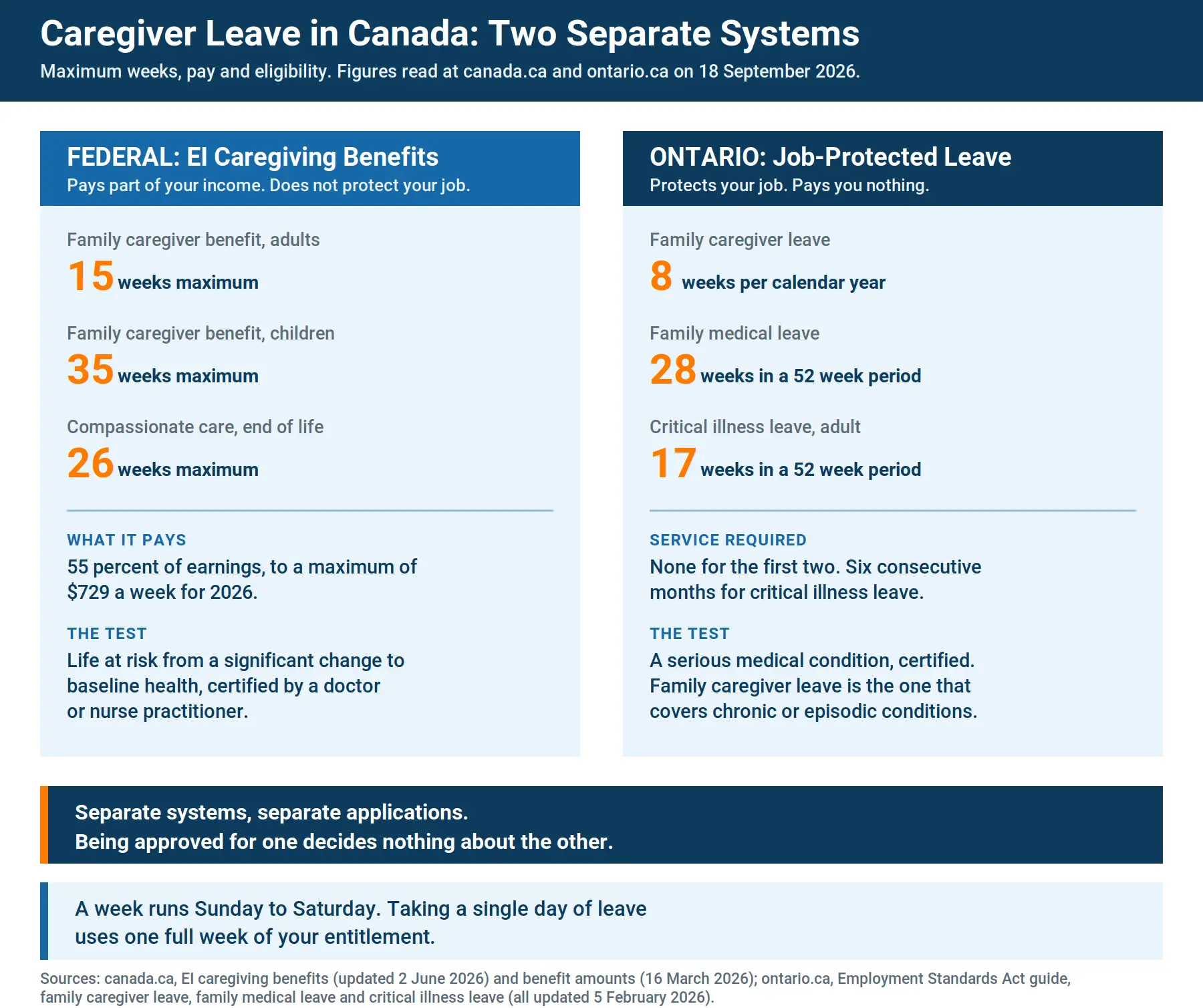
Employment and Social Development Canada runs three of them, and which one fits depends on who is ill and how ill they are. From canada.ca, page last updated 2 June 2026:
The payment is 55 percent of your earnings, to a maximum of $729 a week for 2026, per the same department’s benefit-amounts page, last updated 16 March 2026.
Two details in the small print are worth having early. You do not have to live with the person, and you do not have to be related to them, but you do have to be considered to be like family. And the weeks can be shared between eligible caregivers, either at the same time or one after another, which matters if two adult children are both working.
“Critically ill or injured” has a narrow meaning here, narrower than most families assume. Canada.ca defines it as someone whose baseline state of health has changed significantly because of illness or injury, whose life is now at risk as a result, and whose condition has been certified by a medical doctor or nurse practitioner.
Then comes the sentence that decides most of these claims. If the person is already living with a chronic medical condition, the department states, caregivers are not eligible unless that person’s health changes significantly because of a new and acute life-threatening event.
Read plainly, that means a parent who is simply getting frailer, falling more often, and managing arthritis and some memory change does not open an EI caregiving claim. Knowing that before you build a household budget around the income is worth a good deal.
The tax side sits separately again, and we have already covered the Canada caregiver tax credit. For the wider question of who ends up paying for what, our guide to the cost of caring for elderly parents in Canada covers the family-finances half of this.
Ontario runs three leaves a working caregiver might reach for. All three are unpaid. All three chapters of the provincial guide were last updated on 5 February 2026.
Family caregiver leave. Up to eight weeks per calendar year, for each specified family member. It needs a certificate from a qualified health practitioner stating that the person has a serious medical condition. The certificate does not have to say what the condition is, and the guide states that it can include conditions that are chronic or episodic. Every employee covered by the Act qualifies, full-time or part-time, permanent or on contract, with no minimum length of service and no minimum employer size.
Family medical leave. Up to 28 weeks within a 52-week period, where a practitioner certifies a serious medical condition carrying a significant risk of death within 26 weeks. Again open to every covered employee, with no minimum service.
Critical illness leave. Up to 17 weeks for a critically ill adult within a 52-week period. This one does carry a service requirement: six consecutive months with your employer. Ontario defines critically ill here as a significant change from baseline health with life now at risk, and says specifically that it does not include chronic conditions.
Set those against the federal rules and a pattern appears that is genuinely useful to a family with a declining parent. The EI benefit and Ontario’s critical illness leave both exclude the chronic case. Family caregiver leave does not. So the parent whose situation will never support an EI claim may still support eight weeks of protected time, unpaid, every calendar year.
Two phrases turn up in searches far more often than in the legislation. “Compassionate care leave Ontario”, “caregiver benefits” and “caretaker benefits” are what people type; the official names are different, and knowing which is which saves a wasted application.
Compassionate care leave. In Ontario, the provincial leave for a family member who is gravely ill is called family medical leave, not compassionate care leave: unpaid, job-protected, up to 28 weeks in a 52-week period, where a qualified health practitioner certifies a serious medical condition with a significant risk of death within 26 weeks (Ontario’s Employment Standards Act guide, updated February 5, 2026). The name “compassionate care” belongs to two other things. Federally, the EI compassionate care benefits pay up to 26 weeks to an eligible caregiver of a person who needs end-of-life care, child or adult (EI caregiving benefits, canada.ca, modified June 2, 2026). And employees of federally regulated workplaces in Ontario, such as banks, airlines and telecoms, are covered by the Canada Labour Code rather than the Employment Standards Act, and the Code does call its leave compassionate care leave: up to 28 weeks within a 52-week period, unpaid, on the same significant-risk-of-death test (federal labour standards leaves, canada.ca, modified May 13, 2026). Ontario’s guide also says the medical certificate submitted for the EI benefit can be used to support the family medical leave entitlement, so one certificate can serve both applications.
Caretaker benefits. There is no benefit by that name. What people usually mean is one of the three EI caregiving benefits above: the family caregiver benefit for adults (up to 15 weeks), the family caregiver benefit for children (up to 35 weeks) or compassionate care benefits (up to 26 weeks). The weeks can be shared between eligible caregivers, at the same time or one after another, and the caregiver does not have to live with the person or be related, provided they are considered to be like a family member. For amounts, the EI caregiving benefits pages carry an estimator. The rules change; the official pages govern, and the orientation above is not legal or financial advice.
Working out what to put in place before your leave ends? Call us at 1-888-755-3055 for a complimentary consultation by phone. We will walk you through what a monitored setup covers, what it costs monthly, and what it does not do, with no obligation at the end of it. If something other than monitoring suits your parent better, we will tell you that too.
A single day uses a whole week. Under family caregiver leave and critical illness leave, taking leave for part of a week counts as using one full week of the entitlement, and a week is defined as running Sunday to Saturday. Two days inside the same week still cost one week. Two days in different weeks cost two. If you are spreading leave across appointments, grouping them inside one calendar week is the difference between spending one week of your eight and spending two.
Two of the leaves are a shared pool, not an allowance each. Ontario sets 28 weeks of family medical leave as the total available to all employees taking that leave for the same family member, so a sibling who takes 18 weeks leaves 10 for everybody else. Critical illness leave works the same way, with 17 weeks the total for the same adult. The guide sets out that pooling rule for those two leaves. It does not set one out for family caregiver leave.
The certificate is yours to get and yours to pay for. The employee is responsible for obtaining the medical certificate and for whatever it costs, and the Ministry of Labour, Immigration, Training and Skills Development states plainly that it cannot help you get one. You are allowed to start the leave before the certificate exists. But if a certificate is never issued at all, the entitlement turns out never to have existed either, and every protection that came with it goes with it.
Critical illness leave wants a plan, not just notice. For the other two, written notice to your employer is the requirement. For critical illness leave you also have to hand over a written plan setting out which weeks you intend to take. You can change it afterwards, in writing, as often as you need to, and there is no cap on the number of changes.
Everything above about leave applies to employees covered by Ontario’s Employment Standards Act, 2000. Other provinces and territories run their own job-protected leaves, under their own names and their own lengths, and federally regulated workplaces follow a different statute again. EI caregiving benefits are federal, so those work the same wherever in Canada you are employed.
Start at your own province’s employment standards page, and treat the official page as governing over anything you read anywhere else, this one included.
None of this is legal or financial advice. For anything complicated, and particularly for anything involving termination, accommodation or a disputed benefit, an employment lawyer is the right call rather than a web page.
The leave ends on a fixed date. The reason for it usually does not.
This is the stage a lot of our phone calls actually start at. Not a crisis. Week six of eight, a return-to-work date already on the calendar, and a parent whose situation has not obligingly changed back. The question is nearly always the same one: what covers the hours when nobody is in the house.
That work counts, incidentally. Ontario’s definition of “care or support” for these leaves expressly includes arranging for care by a third-party provider, alongside directly providing care and giving emotional or psychological support. The week you spend organising what happens after you go back is inside what the leave is for.
Two things are worth writing down before the date arrives.
A response plan, in writing. Not a loose arrangement that lives in one person’s head. Who gets called, in what order, who holds a key, what someone arriving at the door needs to know. Bedford Medical Alert® operators work from a personalized response plan held on file for each subscriber rather than a generic script, so the plan a family settles in week seven is the plan that runs at three in the morning in February. If the family is spread across provinces, our guide to long-distance caregiving in Canada covers the visibility problem that creates.
Cover for the empty hours. Bedford is Canadian-owned and operated, with 24/7 monitoring based in Canada, and the equipment is included with the subscription rather than bought separately. Plans typically run month to month after a three-month minimum at the start, with optional six or twelve month initial terms if the savings suit you. Service reverts to month to month afterwards, and there are no cancellation fees. Bedford is a member of the Ontario Community Support Association, has supported hospital education programs and research initiatives from UHN Toronto Rehab to Trillium Health, and brings three generations of experience to this.
One last thing, and it belongs here rather than at the end of the next leave. If your parent is still well enough to be in the conversation about all of this, have it now. Our page on planning ahead for aging parents covers the decisions that hold up best when they are made in an unhurried month.
If your parent is staying in their own home while you are back at work, our Home Freedom system is where most Canadian families start: an in-home base unit paired with a pendant, 24/7 monitoring from right here in Canada, equipment included, Easy Setup, and no long-term contract. Call 1-888-755-3055 and we will talk through what it would actually cover in your parent’s house.
