
A Sunday phone call is a weak instrument. It tells you what your parent chose to say on Sunday.
Families who live nearby fill in the rest without noticing they are doing it. They see whether the mail came in. They notice the bruise on the forearm, the stack of unopened envelopes, the fact that the good winter boots are still in the closet in November. Move four hours away, or four provinces, and every one of those signals is replaced by a question your parent can answer politely.
Bedford Medical Alert® takes calls from adult children who live in one province about a parent who lives in another. This page is about what actually helps in that situation, in what order, and about the parts of it a device cannot solve.
Not speed. Information.
A monitored device summons help at the same rate whether you live upstairs or in Vancouver, because the call goes to a monitoring centre in Canada that is staffed around the clock, not to you. What distance changes is everything before and after the emergency: how long it takes anyone to notice a slow decline, how much of your picture of your parent’s week comes from your parent, and how many decisions you end up making from a phone with incomplete information.
That is the problem worth solving first. The device is the easier half. For what that distance looks like inside a single Ontario county, our Barrie and Simcoe County page walks through it.
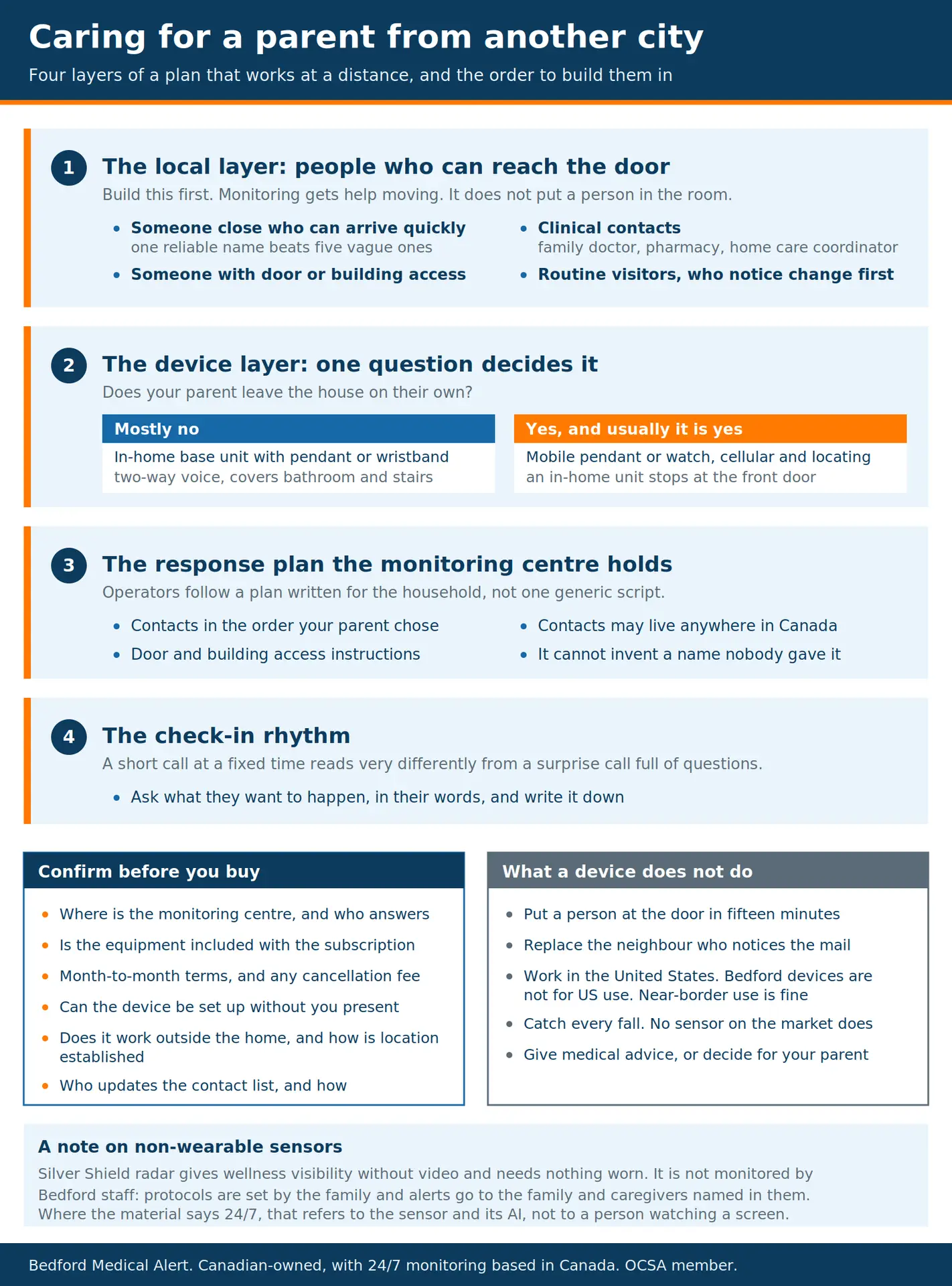
Monitoring gets help moving. It does not put a person at the door in fifteen minutes, and no service can promise that from another city. So the first piece of long distance caregiving is a short list of people who are physically close.
Four kinds of name are worth having written down:
Bedford operators follow a personalized response plan for each household rather than one generic script, which is the practical reason those names matter. The plan can hold the contacts a household names and it does not care which province they live in. What it cannot do is invent a name that nobody gave it. If you want the detail on how a call proceeds and who gets reached, the monitoring journey from the moment the button is pressed is covered on its own page.
If you are the nearby caregiver rather than the distant one, our page for caregivers supporting a parent close to home is the better fit.
And if the worry itself is wearing you down, caregiver burnout in Canada sets out what the research supports and what caregivers say they need.
And if the question is simply how often to call, how often to check on an elderly parent looks at what the Canadian data actually flags and how to set a rhythm a busy family can keep.
Bedford runs five product streams, and for a long distance family the choice usually comes down to one thing: does your parent leave the house on their own?
If the answer is mostly no, an in-home system covers the ground. A base unit and a pendant or wristband, two-way voice, help reachable from the bathroom and the basement stairs.
If the answer is yes, and for most independent parents it is, an in-home unit stops at the door. A mobile device carries the same button outside, with built-in cellular and location technology, either as a pendant or as a watch. That matters more at distance than it does nearby, because you are not the person who can drive around looking. If you want the mechanics rather than the marketing, we explain how GPS and network locating actually work in mobile devices, including where the accuracy comes from and where it degrades.
Equipment is included with the subscription rather than bought separately, and Easy Setup means a device can be running in a home you are not standing in.
Not sure which setup fits a parent you cannot visit this month? Call 1-888-755-3055 for a complimentary consultation by phone. We will talk through how your parent actually lives, who is nearby, and what the response plan should say, with no obligation.
Bedford devices are not for use in the United States. They are designed to work near the border, and living near it is not a limitation.
Say your parent lives in Windsor and your family is in Michigan, or the reverse. The device covers the Canadian side of that life normally. If your parent spends three months of the winter in Arizona, the device is not the answer for those three months, and any provider who tells you otherwise is worth a second look. Better to know that before you buy than after.
Some long distance families are not worried about a single dramatic event. They are worried about not knowing anything for eleven days.
Silver Shield is the stream built for that gap. It uses millimetre wave radar rather than a wearable, so there is nothing to remember to put on, and it gives wellness visibility without video, which matters for a parent who would refuse a camera outright and is right to. Multiple sensors can cover different rooms in the same home under the same protocols.
Two things need saying honestly about it. Silver Shield is not monitored by Bedford staff: the protocols are set by the family, and alerts go automatically to the family and caregivers named in them, with no operator on the line and no emergency dispatch. When the material says 24/7, that refers to the sensor and its AI, not to a person watching. And on fall detection generally, in any form and from any manufacturer, no sensor on the market catches every fall. Treat it as a layer, not a guarantee. The Silver Shield page sets out what it does in more detail.
For a distant adult child, that trade is the whole appeal and the whole limit in one sentence: it tells you, quickly, and then it is your call.
You can do most of the setup work by phone, and doing it in the right order saves a second round of conversations.
Start by asking your parent what they want to happen. Not whether they want a device, which invites a no, but who they would want called first and whether they would rather a neighbour came over than an ambulance for something minor. Write the answers down in their words. Then confirm door access, because a response plan that names three contacts and no way into the house solves half a problem. Then set a check-in rhythm that is not a test. A short call at a fixed time reads very differently from a surprise call that opens with a list of questions.
Bedford brings three generations of experience to this and is an OCSA member, and has supported hospital education programs and research initiatives from UHN Toronto Rehab to Trillium Health. None of that is a partnership claim about your parent’s hospital. It is context for why the questions above are the ones we ask families in the first call.
Circumstances change faster at a distance, so terms matter.
Plans typically run month-to-month after a three-month minimum at the start, with optional six or twelve month initial-term savings for families who want them. Service always reverts to month-to-month afterward. There are no long-term contracts and no cancellation fees, which means a parent moving into a care home in October is not a financial problem in addition to being an emotional one.
That flexibility is worth confirming with any provider you consider, especially at distance, where the person who signs up is often not the person who lives with the outcome.
If your parent still gets out on their own, the mobile pendant is usually the right starting point. See the Go Anywhere Pendant with GPS and fall detection, or call 1-888-755-3055 and we will build the response plan around the people who are actually nearby.