Black Friday to Cyber Monday: six months of service for the price of four.Black Friday to Cyber Monday: six months for the price of four. See the offer
The discharge summary is three pages long, and halfway down the second one sits a line nobody mentioned at the bedside: Clinical Frailty Scale, 5.
Families find that line, or hear the word “frail” in a care conference, and are left to work out what it means. This page explains what clinicians mean by frailty, where the Canadian scale behind that number came from, what its nine levels are called, and what a family can do with the information. It is general information, not medical advice. A frailty score is a clinical judgment, and questions about a parent’s score belong with the team that gave it.
Nova Scotia Health puts it simply: frailty means the body is not as strong and has a harder time recovering from illness or stress. It also makes a point families often need to hear: “frailty is not the same as aging.”
Kenneth Rockwood and Olga Theou of Dalhousie University, who wrote the scale’s guidance, describe frailty in a 2020 paper as a state of increased risk. Their working test is comparative: people are frail when they have more things wrong with them than others of the same age.
The Canadian Frailty Network, based in Kingston, explains why the word matters. Older adults living with frailty are more vulnerable to large declines in health after something minor, such as the flu or a fall, and are more likely to be hospitalized, to need long-term care or to die.
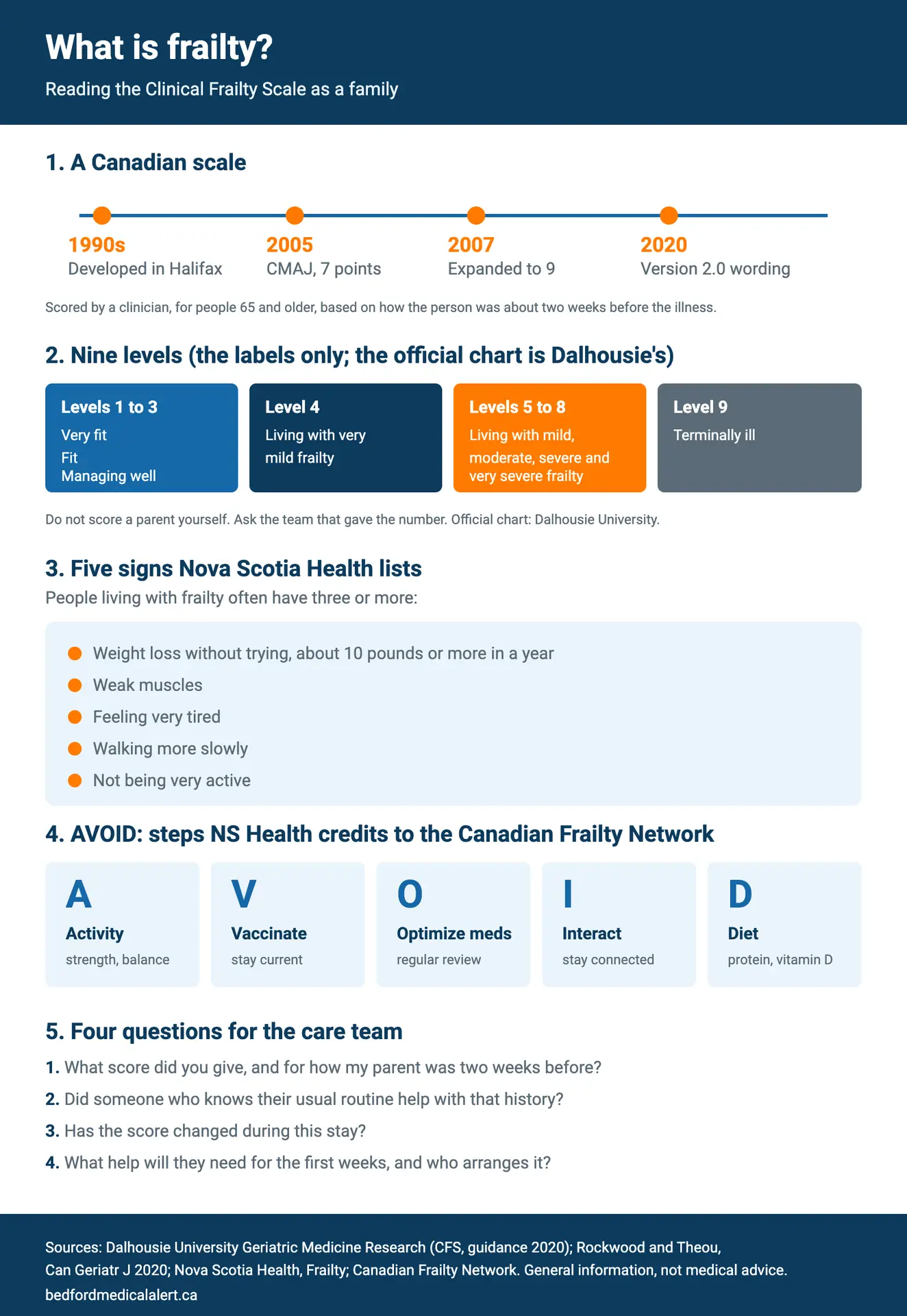
The scale is Canadian. It was developed in Halifax in the 1990s and introduced in the Canadian Study of Health and Aging, then published in the CMAJ in 2005 as a seven-point measure. In 2007 it was expanded to nine points. In 2020 the Dalhousie team released version 2.0, with clarifying edits to the wording; the old label “Vulnerable”, for example, became “Living with Very Mild Frailty”.
Three things about how it is meant to be used help families read it correctly:
The scale is copyrighted through Dalhousie University, and the official chart with its pictures is available on Dalhousie’s Clinical Frailty Scale page. We describe it here in our own words. Bedford has no connection to the scale’s authors.
The scale runs from 1 to 9, and a higher number means greater risk. Levels 1 to 3 are labelled very fit, fit and managing well. Level 4 is living with very mild frailty. Levels 5 to 8 are living with mild, moderate, severe and very severe frailty, and level 9 is terminally ill. Broadly, the further up the scale, the more help from other people a person needs with daily life.
We have not reproduced Dalhousie’s chart or its description of each level; the official wording is on Dalhousie’s page, and the team that gave the score is the right place to ask what it means for your parent.
A score is a description of where someone was, not a verdict on where they are going.
Please do not score a parent yourself from a page like this one. The scale depends on clinical judgment and a proper history, and a home guess can be wrong in either direction.
Rockwood and Theou write that the scale is used both to estimate prognosis and to set care goals. CIHI’s February 2024 podcast with Dr. Rockwood summarizes the risk side: people living with frailty face a higher chance of hospitalizations, longer stays, readmissions, emergency visits and in-hospital death. Our page on hospital readmission in seniors covers who goes back within 30 days and what the research says lowers the odds.
If you find a frailty score in the paperwork, these are fair questions to bring to the team:
Bringing a parent home with “frail” written on the paperwork? Call us at 1-888-755-3055 for a complimentary consultation by phone. We will talk through the first weeks at home, who should be called if something goes wrong, and how a waterproof help button and a personalized response plan would fit their routine.
Families often see frailty before anyone scores it. Nova Scotia Health lists five signs and says people living with frailty often have three or more of them:
Weak muscles show up early in the hands. Our page on grip strength by age sets out the Canadian norms and what a weak grip is, and is not, linked to.
None of these signs is a diagnosis on its own. Several of them together, or a change over a few months, is a good reason to book an appointment and say so plainly.
Nova Scotia Health is direct on this point: “Frailty can often be prevented and may even improve with the right care and support.” It credits its advice to the Canadian Frailty Network’s AVOID program, which groups the steps under five letters:
On the CIHI podcast, Dr. Rockwood is clear about his own aim with people who are already frail: reducing the risk so that they do not get frailer. Exercise has the strongest research behind it for preventing falls, and our page on what the fall prevention evidence backs shows how each step is graded.
The paperwork is also a cue to plan. Powers of attorney, a written list of medications and contacts, and a conversation about where your parent wants to live are easier while life is calm. Our guide to planning ahead for aging parents walks through five of those arrangements.
The Canadian Frailty Network’s description of frailty names the fall as one of the small events that can set off a large decline. For someone who lives alone, the hours after that fall are the part a family can plan for.
A Bedford Medical Alert® Home Freedom system puts a help button on the person all day and night. It comes as a pendant or a wristband, both waterproof, so it can stay on in the shower and overnight. The battery lasts five years with no charging, which matters for someone who already feels tired by mid-afternoon, and the button is rated for a 600 to 800 foot line-of-sight range from the base.
A press goes to our monitoring centre, staffed 24/7 in Canada. The operator speaks through the base unit’s two-way speaker and works from the personalized response plan on file, which can include who to call first and where a spare key is kept. For a fall without injury, that may be a family member who can come over; for an emergency, the operator can dispatch emergency services and pass along the information in the file.
An optional fall detection pendant, worn as a necklace, can call for help when it senses a fall. It adds a layer, and no sensor catches every fall, so the habit stays the same: press after any fall, even one that seems small.
Bedford Medical Alert is Canadian owned and operated, with 24/7 monitoring based in Canada, and our operators follow a personalized response plan for every client. We are a member of the Ontario Community Support Association. We are trusted by clinicians across Canada and have supported hospital education programs and research initiatives from UHN Toronto Rehab to Trillium Health. Canadian families have given us a 4.9-star Google rating, and Bedford brings three generations of experience to this work.
Equipment is included with the subscription, so there is no device to buy. Plans typically run month to month after a three-month minimum at the start, with optional six or twelve month initial terms if the savings suit you. Service reverts to month to month afterwards, and there are no cancellation fees. Easy Setup means the system is ready to use quickly.
A score describes yesterday. A plan covers tonight. A Home Freedom system pairs a waterproof pendant or wristband with our monitoring centre in Canada, staffed 24/7, with no long-term contract. Explore Home Freedom Systems or call 1-888-755-3055 to talk it through.
