Black Friday to Cyber Monday: six months of service for the price of four.Black Friday to Cyber Monday: six months for the price of four. See the offer
Day one is the afternoon the car pulls into the driveway with a discharge folder on the passenger seat. Day 30 is the line Canadian hospital statistics draw.
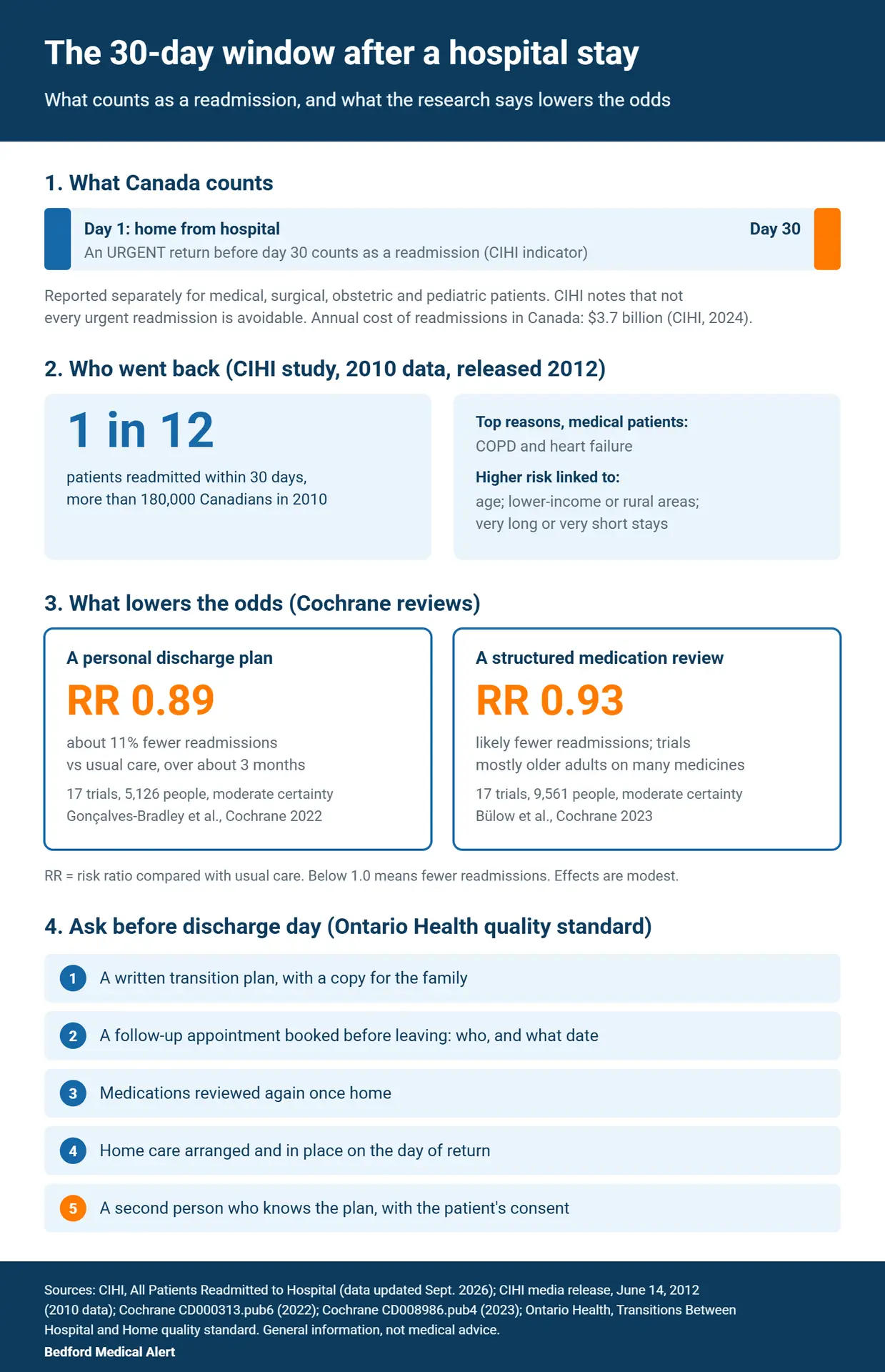
If a patient comes back to hospital urgently inside that window, the Canadian Institute for Health Information (CIHI) counts it as a readmission. CIHI puts the annual cost of hospital readmissions in Canada at $3.7 billion, from its own 2024 figures, and its readmission indicators were last refreshed in September 2026. Behind the dollar figure is something a family feels more directly: a parent who was supposed to be getting stronger at home is back on a stretcher in the emergency department.
This page explains what counts as a readmission, what Canadian data show about who goes back, and what two Cochrane reviews and Ontario Health’s hospital-to-home quality standard say lowers the odds. It also covers where a medical alert fits, and where it does not. It is general information drawn from the public sources listed at the end and from the way we set up response plans at Bedford Medical Alert®. It is not medical advice. The hospital team and your parent’s own clinician are the people to ask about a specific case.
CIHI’s indicator measures the risk-adjusted rate of urgent readmissions within 30 days of discharge. It reports four patient groups separately: medical, surgical, obstetric and pediatric. The medical group counts adults aged 18 and older.
CIHI’s latest figures are for 2025 to 2026. Across all four groups, the risk-adjusted rate for Canada was 9.7 urgent readmissions for every 100 episodes of hospital care. For medical patients alone it was 14.2. Ontario’s figures were 10.2 and 14.8.
Two details are worth knowing before you read any hospital’s number. First, the count is of urgent returns, so it is not a tally of every visit back to the building. Second, CIHI says plainly that not all urgent readmissions are avoidable. Some people go back because something new has gone wrong, and going back was exactly the right call.
CIHI describes urgent readmissions as increasingly used to measure the quality of care and how well care is coordinated. Among the things it says move the rate are the quality of care in and out of hospital, the handover between the two, and the community programs available afterwards. It also says that interventions during and after a hospital stay can be effective in reducing readmissions. A lower rate is better.
The best public breakdown of who returns that we could find is older than we would like. CIHI’s study All-Cause Readmission to Acute Care and Return to the Emergency Department was released in June 2012 and used hospital data from 2010 and early 2011. It found that about one in 12 patients (8.5%) was readmitted within 30 days, which came to more than 180,000 Canadians. Medical patients went back about twice as often as surgical patients: 13.3% against 6.5%.
Several of its findings still frame the question well:
That last finding is worth a second look. A short stay can leave little time to get the plan at home in place. A long stay can mean someone goes home weaker than they arrived. Neither is something a family controls, but either one is a reason to ask more questions before discharge day.
If your parent lives with one of the two conditions at the top of that list, our pages on living alone with COPD and living alone with heart failure cover the warning signs and the home setup for each, so this page does not repeat them.
Two measures have Cochrane reviews behind them, and a third is written into Ontario’s quality standard for leaving hospital. None is dramatic. The effects are modest, and knowing that helps a family spend its energy where it counts.
A discharge plan made for this person. A Cochrane review by Gonçalves-Bradley and colleagues, Discharge planning from hospital (Cochrane Database of Systematic Reviews 2022, Issue 2, published 24 February 2022 and listed by Cochrane as the current version), pooled trials of structured, individual discharge plans. For people admitted with a medical condition, readmission over an average of three months was lower with a plan: a risk ratio of 0.89 (95% confidence interval 0.81 to 0.97), from 17 trials and 5,126 participants, rated moderate-certainty evidence. Put simply, that is about 11% fewer readmissions relative to usual care. The review also found a small reduction in the length of the first hospital stay, and little or no difference in deaths at three to nine months.
A structured review of every medication. A second Cochrane review, by Bülow and colleagues, Medication review in hospitalised patients to reduce morbidity and mortality (2023, Issue 1, published 23 January 2023), concluded that medication reviews in hospitalised adults likely reduce readmissions: a risk ratio of 0.93 (95% CI 0.89 to 0.98), from 17 trials and 9,561 participants, moderate certainty. Almost all of those trials included older patients taking many medications. The same review found, on low-certainty evidence, that medication reviews may have little to no effect on mortality and may reduce emergency department contacts.
A follow-up appointment that is actually booked. This one rests on a standard of care, not on a pooled trial result. Ontario Health’s quality standard, Transitions Between Hospital and Home, notes that some patients moving between hospital and home are particularly vulnerable and at increased risk of readmission, among them older people with several conditions or cognitive impairment. Its statement on follow-up medical care says appointments with a primary care clinician or a specialist should be coordinated and booked before the patient leaves hospital, and that people without a primary care clinician should get help finding one.
Bringing a parent home from hospital soon? Call us at 1-888-755-3055 for a complimentary consultation by phone. We can talk through the first weeks at home, who belongs on the contact list, and whether a landline or cellular setup suits the house.
The current edition of Ontario Health’s quality standard is dated February 2026. It sets out ten quality statements for the move from hospital to home, and several of them turn easily into questions a family can ask. Among them:
Outside Ontario the wording changes from province to province, but the questions travel well. Our coming home from the hospital checklist covers getting the house ready and the first 72 hours, so those steps are left out here.
Consider how a careful discharge can still come apart. The discharge folder goes home with the patient. The daughter who sat in on the discharge meeting flies back to Calgary on Sunday. By Wednesday, the only person who knows which pill was stopped, and when the clinic appointment is, is the person recovering.
Ontario Health’s standard treats family involvement as part of a good transition. In practice, that means one more person, perhaps a sibling or a neighbour, who holds a copy of the transition plan, the medication list and the follow-up date. They do not need to live nearby. They need to know the plan well enough to notice when something is off, and to make a phone call if the appointment date slips past without a visit.
None of the trials behind the reviews above tested a medical alert, and we do not claim that one keeps anyone out of hospital. A medical alert does not review medications, book appointments or replace home care.
What it does is narrower. In the first weeks home, a parent may be weaker than before and alone for long stretches of the day. If something goes wrong, whether a fall in the hallway or sudden trouble breathing at 2 a.m., pressing the button reaches an operator at our 24/7 Canadian monitoring centre. The operator speaks through the base and follows the response plan your parent has set up, calling the people on the list or emergency services as the situation needs.
Bedford’s Home Freedom system is built for that stretch at home. The help button is worn as a pendant or a wristband and is waterproof, so it can stay on in the shower. It is rated for a 600 to 800 foot line-of-sight range from the base. The base has two-way voice and a battery backup, and it connects by landline or VoIP, or by cellular LTE in a home with no wired line. No Wi-Fi is needed. Automatic fall detection is an optional upgrade on the pendant; no sensor on the market catches every fall, which is why the button itself still matters.
If your parent already has a Bedford system, call us before discharge day. The response plan lists contacts in the order your parent chooses and can note where a spare key is kept. A hospital stay is a good reason to check that the first name on that list is still the right one.
Bedford Medical Alert is Canadian owned and operated, with 24/7 monitoring based in Canada, and our operators follow a personalized response plan for every client. We are a member of the Ontario Community Support Association. We are trusted by clinicians across Canada and have supported hospital education programs and research initiatives from UHN Toronto Rehab to Trillium Health. Canadian families have given us a 4.9-star Google rating, and Bedford brings three generations of experience to this work.
Equipment is included with the subscription, so there is no device to buy. Plans typically run month to month after a three-month minimum at the start, with optional six or twelve month initial terms if the savings suit you. Service reverts to month to month afterwards, and there are no cancellation fees. Easy Setup means the system is ready to use quickly.
Plan for the first weeks home. Bedford’s Home Freedom system puts a waterproof help button within reach, answered 24/7 by our Canadian monitoring centre and backed by the response plan your parent chooses. There are no long-term contracts. See how Home Freedom works or call 1-888-755-3055.
