
The Lung Health Foundation describes a COPD flare-up, which it also calls a lung attack, as a stretch of a few hours to 48 hours in which the usual symptoms get worse or new ones appear. The three signs it puts first are an unusual increase in shortness of breath, more coughing, and more mucus, or mucus that is thicker or stickier than usual.
A few hours to two days.
In a shared home, that window usually has a second person in it: someone who hears the cough at breakfast, or notices the pause halfway up the stairs. For someone who lives alone, the window belongs to that person only, and the first decision about what to do is often made while already short of breath.
We are Bedford Medical Alert®, a Canadian medical alert provider. This page is about that window and about the ordinary days around it, from tiredness and balance to the night-time trip to the bathroom and reaching a person when breath is short. A help button does not detect a flare-up and does not treat one. It is a way to reach someone. Nothing here is medical advice: your respirologist, family doctor or respiratory therapist knows your lungs, and the Lung Health Foundation’s own resources go much further into the condition than we can.
The Lung Health Foundation puts the number at about 2 million Canadians living with COPD, and says as many as 1 million more have it without a diagnosis or treatment.
Age shows up clearly in the federal surveillance data. For the fiscal year 2023 to 2024, the Public Health Agency of Canada’s Canadian Chronic Disease Surveillance System data tool puts diagnosed COPD at 15 per cent of Canadians aged 65 to 69, 20 per cent at 75 to 79 and 24 per cent at 80 and older, reaching 25 per cent at 90 and older. The Government of Canada’s COPD page adds that symptoms do not usually appear before age 55, although changes in the lung begin many years earlier.
Hospital data points the same way. The Canadian Institute for Health Information’s report Hospital stays in Canada, 2023 to 2024, released on 20 February 2025, counted 3.05 million acute inpatient hospitalizations. The most common reason was giving birth. Second was COPD and bronchitis, which CIHI groups together, with an average stay of 7.1 days.
That is a great many people going home after a week on a ward, and some of them go home to an empty apartment.
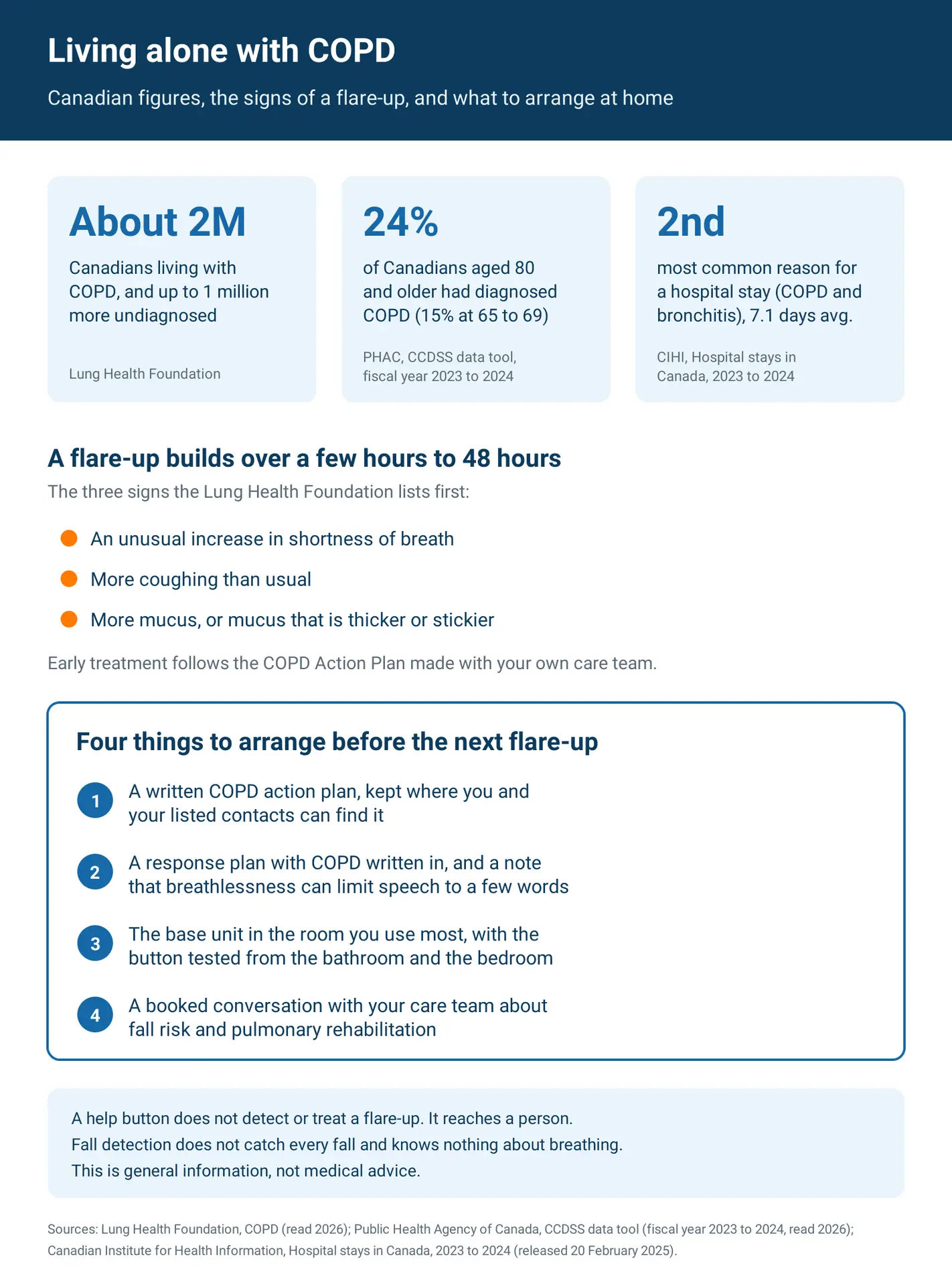
The Lung Health Foundation is direct about timing: if a flare-up is treated early, you are less likely to need hospital care, and the way to treat it is to follow the instructions in your COPD Action Plan. That plan is worked out with your own health care team. If you do not have one, ask for it at your next appointment.
Living alone changes how the plan works in practice. It is usually only read by one person. So tell the people on your contact list that it exists and where it is kept, and keep a copy somewhere a family member or a neighbour with a key would find it without searching.
Some moments go past what an action plan covers. Breathing difficulty and chest discomfort, together with the instruction to call 9-1-1 directly whenever you can, are set out on our page about when to press a medical alert button. We will not repeat them here, and we will not try to tell you which breathless moment is which. That judgment belongs to your care team’s plan and to emergency services.
A medical alert call is a voice call. On a Bedford in-home system, the operator speaks to you through a two-way speaker in the base unit, and you answer from wherever you are in the house.
People who are very short of breath often speak a few words at a time. Some cannot speak at all for a while.
At Bedford, an operator does not treat a silent or unclear call as a false alarm. They follow a set procedure, and your personalized response plan takes over: the contacts, the order they are called in, and the medical information recorded in advance. Our page on what happens when you press a medical alert button walks through the steps. For someone with COPD, the useful thing is to write the condition into that plan, along with a note that breathlessness can cut speech short, so the operator is working from what the plan says and not from what you can manage to say on a bad day.
Living on your own with COPD, or worried about a parent who is? Call the Bedford team at 1-888-755-3055 for a complimentary consultation by phone. We will ask how the home is laid out and what a bad breathing day looks like, and there is no obligation.
Feeling tired is on the Lung Health Foundation’s short list of COPD symptoms, next to the long-lasting cough and breathlessness during everyday tasks such as climbing a flight of stairs.
Balance is less often discussed. A systematic review and meta-analysis by Loughran and colleagues, published in Thorax in 2020, pooled 23 studies with 2,751 participants and found that people with COPD performed worse than healthy controls on standard balance tests, including the Timed Up and Go, standing on one leg, and the Berg Balance Scale. The authors suggest the gap may be related to reduced muscle strength, physical activity and exercise capacity; balance tracked quadriceps strength more closely than it tracked a standard lung function measure. The review measured balance. It did not count falls, and this page does not claim a fall rate from it.
In a home with one person in it, effort and balance meet in a few predictable places. The shower, where steam and standing both cost breath. The stairs. The walk to the bathroom at three in the morning, half awake. A fall in any of them brings a second problem, the time spent on the floor before anyone knows, which our page on the long lie after a fall covers in detail.
Two questions are worth taking to the care team: whether a balance or fall-risk assessment makes sense for you, and whether a pulmonary rehabilitation program runs near where you live.
Smoke is the other outside force worth planning for. As our page on wildfire smoke and seniors sets out, Health Canada names people living with COPD among the groups at higher risk from wildfire smoke, and Environment Canada advises at-risk groups to start taking precautions at a lower Air Quality Health Index reading than the general population. That page explains the index and the indoor steps; on a smoky day, someone alone is better off settling into the room where the base unit is, with the button already on.
Some specifics from our own equipment. The Bedford Home Freedom system connects through a landline or VoIP line, or by its LTE cellular option, and needs no Wi-Fi. The base unit plugs into a standard outlet and has a battery backup. The Mini Pendant can be worn as a pendant or on a wristband, and both it and the Fall Detection pendant are fully waterproof, so the button can stay on in the shower, which is exactly where you want it on a day when standing costs breath.
The button works up to 800 feet from the base unit, but the conversation happens through the base. Put it in the room where you spend most of the day. Then, in the first week, press the button from the bathroom and the bedroom and check that you can hear the operator and be heard, ideally while sitting the way you would sit if you were tired.
Automatic fall detection is available as an option. The Fall Detection pendant is worn as a necklace, and its sensors look for movement patterns that may indicate a fall, so a call can begin without a button press. No sensor on the market catches every fall. Fall detection knows nothing about your breathing, either, so treat it as a layer on top of the button and never as a substitute for pressing it.
Bedford Medical Alert is Canadian owned and operated, with 24/7 monitoring based in Canada and operators who follow a personalized response plan for every client. We are a member of the Ontario Community Support Association, we are trusted by clinicians across Canada, and we have supported hospital education programs and research initiatives from UHN Toronto Rehab to Trillium Health. Canadian families have given us a 4.9-star Google rating. Bedford brings three generations of experience to this work.
Equipment is included with the subscription, so there is no device to buy. Plans typically run month to month after a three-month minimum at the start, with optional six or twelve month initial terms if the savings suit you. Service reverts to month to month afterwards, and there are no cancellation fees. Easy Setup means the system is ready to use quickly.
For someone living alone with COPD, the Bedford Home Freedom in-home system puts a waterproof help button within reach in the shower and at night, with a two-way speaker base and a personalized response plan behind every call. Call 1-888-755-3055 and we will set it up around the rooms you actually use.