
Heart and Stroke gives one instruction on its stroke page that runs against instinct. Do not drive to the hospital. Call 9-1-1, because the ambulance will take the person to the closest hospital that provides urgent stroke care, and that is not always the closest hospital.
That instruction only works if somebody can make the call. Bedford Medical Alert® brings three generations of experience to Canadian homes, and the equipment exists for the minutes when reaching a phone is the hard part. Falls are usually what starts the search. They are not the only reason the button is there.
We are not clinicians and this page does not pretend otherwise. Everything below is drawn from Heart and Stroke and from Diabetes Canada, read on their own pages on August 20, 2026, and linked so you can check it yourself. None of it is medical advice. None of it is a reason to wait, either. On every emergency described here, both organisations say the same thing: call 9-1-1.
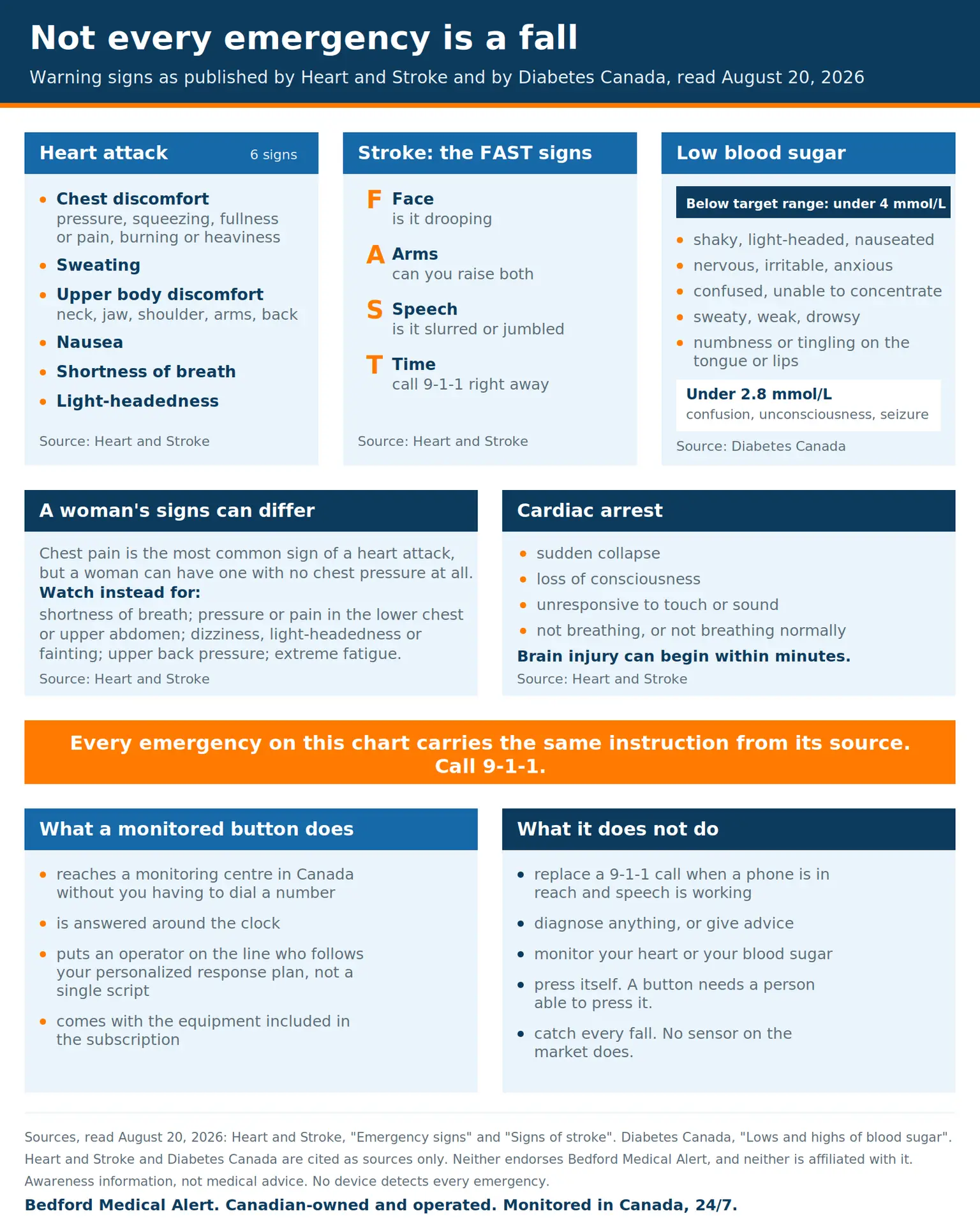
Heart and Stroke names six.
The instruction printed beside that list is short: if you experience any of these signs, call 9-1-1 or your local emergency number immediately.
One passage on that page deserves reading twice. Chest pain or discomfort is the most common sign of a heart attack, but Heart and Stroke states that women can have a heart attack without chest pressure at all. Instead there may be shortness of breath, pressure or pain in the lower chest or upper abdomen, dizziness, light-headedness or fainting, upper back pressure, or extreme fatigue. Heart and Stroke publishes that list separately for a reason.
Heart and Stroke built its FAST campaign to make the most common stroke signs easy to hold in your head. Face, is it drooping. Arms, can you raise both. Speech, is it slurred or jumbled. Time, call 9-1-1 right away.
Then comes the part that argues against getting in the car. Stroke is a medical emergency, and Heart and Stroke says plainly not to drive to the hospital, because the ambulance will take the patient to the closest hospital that provides urgent stroke care. Not every hospital provides it, which is why the instruction exists at all.
Now read the S in FAST again and picture being alone in the house. If speech is what has gone wrong, the easiest way to explain yourself on a phone has gone with it. Heart and Stroke’s instruction does not change: call 9-1-1. A button is a second route to a human voice when the first route is not working. For someone already living alone after a stroke, our page on living alone after a stroke covers balance, fatigue and speech at home.
Diabetes Canada puts numbers on this one, which makes it easier to write about honestly. Blood sugar that has dropped below your target range, under 4 mmol/L, is a low. Early on, Diabetes Canada says a person may feel shaky, light-headed or nauseated, nervous or irritable, confused or unable to concentrate, hungry, sweaty, weak or drowsy, or notice numbness or tingling on the tongue or lips.
Below 2.8 mmol/L it describes something else entirely: confusion and disorientation, loss of consciousness, seizure. Its guidance on treating a severe low includes a line that is easy to skim past, which is that a person may need help from somebody else to get through it.
That is the whole argument for a button in a diabetic household. The button treats nothing. It gets another person on the line.
Diabetes Canada also tells people with diabetes to wear MedicAlert identification, and that is a different product from a monitored button rather than a competing one. Engraved identification tells a responder about your condition once they are with you. A monitored button is how you reach someone in the first place. We set out the difference on our page comparing MedicAlert and a monitored medical alert.
Want to talk this through before deciding anything? Call 1-888-755-3055. Bedford operators follow a personalized response plan for every client rather than one script, and the plan is built around the conditions that actually exist in your home. The consultation by phone is complimentary and there is no obligation.
Heart and Stroke lists four signs of cardiac arrest: sudden collapse, loss of consciousness, unresponsiveness to touch or sound, and not breathing or not breathing normally. It also notes that when the heart stops beating and blood stops reaching the brain, brain injury can begin within minutes.
A person in that state is not going to press anything. We would rather say so plainly here than leave it to be discovered later. Automatic fall detection is designed to raise an alert when it detects a fall, in general terms, and no sensor on the market catches every fall. It is not a cardiac monitor and it is not a substitute for a person in the room. Our explainer on how automatic fall detection works keeps strictly to what the technology does.
What helps in that scenario is unglamorous. A neighbour who has a key. A daughter who knows the difference between an unanswered phone at noon and an unanswered phone at nine in the evening. A household where somebody has learned CPR, which is the reason Heart and Stroke keeps teaching it.
Four of the situations on this page come with a symptom list. One does not, because it is not an illness. It is the ordinary problem of the phone being in the wrong room.
A cordless handset charging in the kitchen is no help on the bathroom floor. A mobile phone left on the bedside table is no help out in the garden. Home Freedom pairs a pendant worn on the body with a base unit in the house for this exact reason: it takes the question of where the phone is out of the emergency altogether. Whether the reason for pressing turns out to be a fall, a chest pain at three in the morning, or a low that arrived faster than anyone expected, the device is on the person rather than across the house.
Whether the person can actually press it is its own question, and our page on accessible medical alert devices covers what changes for hearing, vision, hand strength and memory.
The button is for the moment you cannot get to the phone, or cannot make yourself understood on it. It is not a replacement for 9-1-1. For every emergency on this page the source organisations say to call 9-1-1, and that stays the right answer whenever a phone is in reach and speech is working. Where the two overlap, and where they do not, is set out on our Bedford compared with calling 9-1-1 page. Short breath counts as not being able to make yourself understood: our page on living alone with COPD looks at what a flare-up does to speech and how an operator works from the response plan instead.
As for hesitating because it might turn out to be nothing: notice that neither Heart and Stroke nor Diabetes Canada asks you to be certain first. Their lists are of signs to act on, not of diagnoses to confirm.
Heart and Stroke gives one piece of preparation advice on its emergency signs page that costs nothing to follow. Keep a list of your medications in your wallet and by the phone, because emergency personnel will want it. The same list belongs wherever your monitoring file is kept, and Bedford operators work from a personalized response plan rather than one script. Our page on what happens when you press a medical alert button walks through the call itself, minute by minute.
Bedford is Canadian-owned and operated, and the monitoring centre that answers the button is in Canada, staffed around the clock. Equipment is included with the subscription, so there is no device to buy separately. Plans typically run month-to-month after a three-month minimum at the start. There are no cancellation fees. We are a member of the Ontario Community Support Association, and we hold a 4.9-star Google rating from Canadian families. Getting started is what we call Easy Setup.
Heart and Stroke, Diabetes Canada and MedicAlert appear on this page as sources of information or as points of comparison, and nothing more. None of them endorses Bedford Medical Alert, and none of them is affiliated with us. We name them because they are the right authorities to name, and because you should be able to check every clinical sentence above at its source: Heart and Stroke on the signs of a heart attack and the signs of stroke, and Diabetes Canada on the lows and highs of blood sugar.
Prepared by the Bedford Medical Alert team, August 2026; every clinical statement above is linked to its source.
A pendant that reaches a Canadian monitoring centre covers far more than falls. See what is included with Home Freedom in-home systems, or call 1-888-755-3055 and we will walk you through which system fits the household. No long-term contract, and no cancellation fees.