
Heart & Stroke’s patient guide, Your Stroke Journey, comes back to the same advice twice. In the section on knowing the signs of stroke, it tells anyone who is alone at home to carry a portable phone or wear a medical alert button around the neck that can be pressed when help is needed. In the chapter on everyday tasks, beside the advice on clearing tripping hazards, it says that if you are alone you should have a way to communicate if a problem arises, such as a portable telephone, a cell phone or a safety call button service.
Only one of those two places sits with the advice on hazards in the house. After a stroke, being on your own means more than the risk of a fall. It covers any moment when help is needed and nobody is there to see it.
We are Bedford Medical Alert®, a Canadian medical alert provider, so we will be plain about what a button is. It does not detect a stroke. It does not prevent one. It is a way to reach a person quickly when you need one. This page covers what tends to change at home after a stroke, from balance and energy to speech, and what is worth arranging if you are the only one in the house. It is not medical advice: your stroke team, your family doctor and the occupational therapist who sees you before discharge know your situation, and Heart & Stroke’s recovery resources answer what this page cannot.
Heart & Stroke’s Stroke Month backgrounder of 3 June 2025 counts more than 108,000 strokes a year in Canada, roughly one every five minutes, and almost one million people in Canada living with stroke. About 80 per cent of strokes happen to people over 60. The same document says about 60 per cent of people who have a stroke are left with some level of stroke-related disability, and more than 40 per cent with moderate to severe disability.
More people survive a stroke than did a few decades ago. Heart & Stroke credits research and better awareness, diagnosis, treatment and recovery. More survivors also means more people going home with something that has changed.
Before anyone goes home, the current Canadian Stroke Best Practice Recommendations say that everyone with stroke who moves between care settings should be assessed for mobility and everyday activities before discharge, including a community skills evaluation and a home assessment as needed. Our checklist for coming home from the hospital covers the general steps of any discharge, so this page stays with what is particular to stroke. The same condition series has a page on living alone with heart failure.
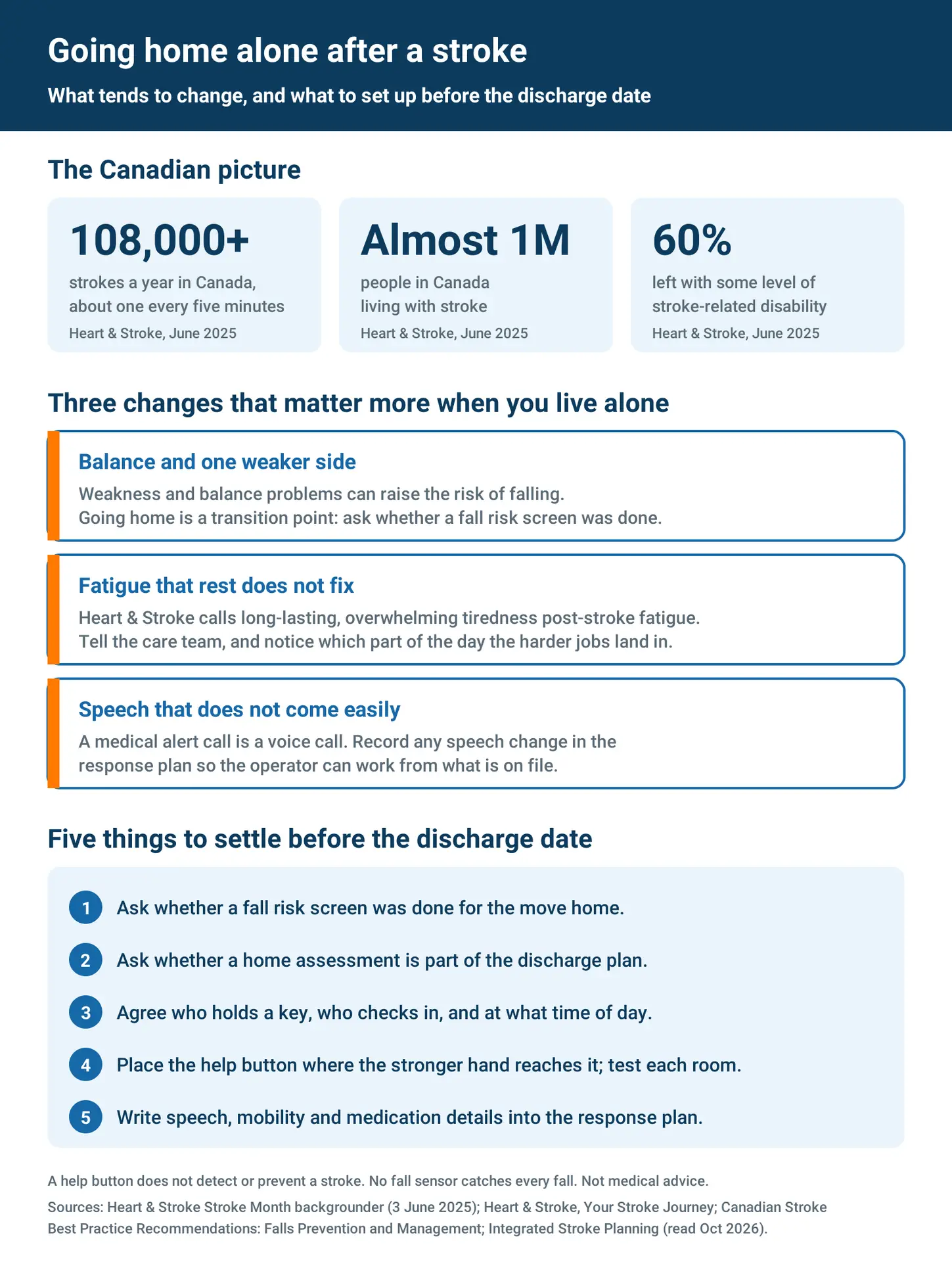
Heart & Stroke’s guide is plain about it: weakness and balance problems may put you at risk of falling, and the care team will assess that risk with you.
That deserves attention from anyone heading home alone. Getting more mobile is the whole point of rehabilitation, and it is also when people start doing things on their own again: carrying laundry down the hall, reaching into a low cupboard, getting up in the night.
The Canadian Stroke Best Practice Recommendations, in their current section on falls prevention and management, say everyone with stroke should be screened for fall risk, including their history of falls, at admission, at all transition points, after a fall, and whenever their health status changes. Going home is a transition point. If nobody has talked to you about fall risk before the discharge date, ask. Heart & Stroke’s guide adds a practical line of its own: if the team gives you a mobility device such as a walker, use it.
A fall in an empty house brings a second problem, which is the time spent on the floor before anyone knows. Our page on the long lie after a fall sets out what the research says about it.
If Parkinson’s is also part of the picture, our page on Parkinson’s and falls when living alone covers freezing and balance in that condition.
Heart & Stroke describes low energy, in body and in mind, as one of the invisible after-effects of a stroke. Feeling tired for a few weeks is normal. When the tiredness becomes long-lasting, intense and overwhelming, and does not get better with rest, it is called post-stroke fatigue.
For someone who lives alone, fatigue changes the timing of risk. A shower at the end of a long day is a different job from the same shower at ten in the morning. Tell your care team about the fatigue rather than quietly planning around it.
Planning a parent’s return home after a stroke? Call the Bedford team at 1-888-755-3055 and talk it through with a Bedford advisor in a complimentary consultation by phone. We will ask about the house and which hand your parent relies on, and there is no obligation.
Heart & Stroke lists several communication changes that can follow a stroke. With aphasia, you may know what you want to say and still struggle to find the words, use the wrong word, or misunderstand what others are saying. Dysarthria makes speech slurred. Apraxia of speech can make it sound jumbled. Heart & Stroke notes that these changes may be temporary and improve quickly, and that for some people they are long-lasting or permanent.
Now consider what a medical alert call is. It is a voice call. On a Bedford in-home system, the operator speaks to you through a two-way speaker on the base unit.
So what happens if you press the button and cannot explain yourself?
At Bedford, the operator does not assume a silent or unclear call is a false alarm. They follow a set procedure, and your personalized response plan takes over: the contacts, the order they are called in, and the medical information recorded in advance. Our page on what happens when you press a medical alert button walks through that sequence step by step.
This is the best reason we know to fill in the response plan carefully. If speech is unreliable, make sure that is recorded with your medical information, so the operator works from what the plan says rather than from what you can manage to say on the day.
A help button only works if a hand that still works can reach it. With one-sided weakness, a button on the weaker wrist can be awkward to press with the other hand. A pendant sits at the centre of the chest, where either hand can find it. Which arrangement suits you is a good question for the occupational therapist, who has watched how your hands are working.
Some specifics from our own equipment. On the Bedford Home Freedom system, the Mini Pendant can be worn as a pendant or on a wristband, and both it and the Fall Detection pendant are fully waterproof, so the button can stay on in the shower. It works up to 800 feet from the base unit. The speaker is in the base, so the base belongs in the room where you spend most of the day. Once it is installed, press the button from the bedroom and the bathroom and make sure you can hear the operator and be heard.
If grip strength is the issue, Bedford offers help buttons that are easier to trigger, which we suggest for people with more advanced arthritis. Ask whether one fits your situation. Our page on accessible medical alert devices covers what can be adjusted on the device itself.
Automatic fall detection is available as an option. The Fall Detection pendant is worn as a necklace, and its sensors look for movement patterns that may indicate a fall, so a call can begin without a button press. No sensor on the market catches every fall, and fall detection says nothing at all about a stroke. Treat it as a layer on top of the button, never a replacement for it.
Heart & Stroke’s guide notes that having a stroke or a TIA (a transient ischemic attack, sometimes called a mini-stroke) puts a person at higher risk of having another one. The FAST signs, and Heart & Stroke’s instruction to call 9-1-1 right away, are set out on our page about when to press a medical alert button. We will not repeat them here.
One point from that page bears repeating for anyone living alone. If speech is one of the things affected, a phone call may be the hardest thing in the house to make, and a button that reaches an operator with your plan already on file asks less of you.
Most of these take one conversation. Do them while the care team is still close at hand.
Bedford Medical Alert is Canadian owned and operated, with 24/7 monitoring based in Canada and operators who follow a personalized response plan for each person. We are a member of the Ontario Community Support Association. We are trusted by clinicians across Canada and have supported hospital education programs and research initiatives from UHN Toronto Rehab to Trillium Health. Canadian families have given us a 4.9-star Google rating, and Bedford brings three generations of experience to this work.
The terms are plain. Equipment is included with the subscription, so there is no device to buy. Plans typically run month to month after a three-month minimum at the start, with optional six or twelve month initial terms if the savings suit you. Service reverts to month to month afterwards, and there are no cancellation fees. Easy Setup means the system is ready to use quickly.
For a stroke survivor going home to an empty house, the Bedford Home Freedom in-home system keeps a waterproof help button within reach of the stronger hand, with a two-way speaker base and optional fall detection. Call 1-888-755-3055 and we will set it up around the rooms you actually use.