
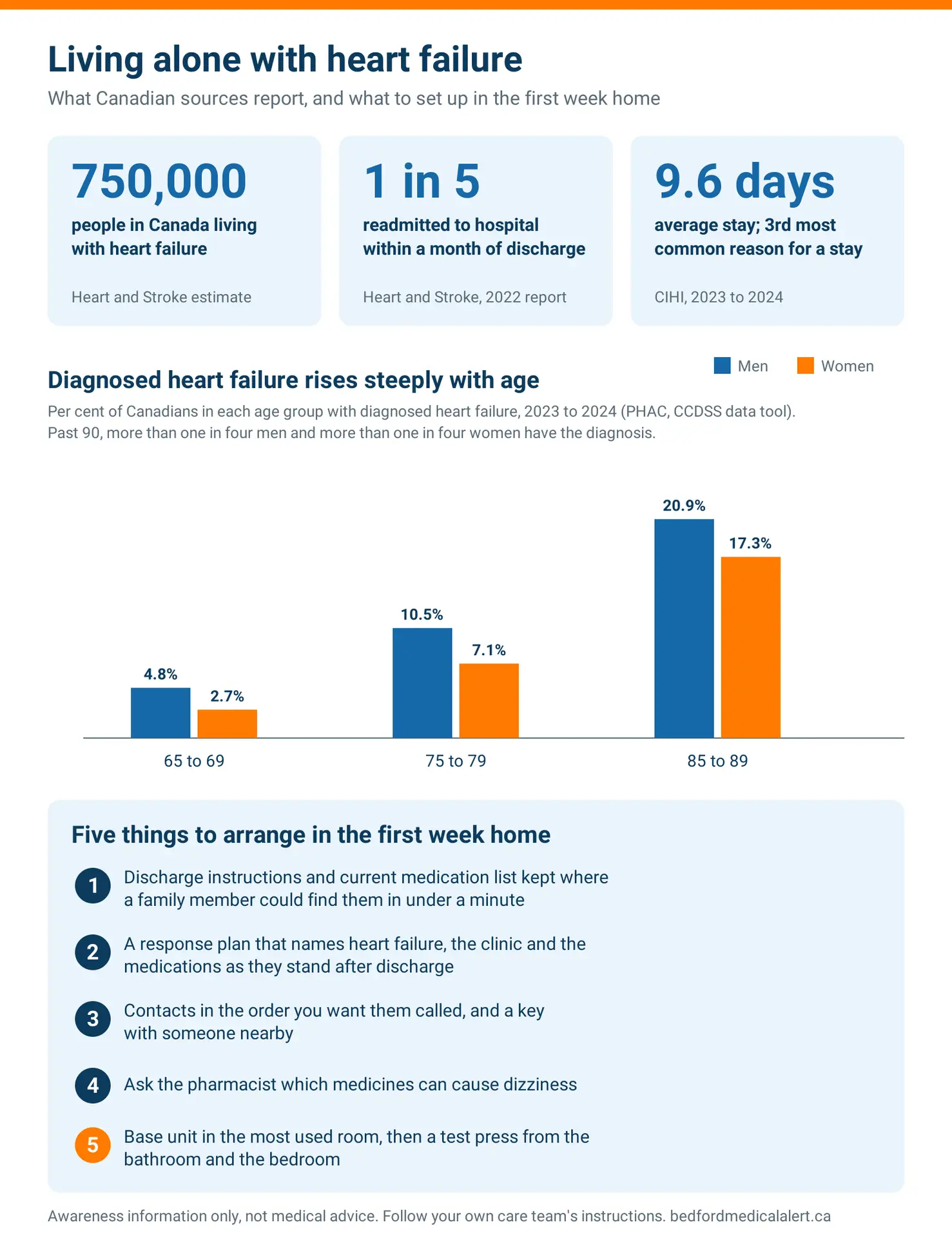
One in five. That is how many people with heart failure are readmitted to hospital within a month of being discharged, according to Heart & Stroke’s 2022 report on the condition, Falling short.
The report does not say who was waiting at home for those patients. It does not need to. In a house with two people in it, someone usually notices the first evening that goes wrong. For a person who lives alone, that someone has to be arranged in advance.
We are Bedford Medical Alert®, a Canadian medical alert provider, and this page is about that arrangement. It covers the first weeks home, the tired days, the night, and how to reach a person quickly when something is wrong. A help button does not detect a cardiac event or a worsening of heart failure, and it does not treat anything. It is a way to reach someone. None of this is medical advice. Your cardiologist, heart function clinic, family doctor and pharmacist know your heart, and their instructions come first.
Heart & Stroke estimates that about 750,000 people in Canada are living with heart failure. Its 2022 report adds that the condition has no cure, and that “dealing with heart failure can feel very isolating, frustrating and all-consuming.”
The Canadian Institute for Health Information’s report Hospital stays in Canada, 2023 to 2024, released 20 February 2025, ranks heart failure as the third most common reason for an acute hospital stay in the country, behind giving birth and COPD with bronchitis. The average stay for heart failure was 9.6 days, the longest of the three.
Age matters a great deal. The Public Health Agency of Canada’s Canadian Chronic Disease Surveillance System data tool gives the crude prevalence of diagnosed heart failure by age and sex for the 2023 to 2024 fiscal year. At ages 65 to 69 it was 4.8 per cent of men and 2.7 per cent of women. At 75 to 79 it was 10.5 per cent of men and 7.1 per cent of women. At 85 to 89 it was 20.9 per cent of men and 17.3 per cent of women, and past 90 it was more than one in four for both. The shape is steep.
Discharge from a heart failure admission usually comes with paperwork: a medication list that may have changed, follow-up appointments, and a set of daily self-care instructions. Heart & Stroke publishes its own self-care guidance for people with heart failure, and many heart function clinics hand out a written routine. We will not restate any of it here. Your routine is the one your team gave you, and it may differ from a general page for good reasons.
What living alone changes is who else knows the routine exists.
If a daughter in Ottawa or a son two hours away is part of the picture, they can only help if they know what the discharge instructions say and which changes the care team asked to hear about. Put a copy of the instructions where a family member or a neighbour with a key would find it. Put the clinic’s phone number on the same sheet.
Our page on coming home from the hospital has the general discharge checklist, from the ride home to the first follow-up appointment. Everything there applies to a heart failure discharge too.
Heart & Stroke’s report states that more than 40 per cent of people with heart failure have cognitive impairments. It also lists “new experience of cognitive impairment (confusion and trouble thinking clearly)” among the symptoms on its heart failure page.
For a medical alert call, that matters in a specific way. When someone presses a Bedford button, the operator works from a personalized response plan set up in advance. As our page on what happens when you press a medical alert button explains, that plan holds the person’s medical information, the medications they take, where a spare key is kept, and the emergency contacts in the order they want them called. If a call is silent or unclear, the operator does not assume it was a false alarm. They follow a set procedure and the plan takes over.
So the plan should say heart failure, plainly, along with the cardiologist or clinic name. And it should be updated after any hospital stay that changed the medications. A tired, foggy evening is the worst time to be spelling out a drug list over a speaker.
Coming home after a heart failure admission, or worried about a parent who lives on their own with it? Call the Bedford team at 1-888-755-3055 for a complimentary consultation by phone. We will ask about the home, the medications that changed at discharge and who should be called first, and there is no obligation.
It is easy to assume heart failure means more falls. The research is less tidy than that.
A systematic review by Bourke and colleagues, published in The Journals of Gerontology: Series A in 2023, looked at cardiovascular disorders and falls in older adults across 184 studies. For heart failure specifically, 23 observational studies were included. Fifteen found no association with falls and eight found a positive one. The four largest studies, each with more than 10,000 participants, split two and two. The authors note that most of the evidence is observational and that firm conclusions about cause are not possible.
That does not mean falls are off the table. Tiredness is on Heart & Stroke’s symptom list for heart failure, and its report notes that fatigue, shortness of breath and other symptoms can limit physical and social activities. Many people with heart failure also take medicines that act on blood pressure or fluid. Our page on medications that increase fall risk covers how some heart and blood pressure drugs, and diuretics in particular, can lead to dizziness on standing or hurried bathroom trips. Ask your pharmacist which of yours fall into those groups. Do not stop or change a heart medication on your own.
Two items on Heart & Stroke’s symptom list are night-time ones: shortness of breath that is worse lying flat, and increased urination at night. What either one means for you is a question for your care team.
The practical side is easier to plan.
A night of extra trips to the bathroom is a night of walking half awake through a dark hallway, often more than once. For someone alone, a fall on one of those trips can mean hours on the floor before anyone knows. Night lights along the route help. So does keeping the help button on through the night rather than on the nightstand.
The Bedford Home Freedom system is an in-home setup: a wearable button and a base unit with a two-way speaker. The button works up to 800 feet from the base. The base connects by landline or VoIP, or by an LTE cellular option, needs no Wi-Fi, and has a battery backup for power outages.
The Mini Pendant can be worn around the neck or on a wristband, and the pendants and wristbands are waterproof, so the button can stay on in the shower and in bed. If two people in the house both need one, more than one pendant can be paired with the same base.
Automatic fall detection is an optional upgrade, worn as a necklace pendant. Its sensors look for movement patterns that may indicate a fall, so a call can start without a press. No sensor on the market catches every fall, and fall detection knows nothing about how your heart is doing. Press the button whenever you need help, whether or not you fell.
For chest pain and the other emergency signs, call 9-1-1 directly whenever you can. Our page on when to press a medical alert button sets out when the button is the right tool and when it is not, and we will not repeat it here.
Bedford Medical Alert is Canadian owned and operated, with 24/7 monitoring based in Canada, and our operators follow a personalized response plan for every client. We are a member of the Ontario Community Support Association. We are trusted by clinicians across Canada and have supported hospital education programs and research initiatives from UHN Toronto Rehab to Trillium Health. Canadian families have given us a 4.9-star Google rating, and Bedford brings three generations of experience to this work.
Equipment is included with the subscription, so there is no device to buy. Plans typically run month to month after a three-month minimum at the start, with optional six or twelve month initial terms if the savings suit you. Service reverts to month to month afterwards, and there are no cancellation fees. Easy Setup means the system is ready to use quickly.
For someone living alone with heart failure, the Bedford Home Freedom in-home system keeps a waterproof help button on through the night and in the shower, with a two-way speaker base and a response plan that already knows your medications. Call 1-888-755-3055 and we will set it up around the rooms you actually use.