
A dosette box does not look like safety equipment. For many Canadian seniors it is. Two in three Canadians over 65 are prescribed five or more different drug classes, and about one in four is prescribed ten or more, according to the Canadian Institute for Health Information’s reporting on drug use among seniors (2021 data). Several of the most commonly prescribed classes act on blood pressure, alertness, or reaction time. Those are the systems that keep a person upright.
The Public Health Agency of Canada reports that falls are the leading cause of injury-related hospitalization among Canadian seniors, and that 20 to 30 percent of seniors fall each year. Home hazards get most of the attention in fall prevention, and they matter. We cover them in our guide to fall prevention for seniors at home. Medication is different in one important way: it is one of the few fall risk factors a doctor or pharmacist can actually adjust.
The connection is rarely dramatic. It shows up as a half-second of unsteadiness.
Some medications cause drowsiness or slow reaction time, so a stumble that a person would normally catch becomes a fall. Some cause dizziness or blurred vision. Others lower blood pressure, and if the pressure dips when a person stands up (doctors call this postural hypotension), the room can tilt for a moment. Diuretics add urgent trips to the bathroom, sometimes at night, on a route walked in the dark. For someone taking them for heart failure and living alone, our page on living alone with heart failure covers the nights. None of these effects mean a medication is wrong for the person taking it. They mean the medication list and the fall risk belong in the same conversation.
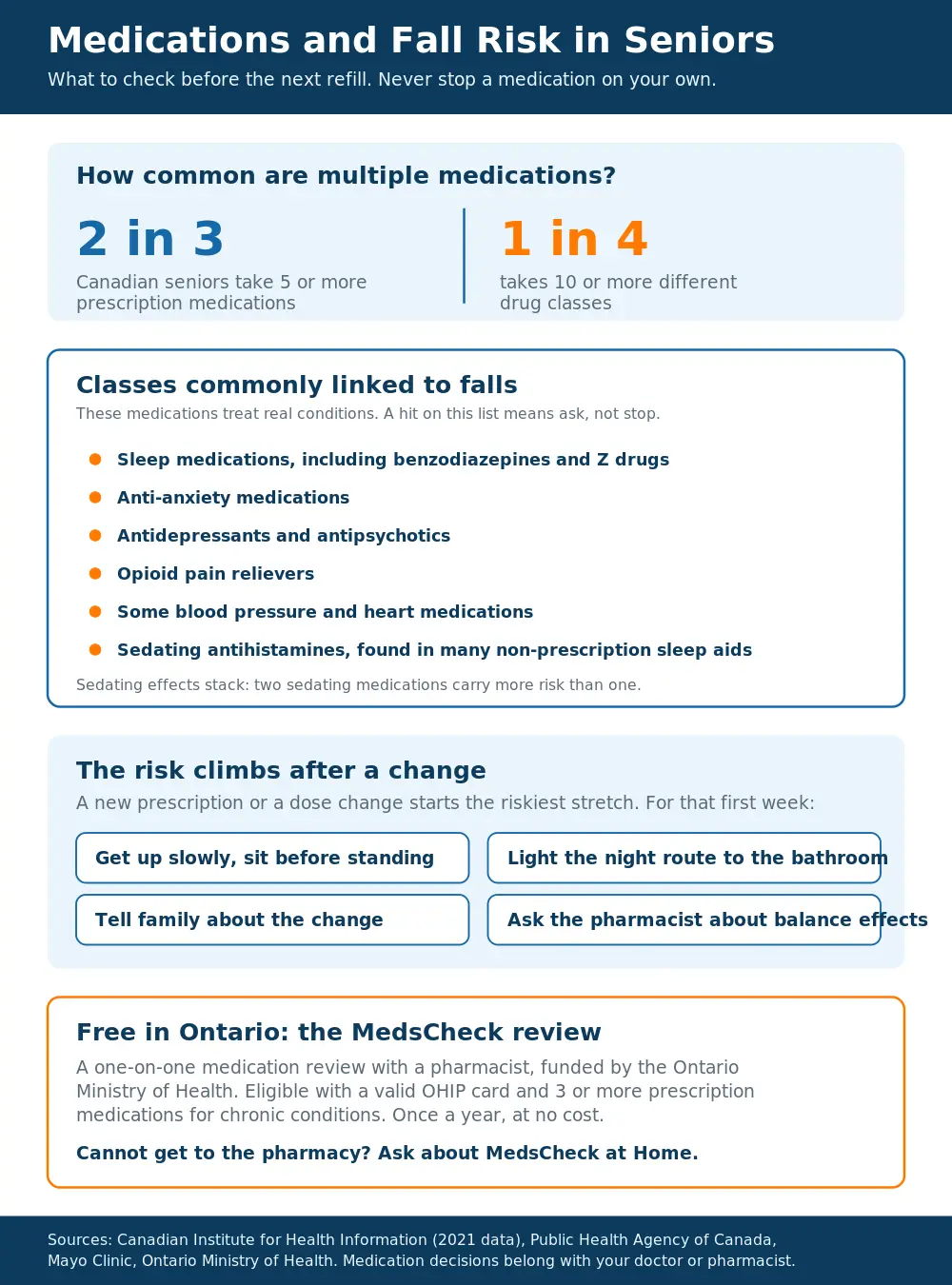
Mayo Clinic’s guidance on medicines that increase fall risk in older adults points to a consistent set of classes. Sleep medications, including benzodiazepines and the newer Z drugs. Anti-anxiety medications. Antidepressants. Antipsychotics. Opioid pain relievers. Some blood pressure and heart medications. Older antihistamines with sedating effects, which appear in many over-the-counter sleep and allergy products, are on the list too.
Two things about that list are easy to miss. First, it includes non-prescription products, so the pharmacist should hear about everything in the cabinet, not just what is on file. Second, sedating effects stack. Mayo Clinic notes that an older adult taking two sedating medications is at greater risk than someone taking one.
If a medication on this list is part of your routine, that is a reason for a conversation, not a change. These drugs treat real conditions, and stopping one abruptly can be far more dangerous than continuing it. Nothing on this page is medical advice. Decisions about any medication belong with your doctor or pharmacist. Sleep medications in particular have a safer path worth asking about, and we have written before about how night-time security affects senior sleep without a pill being involved.
Fall risk from a medication is not constant. Mayo Clinic notes it climbs after a new prescription or a dose change, before the body adjusts and before anyone knows how this particular person responds.
That first week deserves some plain, practical caution. Get up slowly, and sit on the edge of the bed for a moment before standing. Leave a light on along the night route. Mention the new prescription to family so someone is checking in. Ask the pharmacist what side effects would matter for balance and when in the day to take the dose. Small adjustments, one risky week, and then it is routine.
Beyond any single drug, the number of daily medications carries its own risk. A systematic review of community-dwelling older adults (indexed on PubMed Central, PMC5864570) found that people taking four or more prescription medications daily had roughly 1.5 to 2 times the risk of recurrent falls. More medications mean more possible interactions, and interactions are where side effects like dizziness tend to multiply.
The point is not that anyone is taking too many pills. Chronic conditions are real, and so are the prescriptions that manage them. The point is that a list that long has usually been assembled by several prescribers over several years, and it deserves a scheduled review by one professional who sees the whole picture.
Sorting out a parent’s safety while the medication questions get answered? Bedford’s Canadian care team is happy to talk through how monitoring fits alongside a medication routine, in plain language and with no obligation. Call 1-888-755-3055 any time.
Ontario funds exactly the review described above. Through the Ministry of Health’s MedsCheck program, anyone with a valid OHIP card who takes three or more prescription medications for chronic conditions can book a one-on-one review with a pharmacist, once a year, at no cost. There is a MedsCheck at Home version for people who cannot physically get to the pharmacy, which is often the same group most worried about falls.
Bring the full picture to that appointment: prescriptions, over-the-counter products, vitamins, and supplements. Ask directly which items on the list are associated with falls and whether timing or alternatives are worth discussing with the doctor. The Canadian Deprescribing Network, a national group of researchers and clinicians focused on safer medication use in older adults, publishes plain-language handouts that are useful preparation for exactly this conversation. Outside Ontario, ask your pharmacy what medication review services your province funds; several have their own versions.
Keep every prescription at one pharmacy where possible. Interaction checking works best when one system sees the whole list.
Keep a current written medication list somewhere a paramedic would find it, like the fridge door. In an emergency, the minutes saved answering “what is she taking” are real. This is also part of how we work: Bedford Medical Alert® monitoring operators follow a personalized response plan for each customer, so the person answering an alert already knows who to call and what matters for that household. A current medication list at home completes that chain for the responders who arrive.
And after any hospital stay or specialist visit, assume the list changed. Confirm what was added or stopped before the first refill, not after.
A monitoring service does not prevent a fall, and we will not tell you otherwise. What it changes is what happens next, especially for someone who lives alone and is adjusting to a new prescription.
A help button that is worn day and night, including in the shower, means dizziness on the bathroom floor at 2 a.m. is a pressed button and a voice from our 24/7 Canadian monitoring centre, not hours on the floor waiting for the morning phone call. If the person’s eyesight is also failing, our page on living alone with low vision covers a help button you can find by touch. Some Bedford devices also include automatic fall detection, which in general terms uses motion sensors to recognize the signature of a hard fall and open a call to an operator on its own. No fall detection technology can guarantee that every fall will be detected, which is why we explain how automatic fall detection works in plain terms rather than promises. The right device depends on the person’s routine, and our short guide to which medical alert device is right for you walks through the fit questions families actually ask.
A medication review costs nothing in Ontario. A written list on the fridge costs a sheet of paper. Both make the next fall less likely or less lonely, and neither requires anyone to give up the treatment they need.
Bedford brings three generations of experience to helping Canadian seniors stay safely independent. Families rate the service 4.9 stars on Google, we are an OCSA member, and we are trusted by clinicians across Canada, having supported hospital education programs and research initiatives from UHN Toronto Rehab to Trillium Health. There are no long-term contracts and no cancellation fees, the equipment is included with the subscription, and Easy Setup means the system is working the day it arrives.
Ready to add a layer of safety at home? See how the Home Freedom in-home system works, or call our Canadian team 24/7 at 1-888-755-3055. Equipment included, no long-term contract, Easy Setup.