
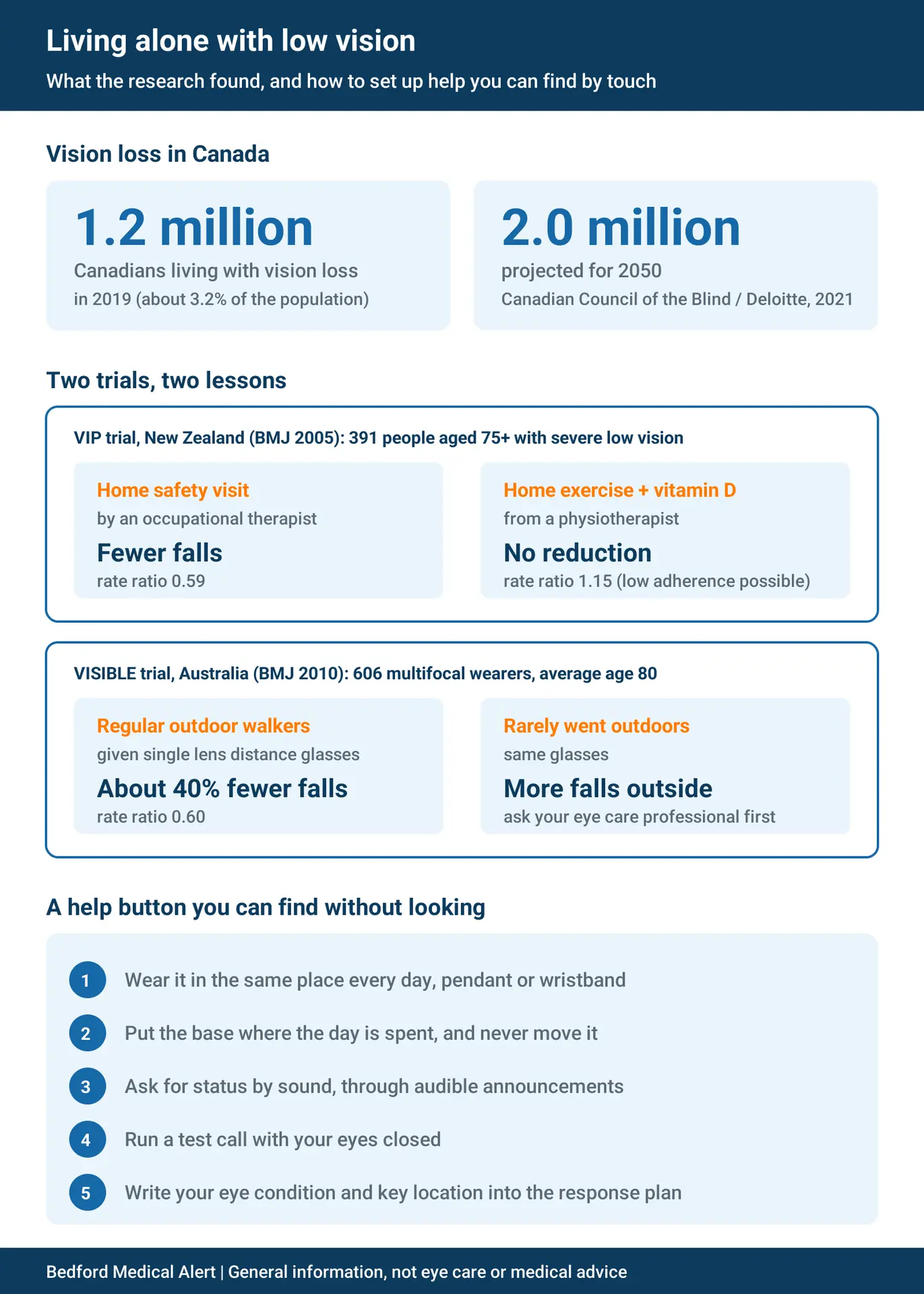
In an Australian trial published in the BMJ in 2010, older adults who wore multifocal glasses were given a second pair: plain single lens glasses for distance, to use when walking outside. Among the people who got out and about regularly, falls dropped by about 40 per cent.
Among the people who rarely went outdoors, the same glasses led to more falls outside.
That result says something useful about living alone with low vision. The fix that helps one person can trip up the next, so the setup at home has to fit the person who lives there. We are Bedford Medical Alert®, a Canadian medical alert provider, and this page covers what the research says about vision loss and falls, the changes that have been tested, and how to set up a help button that works when you cannot see it. It is general information, not eye-care or medical advice.
A 2021 report commissioned by the Canadian Council of the Blind from Deloitte Access Economics, The Cost of Vision Loss and Blindness in Canada, estimated that 1.2 million Canadians were living with vision loss in 2019, about 3.2 per cent of the population. Its projection for 2050 is 2.0 million.
The report links vision loss in Canada to five major causes: age-related macular degeneration, cataracts, glaucoma, diabetic retinopathy, and a group of other conditions. Most of these become more common with age. Its introduction, citing earlier research, puts the stakes for older people plainly: “Seniors with VL face twice the risk of falls, four times the risk of hip fractures” and they are admitted to nursing homes “an average of three years” earlier than they otherwise would be.
For someone who lives alone, those numbers come down to a single question. If you fall in the hallway at night, how do you reach help?
A trial designed specifically around falls in people with poor eyesight is the VIP trial, published in the BMJ in 2005 by A. John Campbell and colleagues. It enrolled 391 people aged 75 and older in Dunedin and Auckland, New Zealand, all living in the community with visual acuity of 6/24 or worse.
Participants were assigned to one of four groups:
| Group | What they received | Result for falls |
|---|---|---|
| Home safety | A home safety programme delivered by an occupational therapist | Fewer falls (rate ratio 0.59) |
| Exercise | A home exercise programme from a physiotherapist, plus vitamin D | Not effective (rate ratio 1.15) |
| Both | Home safety and exercise | Not reported as a separate group in the abstract |
| Social visits | Visits with no safety or exercise content | The comparison group |
The home safety programme cut falls by roughly 40 per cent. The exercise programme did not reduce falls in this group, and the authors suggest low adherence may be part of why. A conservative analysis found that neither programme reduced injuries from falls.
The change that worked here was a trained person walking through the home with them. Our guide to fall prevention at home covers what that kind of walk-through looks for, room by room.
The VISIBLE trial from Sydney and the Illawarra (Haran and colleagues, BMJ 2010) enrolled 606 regular multifocal wearers with an average age of 80. Overall, single lens distance glasses brought an 8 per cent drop in falls, which was not statistically significant. The benefit showed up in one group only: people who took part in regular outdoor activities, whose falls of all kinds fell by about 40 per cent. People with little outdoor activity had a significant increase in falls outside.
The authors concluded the approach works for active older wearers “with appropriate counselling” and may harm those who rarely go out. That is a conversation for an optometrist or ophthalmologist, who knows your eyes and your routine. We mention it because many people never think to ask whether the glasses they wear for reading are the right ones for the front steps.
Indoors, light and contrast do a lot of quiet work: a lit path from the bed to the bathroom, a strip of contrasting tape on the edge of a step, no loose mat at the top of the stairs. Our bathroom and night-time safety guide goes room by room.
A help button that has to be found by sight is the wrong button for this household. Our page on accessible medical alert devices explains how the status channels change for someone with low vision: equipment status can arrive as speech, through audible announcements, instead of through lights. Here we focus on the button itself.
On a Bedford Home Freedom system, the help button comes as a pendant or a wristband, and both are waterproof. A single press connects you to our 24/7 monitoring centre, and the button works up to 800 feet from the base unit. Its battery is rated for about five years, so there is no small battery door to find by feel.
Choose by habit. Someone who reaches for their chest when startled may do better with a pendant. Someone who keeps their hands busy may find a wristband easier to locate. Wear it in the same place every day, so your hand learns where it is.
The base has a large, easy-to-reach help button of its own and a two-way voice speaker, so you can talk with the operator from across the room. It plugs into a standard outlet and has battery backup for a power outage. Put it where you spend most of the day, on a surface that never gets cleared off, and leave it there.
Once it is set up, practise. Our page on how to test a medical alert system walks through a test call, and doing it with your eyes closed is a good check.
Setting up for someone with low vision? Call us at 1-888-755-3055 for a complimentary consultation by phone. Tell us which hand is steadier, where the day is spent, and whether a pendant or a wristband would be easier to find, and we will talk it through with you.
The operator who answers does not need you to read anything. Before service starts, we record a response plan: your medical information, the medications you take, where a spare key is kept, your emergency contacts and the order you want them called. When you press the button, the operator follows that plan.
If you cannot answer, the operator does not assume it was a false alarm. For a minor problem, the call might go to a family member or a neighbour who can come over. For a possible emergency, the operator can dispatch emergency services and pass along what is in your file, including how to get in. For someone who cannot see who is at the door, a key arrangement written into the plan matters more than usual. The full sequence is on our page about what happens when you press a medical alert button.
Vision rehabilitation teaches practical skills for living with the sight you have. One Canadian organization that provides it is Vision Loss Rehabilitation Canada, which describes its staff as certified specialists and is CARF Canada accredited. A community directory listing for its Halton-Peel region (last updated February 2026) lists services that include:
The same listing says the service is for “individuals of any age experiencing vision loss that is affecting their independence, safety, and mobility,” that a referral can come from an eye health care professional or you can refer yourself, and that recent information on your vision history is needed from an eye care professional. The directory listing shows no fee. The organization’s website has a location finder for offices near you. It is also an authorized service provider for Veterans Affairs Canada.
Bring the answers home and add them to the response plan. A note such as “glaucoma, poor side vision” tells an operator and a paramedic something useful before they reach you.
Bedford Medical Alert is Canadian owned and operated, with 24/7 monitoring based in Canada, and our operators follow a personalized response plan for every client. We are a member of the Ontario Community Support Association. We are trusted by clinicians across Canada and have supported hospital education programs and research initiatives from UHN Toronto Rehab to Trillium Health. Canadian families have given us a 4.9-star Google rating, and Bedford brings three generations of experience to this work.
Equipment is included with the subscription, so there is no device to buy. Plans typically run month to month after a three-month minimum at the start, with optional six or twelve month initial terms if the savings suit you. Service reverts to month to month afterwards, and there are no cancellation fees. Easy Setup means the system is ready to use quickly.
A button you can find in the dark. Bedford’s Home Freedom system pairs a waterproof help button, worn as a pendant or on the wrist, with a two-way voice base, and our Canadian monitoring centre answers 24/7. There are no long-term contracts. See how Home Freedom works or call 1-888-755-3055.