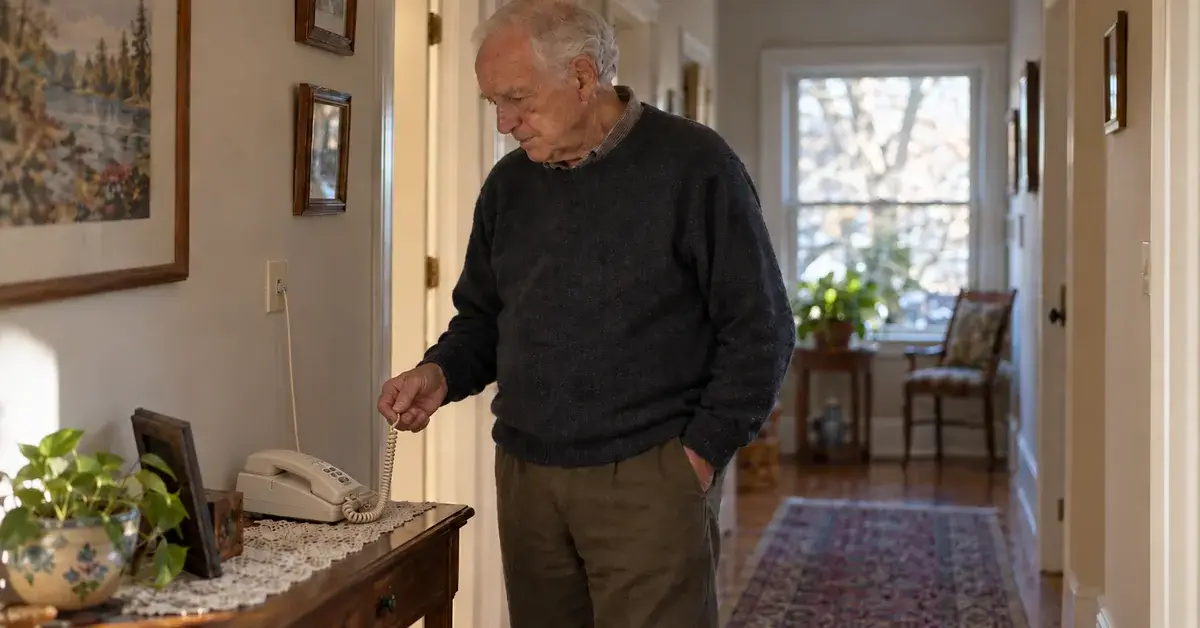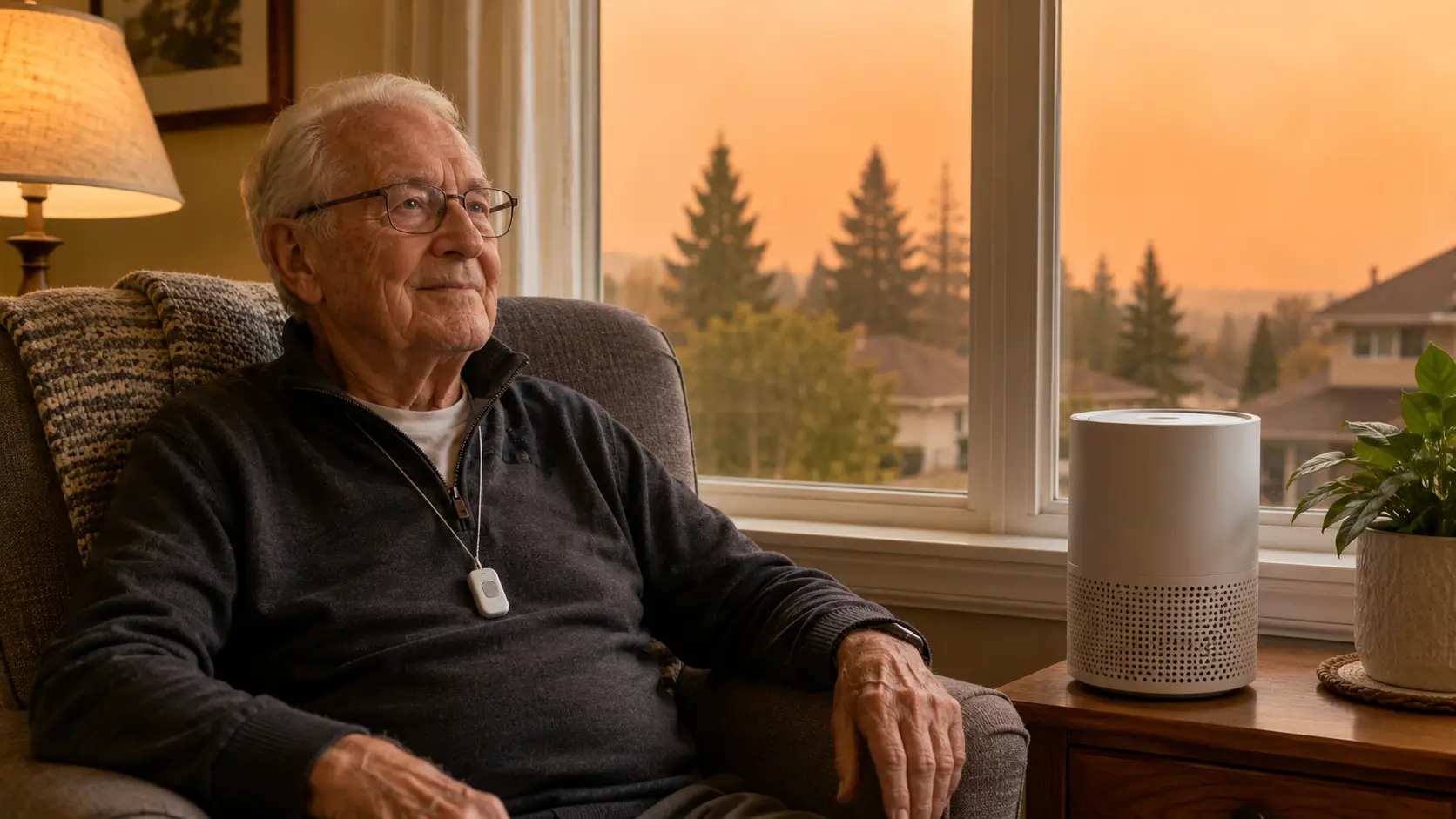
By late June, the sky over much of Canada can turn the colour of weak tea. Wildfire smoke drifts hundreds of kilometres from the fires that make it, and the air outside a home in Toronto or Kelowna can carry a health warning even when there is no flame in sight. For an older adult who lives alone, a smoky stretch is more than uncomfortable. It can mean several days indoors with the windows shut and no visit from a neighbour or an adult child. At Bedford Medical Alert®, the check-ins we handle shift on those days, and so does what families ask us about.
This guide is about staying safe and connected indoors when the air outside is dangerous, with a focus on the people it affects most: seniors, and anyone living with a heart or lung condition. It is not medical advice. For health questions, follow the guidance of Health Canada and your own doctor. What a medical alert device can do here is narrow, and worth being honest about. It does not clean the air or prevent a smoke-related illness. What it does is make sure that if something goes wrong while someone is alone, help is one button away.
Why wildfire smoke is harder on older bodies
The real hazard in wildfire smoke is not the grey haze you can see. It is fine particulate matter, called PM2.5, small enough to travel deep into the lungs and pass into the bloodstream. Health Canada notes that these particles are not visible to the eye, and that for some of the pollutants in smoke there is no known safe level of exposure. Smoke can affect health even when the air looks only faintly hazy.
Age changes the math.
Health Canada identifies adults 65 and older as a group at increased risk of both respiratory and cardiovascular effects from smoke, alongside people living with asthma, COPD, or heart disease. A second layer of risk has little to do with the lungs. An older adult who lives alone, has limited mobility, lacks air conditioning or good filtration, or has trouble getting to medical care can be more vulnerable once smoke settles in for days, in part because it is harder to control the air in the home and harder to reach help. Those circumstances describe a great many of the people Canadian families ask us to help watch over. If COPD is the reason smoke matters in your house, our page on living alone with COPD covers flare-ups, balance and reaching an operator when breath is short.
What the Air Quality Health Index is telling you
Canada has a national scale for this, and learning to read it takes about a minute. The Air Quality Health Index, or AQHI, is produced by Environment and Climate Change Canada. It blends three pollutants that matter for health: ground-level ozone, nitrogen dioxide, and the fine particulate matter that dominates wildfire smoke.
The AQHI runs from 1 to 10+, in four bands. A reading of 1 to 3 is Low Risk, 4 to 6 is Moderate Risk, 7 to 10 is High Risk, and anything above 10 is Very High Risk. Environment Canada advises that at-risk groups, which include older adults and people with heart or lung conditions, start taking precautions earlier than the general population, around a reading of 4, and then adjust based on their own symptoms. If a senior notices coughing or breathlessness at a certain level, that level becomes their personal signal to stay in and take it easy.
Check the current number for almost any Canadian community on the Environment Canada weather site or through a local air quality alert. On a smoky day, look in the morning and again in the afternoon, because the reading moves with the wind.
Caring for an older parent who spends smoky days alone indoors? Bedford’s Home Freedom system keeps 24/7 Canadian monitoring one button away, right where they are sheltering. Call us at 1-888-755-3055 to talk through what would help.
Getting the home ready before the smoke arrives
When an air quality alert shows up in the forecast, a few steps make an indoor day safer. Public-health guidance from Health Canada points in a consistent direction. Keep windows and doors closed. Set up one room that is easiest to keep clean, ideally with a portable HEPA air cleaner sized for the space, and run air conditioning on the recirculate setting if it is available. Avoid adding to the indoor particle load, which means no candles, no frying, no wood stove, and no smoking inside.
Stocking up matters more than it sounds. If a few days of easy meals and the current medications are already in the house, a senior does not have to head out into the worst of the air to run errands. Keep prescriptions filled ahead of a smoky spell, and keep any rescue inhaler or heart medication within easy reach rather than in a far cupboard.
Staying put at home is usually the safest choice during a smoke event, and it is how many of the people we serve prefer to live anyway. Our overview of aging in place in Canada looks at the wider picture of doing that safely. Canadian families already build plans for winter storms and power outages, something we covered in our guide to emergency preparedness for Canadian winters. Smoke season deserves the same kind of plan.
This is also the moment to make sure any medical alert equipment is charged and worn. Bedford’s Home Freedom base unit and help button use Easy Setup and work throughout the home, so the pendant keeps working in whichever room becomes the clean-air room.
The quiet problem: days alone with the doors shut
Smoke events do something specific to a family’s routine. The daughter who normally drops by after work thinks twice about driving through heavy smoke. The neighbour who usually knocks stays home. A senior who is otherwise seen by someone most days can go the better part of a week with the doors shut and no visitors, at exactly the time when a breathing problem or a fall would be hardest for anyone to notice. We hear from adult children about this every smoke season, and it is a fair thing to worry about. If you are the one worrying from a distance, our guide to medical alert systems for caregivers covers practical ways to share the load.
A monitored in-home system is built for that gap. With Bedford’s Home Freedom system, one press of the help button connects to a monitoring station staffed around the clock in Canada, and the operator who answers is working from the personalized response plan set up for that person. Bedford operators follow more detailed response protocols than a generic call centre, so the person on the line already knows who to reach and what matters for that household.
Here is the honest version of what the device changes. It will not filter a single particle of smoke out of the air. What it changes is the answer to the question families actually lose sleep over on bad-air days: if Mom feels unwell or falls while she is alone with the windows sealed, does someone find out, and does help come? With the button on her wrist or around her neck, the answer is yes.
A bad-air-day checklist for families
When the AQHI climbs, a short routine covers most of what matters:
- Check the AQHI in the morning and again later in the day, and keep the person in the clean-air room while it sits at 4 or higher.
- Make sure a few days of food and medications are in the house so no one has to go out.
- Confirm the help button is charged, worn, and within reach, not left on a nightstand.
- Agree on who gets called first, and make sure Bedford’s monitoring team has the current contacts and any health notes on file.
- Phone or video-call once a day when you cannot visit, and watch for new coughing, breathlessness, or confusion, which are reasons to seek medical care.
None of this is complicated. The point is to decide it before the sky turns orange, not during.
Peace of mind when no one can be in the room
Wildfire smoke is becoming a regular part of the Canadian summer, and the people it affects most are often those already living with a little more risk. Bedford Medical Alert is Canadian-owned and operated, with 24/7 monitoring based in Canada, equipment included in the subscription, and no long-term contract. Bedford is recommended by doctors and hospitals, holds a 4.9-star Google rating, is an OCSA member, and brings three generations of experience to the families it serves. A smoky week is easier to face when someone is watching out, even on the days when no one else can be in the room.
Make sure help is always within reach, on smoky days and every other day. Bedford’s Home Freedom in-home system includes the equipment, connects to 24/7 Canadian monitoring, and comes with no long-term contract. See how Home Freedom works, or call 1-888-755-3055 to get started.
By Eryn