The first icy morning of the season tends to arrive before anyone has found the good boots. For an older adult, that morning carries more risk than it looks: the walk to the mailbox, the two steps down from the side door, the bus stop that nobody has sanded yet. This post sets out what the Canadian data says about winter falls, the steps public health units recommend for ice and snow, and where a monitored alert from Bedford Medical Alert® fits once the boots are on. It replaces an earlier version of this post from January 2025; the figures and sources below were read on 24 October 2026.
What the Canadian numbers say about falls, and about winter
The Public Health Agency of Canada keeps a running summary of fall statistics for adults 65 and older, last updated in November 2025. In 2022, 7,621 Canadians in that age group died of a fall, and deaths from falls rose 51 percent between 2017 and 2022. In the 2022 to 2023 data year there were 78,076 fall-related hospital admissions among older adults outside Quebec, and about a third of them, 34 percent, involved a hip fracture. Sixty-one percent of the falls that injured an older adult happened while walking.
Winter adds its own layer. A Public Health Agency of Canada study published in December 2021 examined 761,853 emergency department visits for falls in Ontario during the winter months, November to March, from 2011 to 2015. On days with a snowfall of at least 0.2 centimetres, the odds of a fall-related emergency visit were 5 to 8 percent higher than on days with no snow, and the increase lasted for most of the week that followed. The authors’ explanation is thaw and refreeze: the ice that forms a few days after the snow is what people slip on. Milder winter days were riskier than deep-cold ones. Days averaging between about minus nine and three degrees carried higher odds than warmer days, while days colder than minus nine carried slightly lower odds, most likely because people stay in. Adults 65 and older accounted for just under 30 percent of those visits.
Two things follow. The dangerous day is often not the storm itself but the second or third morning after it, when the sidewalks look clear and are not. And the mild, grey day near zero deserves the same care as the obviously cold one.
Ice and footwear: what the public health units recommend
Ottawa Public Health’s falls prevention page keeps its winter advice short. Choose boots with a wide, low heel and a non-slip sole. If you use a cane, attach a retractable ice pick to it, and flip the pick up when you come indoors, because it is a slip hazard on a hard floor. Keep entrance ways, walkways, stairs and driveways clear of ice and snow. Carry a small bag of grit, sand or non-clumping cat litter in a pocket and sprinkle it on an icy step, sidewalk or bus stop before you cross it. The Public Health Agency of Canada’s summary makes the same point from the community side: removing snow and ice from public walkways is listed among the measures that prevent falls in older adults.
On the boots themselves, there is Canadian testing worth knowing about. KITE, the research institute at UHN’s Toronto Rehab, runs a WinterLab that recreates sub-zero temperatures, snow and ice-covered surfaces and winds over 70 kilometres an hour inside a controlled laboratory, on a platform that tilts to form slopes, so scientists can study winter slips and falls without putting a study participant on a real icy hill. Its public website, Rate My Treads, publishes independent traction ratings for winter boots and ice spikes by brand and model. If you are buying boots for a parent this year, that list is a better starting point than the label on the box.
A few habits that cost nothing: clear the one step everyone uses before the rest of the walk, keep a pair of indoor shoes by the door so wet soles come off, allow ten extra minutes for anything that involves a parking lot, and treat any surface that shines as ice until a boot proves otherwise. For the house itself, our guide to fall prevention for seniors at home covers the lighting, the mats and the bathroom, which do not change with the season.
If a fall happens anyway, the wait is what matters
Even with good boots and a sanded step, falls happen, and what decides how the winter goes is often what happens in the minutes after one. Outdoors in January, a person who cannot get up is in a different situation from the same fall in July, because the cold adds urgency. We have written separately about the long lie after a fall, the stretch of time on the floor or the ground before help comes, and about what to do after an elderly parent’s first fall, so we will not repeat them here.
Planning the winter for a parent who still walks to the shops? Call our care team at 1-888-755-3055 for a complimentary consultation by phone. We will ask how far they walk, who is nearby and what the home phone is, and tell you plainly which setup fits. Bedford is Canadian-owned, and our monitoring centre is based in Canada and staffed 24/7.
Where a monitored medical alert fits in winter
A medical alert does not prevent a slip, and we would not claim it does. What it changes is the wait. With a Bedford system, pressing the button reaches our monitoring centre in Canada at any hour, and the operator works from a response plan your family set up with us in advance: who is called first, who is next, and when paramedics are sent.
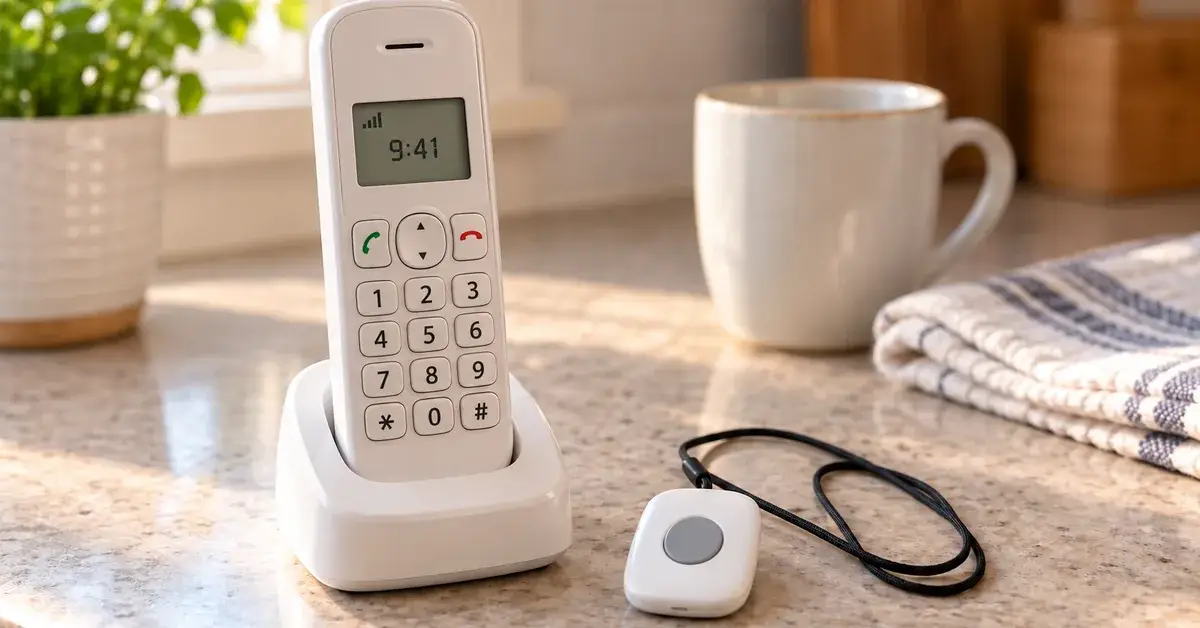
For the walk outside, the device that matters is the Go Anywhere pendant. It carries its own cellular connection and GPS, needs no landline or base unit, and has a built-in help button with two-way voice, so the person who has fallen on a path can speak to the operator from where they are, and the pendant’s location goes to the monitoring centre. It is water-resistant, and the battery runs up to a week without fall detection or up to three days with it, which in practice means charging it overnight like a phone. Coverage requires an available cellular and GPS signal. Automatic fall detection is optional on it: it senses the motion patterns typical of a fall and calls on its own when the wearer cannot press, and no sensor on the market catches every fall, so the button stays the main way to call for help. We say that on the phone too.
At home, Home Freedom is the in-home system: a waterproof pendant or wristband that works up to 800 feet from a base unit with two-way voice and a backup battery, connected through a landline, a VoIP line or an LTE unit, with no Wi-Fi needed. Some households use both through the winter, Home Freedom in the house and the Go Anywhere pendant in the coat pocket for the walk. If an adult child is the one reading this, our post on how to talk to a parent about a medical alert covers the conversation.
On terms: plans typically run month to month after a three-month minimum at the start, with optional six or twelve month initial terms if the savings suit you. Service reverts to month to month afterwards, and there are no cancellation fees. The equipment is included with the subscription.
Bedford brings three generations of experience to this work, is a member of the Ontario Community Support Association, and has supported hospital education programs and research initiatives from UHN Toronto Rehab to Trillium Health. Fall Prevention Month, a Parachute program, is held every November in Canada, which makes the weeks before the first snow a natural time to sort the boots, the sand and the plan. For the storm that keeps everyone indoors for days, our companion post on emergency preparedness for seniors in Canadian winters covers the cold and the power side.
If your parent walks outside through the winter, the Go Anywhere pendant goes with them, with GPS, two-way voice and 24/7 monitoring from Canada; at home, Home Freedom keeps a button within reach in every room. Call 1-888-755-3055 and tell us about the walk and the house; we will match the device to both.
Sources
- Public Health Agency of Canada, “Falls among older adults in Canada,” Health Infobase data blog, last updated 28 November 2025: health-infobase.canada.ca
- Huynh D, Tracy C, Thompson W, Bang F, McFaull SR, Curran J, Villeneuve PJ, “Associations between meteorological factors and emergency department visits for unintentional falls during Ontario winters,” Health Promotion and Chronic Disease Prevention in Canada, volume 41, number 12, December 2021: canada.ca
- Ottawa Public Health, “Preventing Falls,” the Stay Safe in Winter section, read 24 October 2026: ottawapublichealth.ca
- KITE Research Institute, University Health Network, WinterLab and Rate My Treads, read 24 October 2026: kite-uhn.com and ratemytreads.com
- Parachute, Fall Prevention Month, page reviewed 21 April 2026: parachute.ca
- Bedford Medical Alert, the Go Anywhere and Home Freedom product pages linked above