
The adult child usually calls us first. A parent has had a near miss on the stairs, or a sister noticed Dad seemed shaky at dinner, and now a son or daughter is on the phone with Bedford Medical Alert® asking the same thing: how do I bring this up without starting a fight?
It is one of the most common questions our Canadian care team hears, and it is a fair one. A medical alert can turn a frightening wait for help into a short one, but only if a parent actually agrees to wear it. That agreement starts with a conversation, not a purchase. Here is what tends to work, drawn from years of these calls.
Picture the suggestion from your parent’s side. You are handing them a device that, in their mind, sorts people into those who can still manage and those who cannot. Independence, privacy, and pride are all wrapped up in one small button, so a practical safety idea can land as a verdict on how they are aging.
The numbers back up that instinct. AGE-WELL, Canada’s technology and aging network, had Environics Research poll 2,026 Canadians aged 50 and over in July 2020. Almost seven in ten said they would pay out of pocket for technology that allows them to stay at home as they age, and 72 percent of those aged 65 and over said they feel confident using current technology. In the same poll, 46 percent were significantly or somewhat more concerned about moving to a nursing home. AGE-WELL’s own reading of its results: older adults are not technophobic, and they are receptive to technology that lets them stay in their own homes. Read together, those answers point at the real subject of the conversation, which is not the device but the home.
It helps to hold the real stakes in view. The Public Health Agency of Canada reports that falls are the leading cause of injury-related hospitalization among Canadian seniors, and that between 20 and 30 percent of older adults fall each year. Those are not rare events.
But a parent who has never fallen, or who fell once and got right back up, often does not see themselves in that number yet. If you have started noticing changes at home, our note on when a loved one may be at risk of a fall can help you tell a genuine worry apart from ordinary caution. If what you are noticing goes beyond balance, our guide to recognizing self-neglect without taking over covers the warning signs and how to raise them.
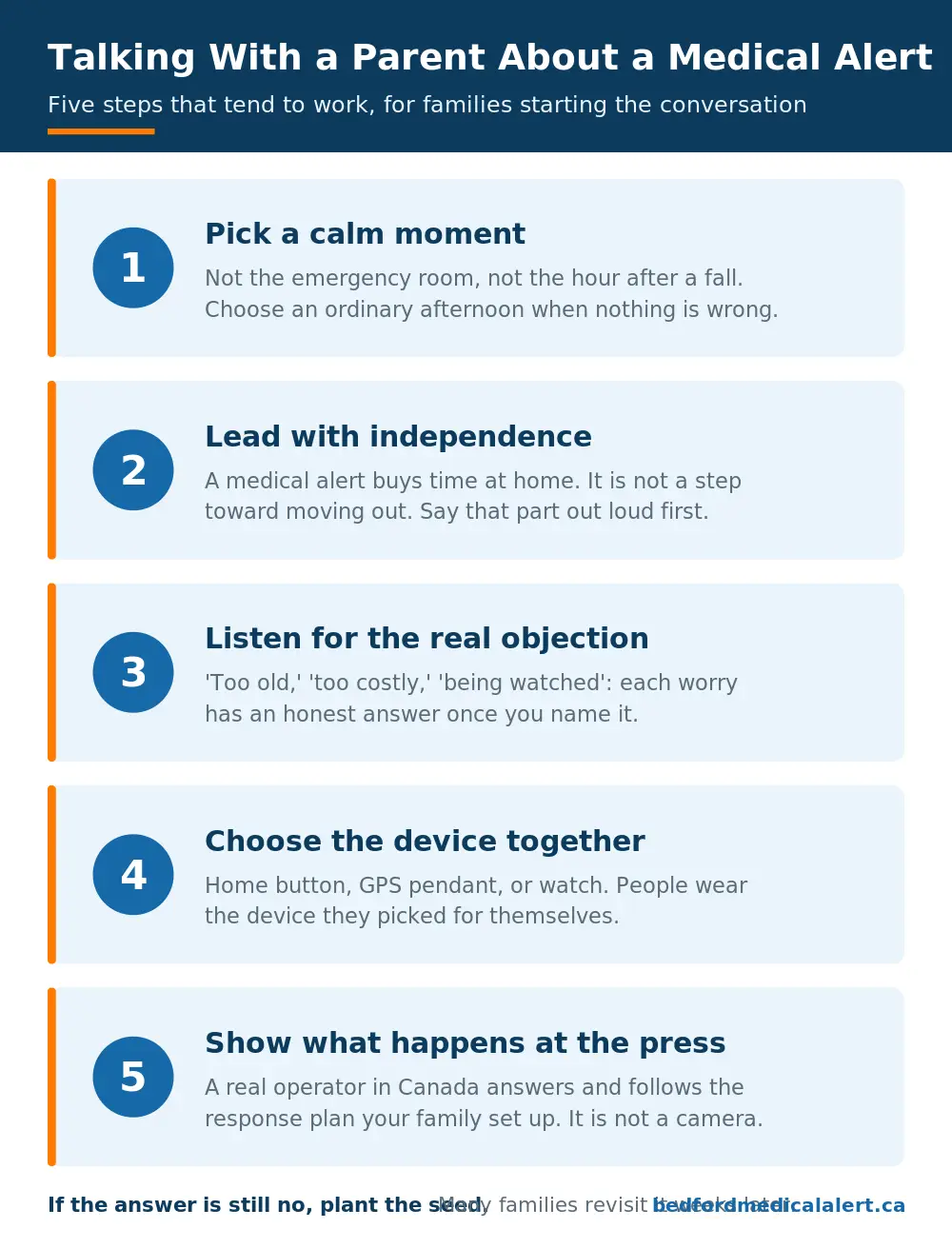
The worst place to raise this is the emergency room, or the tense hour after a fall when everyone is frightened and a little defensive. The best time is an ordinary afternoon when nothing at all is wrong.
A doctor’s appointment can open the door gently. In our experience the visit is often the opening families use: if a physician has already mentioned balance, medication side effects, or fall risk, you can pick the thread up later at home. “The doctor got me thinking. Can we talk about it?” Let this be a subject you return to more than once, not a single verdict you hand down.
The Alzheimer Society of Canada’s communication tips are written for conversations with people living with dementia, but two of them apply to any family conversation about safety. Hold it somewhere calm and quiet, with few distractions. And remember that how you feel comes through in your tone and body language, so take a breather first when you need one.
For many families, a medical alert is one of the things that makes independent living last longer. It buys time at home, not a move out of it. Say that part out loud, because it is the part a parent most wants to hear.
Then describe what the device actually does in plain terms. With Bedford’s Home Freedom system, a lightweight help button is worn as a pendant or on the wrist, and pressing it connects your parent to a live operator at a monitoring centre based in Canada, around the clock. The equipment is included with the subscription, so there is no separate device to buy, and Easy Setup means it is working within minutes of arriving. Framed this way, the button is not a loss. It is what lets your parent keep their routines and their own front-door key, with a quieter kind of backup standing behind them.
Not sure how to start, or want a second opinion before you raise it? Our Canadian care team is glad to talk it through with you first, with no pressure and no obligation, even if your parent is not ready yet. Call Bedford Medical Alert at 1-888-755-3055 and ask us anything.
Most resistance is really one specific worry wearing a disguise. Name the real one and you can answer it honestly.
“I do not need it. I am fine.” Agree with the part that is true. This was never about today. It is about the one bad evening nobody plans for, when help being one button away is what matters.
“It will make me look old.” Modern help buttons look nothing like the boxy pendants of a decade ago. A slim watch or a discreet pendant reads as an ordinary accessory, and your parent gets to pick the one that feels like them.
“It is too expensive, and I do not want to be locked in.” Bedford is built for exactly this hesitation. There is no long-term contract. Plans typically run month-to-month after a three-month minimum at the start, with no cancellation fees, so the decision is never a trap.
“I do not want to be watched.” This worry deserves a straight answer. The monitoring is not a camera, and it is not a microphone left listening in the house. An operator connects only when the button is pressed, and then follows a personalized response plan your family helped set up. It is help on demand, not surveillance.
Wherever you can, hand your parent the decision rather than presenting a done deal. People wear what they chose for themselves.
There is research behind that. In health care it is called shared decision-making. A Cochrane review updated in January 2024, covering 209 studies and 107,698 adults facing treatment and screening decisions, found with high certainty that giving people a structured decision aid improved their knowledge of the options, reduced the conflict they felt about the decision and cut the share who stayed passive and let the clinician decide, with no difference in regret afterwards. Those studies were about medical choices, not devices, so take the lesson in its general shape: people who are shown their options plainly take part in the decision and are more likely to choose what matters most to them. Closer to home, a Canadian Frailty Network funded trial in 2015, led by Dr. France Légaré at Laval University, trained Quebec home care teams in a shared decision-making process for the hardest version of this conversation, whether to stay home or move into care. In Dr. Légaré’s words, the people those teams supported felt engaged and that they had been given the opportunity to play the role they had wanted to play. The Alzheimer Society of Canada’s advice on choices points the same way: when the person is making a choice, offer a couple of options you know they will like.
Sit down together and look honestly at how they live. A parent who is mostly at home has different needs from one who still drives, gardens, or takes the bus downtown. Our guide to choosing the right device works through those trade-offs in a handful of questions, and it is a good thing to go through side by side. If fall detection comes up, keep it general: the technology can help summon assistance, but no device detects every fall or replaces good judgment.
A lot of the fear comes from not knowing what the button even does. So walk through it. When your parent presses it, a real person answers, speaks to them by name, and either reaches a family member or dispatches emergency services according to the plan on file. We laid out the whole sequence in plain language in what happens when you press a medical alert button. Reading it together turns an abstract fear into something concrete, and usually a good deal smaller.
Sometimes it is. A capable adult is allowed to decline, and pushing harder tends to entrench the position rather than move it. If that happens, say your piece once, clearly, and then leave the door open.
Plant the seed and let it grow. Many parents come around weeks or months later, often after a friend’s fall or a second wobble of their own. In our experience the second conversation goes more easily than the first. Keep the information within reach so that when your parent is ready, acting on it is simple rather than another project to start from scratch. Our overview of when it is time to get a medical alert system is a calm resource to revisit together when the moment arrives. If the conversation opens a bigger one about the years ahead, our guide to planning ahead for aging parents walks through the decisions that are easier to make early, with your parent in the room.
You do not have to win the whole argument in one sitting. Aim for something smaller: your parent agrees to look at the options with you, without committing to anything today.
It can also help to say who stands behind the button. Bedford Medical Alert is Canadian owned and operated and an OCSA member, and it has supported hospital education programs and research initiatives from UHN Toronto Rehab to Trillium Health. Bedford brings three generations of experience and a 4.9-star Google rating, which is worth mentioning to a parent who wants to know the company on the other end of the line is trustworthy and close to home. If your parent lives north of Toronto, our medical alert systems in Markham guide covers the local picture, from York Region programs to language support.
AGE-WELL and Environics Research, national poll of 2,026 Canadians aged 50 and over, July 16 to 27, 2020. Alzheimer Society of Canada, Communicating with people living with dementia, 5 communication tips, October 2021. Cochrane Database of Systematic Reviews, Stacey and colleagues, Decision aids for people facing health treatment or screening decisions, version published 29 January 2024. Canadian Frailty Network, Should I stay or should I go?, impact story on Dr. France Légaré’s CFN-funded 2015 trial, published July 2020.
When your parent is ready to look together, the Home Freedom in-home system is a comfortable place to start: a worn help button, a base unit, and 24/7 monitoring based in Canada, with Easy Setup and no long-term contract. See what is included, or call Bedford Medical Alert at 1-888-755-3055 and we will help you and your parent choose together.