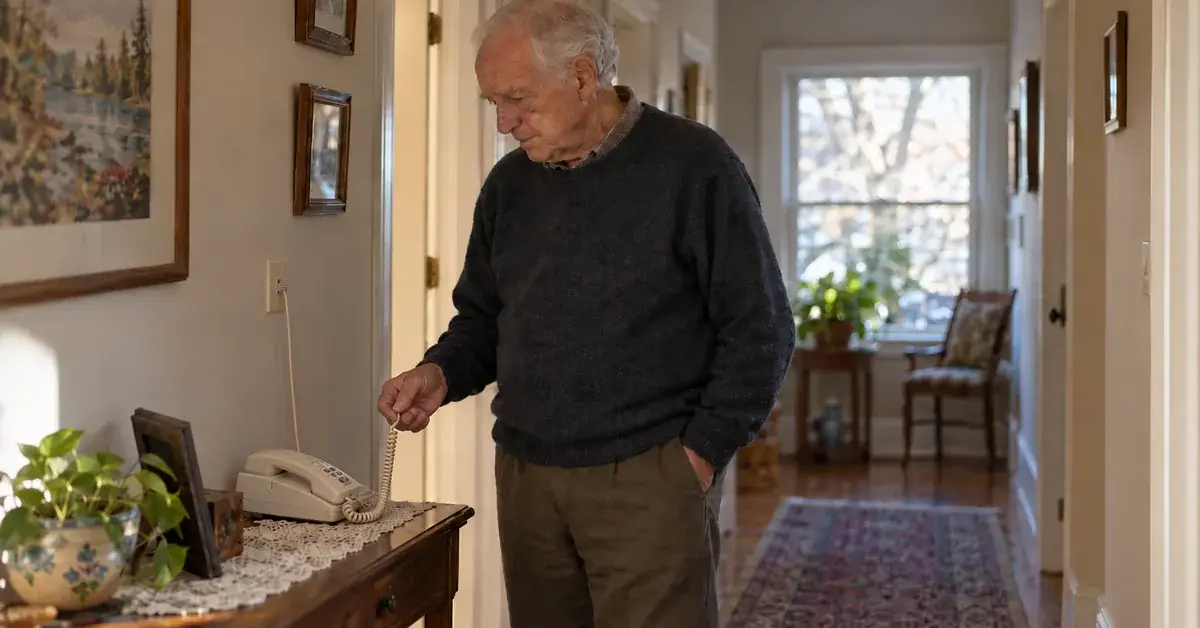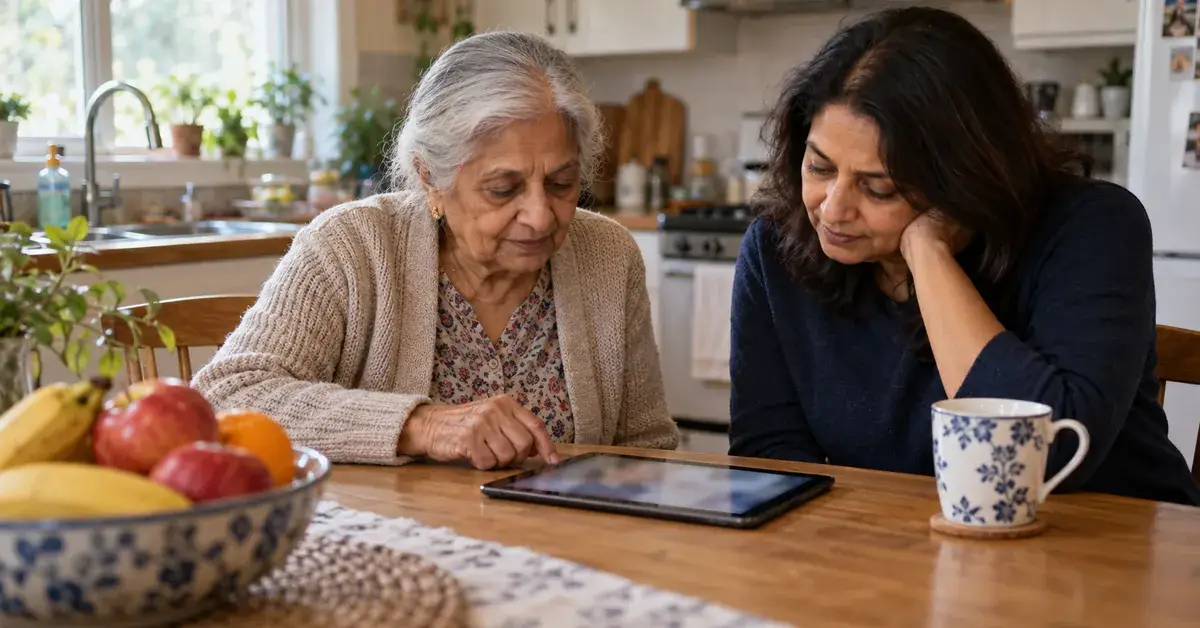
Often it comes out sideways. Your mother mentions, a week after the fact, that she “had a little tumble” by the back door, got herself up, and is fine. No bruise worth showing. No trip to the emergency department. She would rather talk about something else.
That first fall is worth more attention than it usually gets. A first fall is one of the most common reasons a family calls us, and the questions on those calls are about the next fall as much as this one.
This post covers the weeks after a first fall that caused no serious harm: what to tell the doctor, how the fear of falling tends to show up, what the research says helps with it, and how to raise any of it without making your parent feel watched.
Why a fall with no injury still counts
The Canadian numbers mostly count falls that hurt someone. In the Public Health Agency of Canada’s Surveillance report on falls among older adults in Canada (published February 2024), 5.8% of adults 65 and older living in a household said they had been injured in a fall in the previous 12 months, about 350,000 people in the 2017 to 2018 data. Sixty-one percent of those falls happened while walking. Seventy percent of the injured went on to get medical attention.
A fall that leaves no mark appears in none of those figures. It also tends not to reach a doctor at all. The World guidelines for falls prevention and management for older adults, published in Age and Ageing in 2022 by an international working group with Manuel Montero-Odasso as lead author, recommend that clinicians ask older adults about falls rather than wait to be told, because “older adults may not present following a fall and may be reluctant to report falls.”
Those guidelines also describe the fall that should prompt a fuller assessment: a fall with an injury, two or more falls in the past year, known frailty, a fall after which the person could not get up without help for at least an hour, or a fall with a suspected loss of consciousness. A single uninjured fall sits below that line. It is still the earliest warning a family gets. If you are wondering what put your parent at risk in the first place, our older post on whether a loved one is at risk of a fall walks through the factors clinicians look at.
The first two weeks: four things worth doing
None of these is medical treatment. They are the practical steps that make the next appointment useful.
- Tell the family doctor or nurse practitioner, even though nothing hurt. Write down what you can while it is fresh: the date, the time of day, the room, what your parent was doing, whether they felt dizzy or tripped, and whether they could get up on their own and how long that took. A short note like that gives the clinician something concrete to work from.
- Bring the medication list. Some prescriptions and over-the-counter products raise fall risk, and a fall is a good reason to have the whole list reviewed by the doctor or pharmacist. Our page on medications that increase fall risk in seniors explains which classes are involved; the decisions belong to the prescriber.
- Ask whether a falls assessment, physiotherapy or a balance class makes sense. Programs differ by province. In Ontario, for example, the government lists Exercise and Falls Prevention Programs for people 65 and older who are at risk of falls, states that there is no fee and no referral needed, and points people to Health811, Ontario Health atHome or the Seniors’ INFOline to find a class (ontario.ca, page updated December 1, 2025). In Alberta, Finding Balance is a seniors’ falls prevention initiative developed by the Injury Prevention Centre at the University of Alberta, with tools for older adults and families.
- Look at the spot where it happened, together. A loose mat at the back door is a five-minute fix. Do it with your parent rather than for them. For the rest of the house, our guide to fall prevention for seniors at home covers what is worth changing and what is not.
How the fear of falling shows up
The fear usually arrives after the fall, and it is quieter than the fall itself.
Researchers treat it as a problem in its own right. The Cochrane review on the subject describes fear of falling as common in older people and “associated with serious physical and psychosocial consequences.” The 2022 World Guidelines put it more plainly for families: concerns about falling “may limit activity.”
In daily life, limited activity rarely announces itself. It looks like a parent who:
- stops walking to the mailbox in winter, then in spring too
- takes the elevator instead of the one flight of stairs they used to climb without thinking
- turns down the grocery run with a sibling or friend and orders in
- sits for most of the afternoon and says they just feel like resting
Any one of these has an ordinary explanation. Several together, starting soon after a fall, are worth raising with the doctor at that same appointment. Fear of falling is something clinicians can assess, and the World Guidelines ask them to check whether a concern about falling is limiting a person’s usual activities.
What the research says helps with the fear
The best-known evidence here is a Cochrane systematic review, Exercise for reducing fear of falling in older people living in the community, by Denise Kendrick and colleagues. The current version on the Cochrane Library was published in November 2014, with a literature search that ran to July 2013. It included 30 studies with 2,878 participants, and its main analysis, of fear of falling measured right after a program ended, pooled 24 of those studies with 1,692 participants.
What it found is modest, and the authors say so. Exercise programs probably reduce fear of falling “to a limited extent” immediately after the program ends, without increasing the risk or frequency of falls. The evidence for that was rated low quality. Whether the effect lasts in the months that follow, the authors found the evidence insufficient to say, and they rated what there was as very low quality.
That is a narrower result than the headlines that sometimes get attached to it. It supports exercise as a reasonable thing to try, under the guidance of a clinician or a structured program, and it says nothing about any device. For which kinds of exercise have the strongest evidence for preventing falls, and how the grades work, see our walk through the fall prevention evidence.
Thinking about what should be in place before the next fall, not after it? Call our care team at 1-888-755-3055 for a complimentary consultation by phone. We will ask how your parent lives, who is nearby and what the home phone is, and tell you plainly which setup fits. Bedford is Canadian-owned, and our monitoring centre is based in Canada and staffed 24/7.
Talking about it without making it worse
How the conversation goes can feed the fear or ease it. Opening with “you could have broken your hip” tends to do the first. Asking what happened, and what your parent thinks would help, tends to keep them in charge of the plan.
A few things that keep the tone practical: ask questions before you offer solutions. Agree on one change at a time. Keep the doctor’s appointment as the next step rather than a verdict. If your parent pushes back on the idea of any kind of alert device, give it time; our guide on how to talk to a parent about a medical alert covers that conversation in detail, including what to do when the first answer is no.
Where a monitored alert fits, and where it does not
A medical alert does not prevent falls. It does not treat fear of falling, and we would not claim it does. What it changes is the stretch of time after a fall, when someone who lives alone is on the floor and nobody knows.
That stretch has a name in the research, the long lie, and the World Guidelines treat an hour on the ground without help as one of the markers of a high-risk fall. We have set out the studies behind it on our page about the long lie after a fall, so we will not repeat them here. Getting up again is its own question, and our page on senior lift assist in Canada covers who to call when a person is down but not hurt.
With a Bedford Medical Alert® system, pressing the button reaches our monitoring centre in Canada, at any hour. The operator who answers works from a response plan your family set up with us in advance: who gets called first, who is next, and when to send paramedics. Plans differ from home to home, because a parent with a daughter five minutes away needs a different plan from one whose children are a province away.
Some households add automatic fall detection, worn as a pendant, for the fall where a person cannot or does not press. It works by sensing the motion patterns typical of a fall, and no sensor on the market catches every fall, so the button stays the main way to call for help. We say that on the phone too.
On terms: plans typically run month to month after a three-month minimum at the start, with optional six or twelve month initial terms if the savings suit you. Service reverts to month to month afterwards, and there are no cancellation fees. The equipment is included with the subscription.
Bedford brings three generations of experience to this work, is a member of the Ontario Community Support Association, and has supported hospital education programs and research initiatives from UHN Toronto Rehab to Trillium Health. Fall Prevention Month, a Parachute program, runs every November in Canada, which makes the weeks ahead a natural time to book that doctor’s appointment if a first fall has already happened. If all of this is new, our main page is the place to start.
If your parent lives alone and has had a first fall, Home Freedom puts a help button within reach anywhere in the home, with Easy Setup, equipment included and 24/7 monitoring from Canada. Call 1-888-755-3055 and tell us about the house and the people nearby; we will build the response plan around them.
Sources
- Public Health Agency of Canada, “Surveillance report on falls among older adults in Canada,” published 20 February 2024 (2017 to 2018 Canadian Community Health Survey data): canada.ca
- Kendrick D et al., “Exercise for reducing fear of falling in older people living in the community,” Cochrane Database of Systematic Reviews, version published 28 November 2014 (CD009848.pub2): cochranelibrary.com
- Montero-Odasso M et al., “World guidelines for falls prevention and management for older adults: a global initiative,” Age and Ageing, 2022, volume 51, issue 9: academic.oup.com
- Government of Ontario, “Exercise and Falls Prevention Programs,” page updated 1 December 2025: ontario.ca
- Injury Prevention Centre, University of Alberta, Finding Balance: findingbalancealberta.ca
- Parachute, Fall Prevention Month: parachute.ca