“Alexa, call for help.”
Say that in a Canadian living room and what happens next depends entirely on settings a family may never have opened. If an emergency contact has been set up in the Alexa app, the speaker will try to call and text that one person. If not, the request goes nowhere useful. What it will not do, in either case, is call 911.
That gap surprises people, and it is the right place to start an honest comparison. At Bedford Medical Alert®, we get asked about smart speakers often enough that this deserves a full answer rather than a shrug: what Alexa does well for an older adult, and exactly where its emergency features stop in Canada. The two turn out to be different tools for different jobs.
What a smart speaker does well for a senior
Credit where it is due, because there is real value here.
A speaker answers the phone hands-free, sets medication reminders that actually get spoken out loud, runs timers for the stove, turns lamps on before the hallway goes dark, and plays the radio station that makes an empty house feel less empty. For someone with arthritis, voice control removes a dozen small daily frictions. Families use the drop-in feature as a casual way to check in without making it a formal phone call. Drop-in deserves a conversation about privacy first, since it opens a live line into the home, and families who set clear ground rules for it keep everyone comfortable.
None of that is trivial. A device that gets a lamp on before the midnight walk to the bathroom is doing quiet fall-prevention work, and we are glad when it is in the room.
What “Alexa, call for help” actually triggers in Canada
Amazon’s Canadian help pages describe the emergency feature plainly: you can designate one emergency contact in the Alexa app, and when someone says a phrase like “call for help,” Alexa attempts to call and text that person.
Read that twice, because the design carries three assumptions. Someone set the feature up. The chosen contact answers an unexpected call. And the person on the floor can speak loudly and clearly enough for the microphone to catch it. When all three hold, a daughter’s phone rings. When any one fails, nothing happens.
In the United States, Amazon sells a subscription called Alexa Emergency Assist that connects speakers to trained agents who can request emergency dispatch. According to Amazon’s own Alexa Emergency Assist FAQ, that service is available only in the 50 US states and the District of Columbia. It does not operate in Canada, so the version of Alexa in a Canadian home is the version without it.
The distance between a contact and a response
A monitored medical alert is built around the moment the plan has to work.
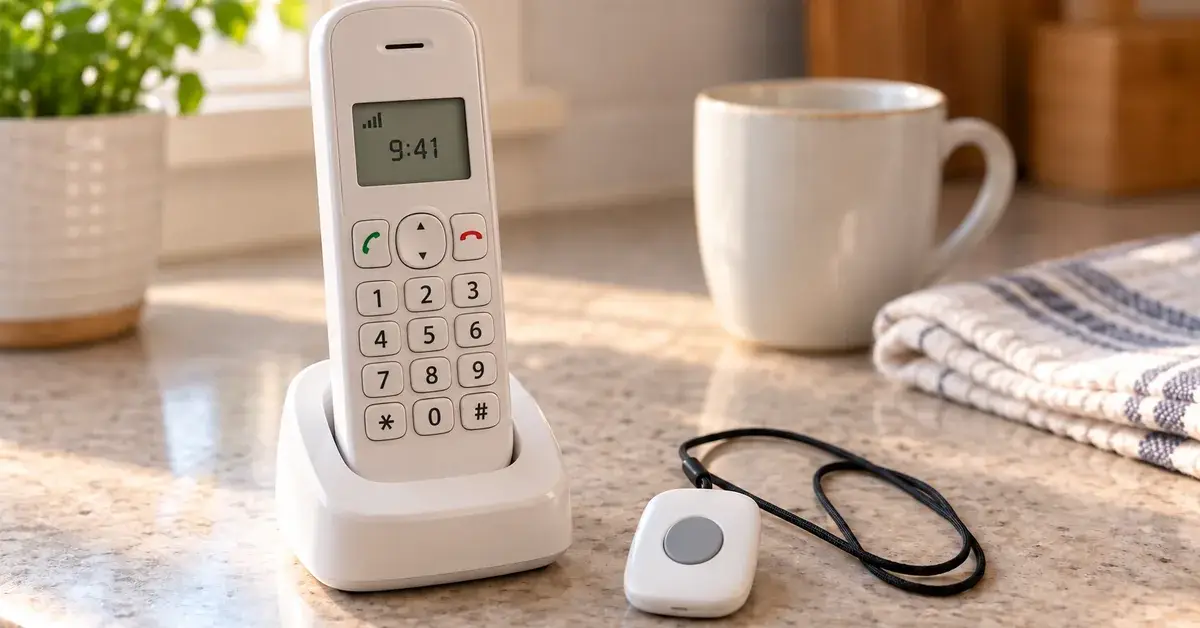
Press a Bedford button and a trained operator at our Canadian monitoring centre answers through the device, already reading a personalized response plan: the medications on file, the neighbour with a key, which family member to call first, when to send emergency services. We wrote a step-by-step walkthrough of that sequence in what happens when you press a medical alert button. The short version is that nobody has to hope the right person picks up. Reaching the right response is the operator’s job, at 3 a.m. on a holiday weekend as much as on a Tuesday afternoon.
A speaker’s emergency feature, by contrast, ends where it starts: one call and one text to one person. There is no plan B written down anywhere, and no one whose job it is to notice that plan A failed.
Weighing a smart speaker against a monitored system for a parent? Call our Canadian team at 1-888-755-3055 and we will talk through how the two actually fit together, with Easy Setup and no long-term contract.
Where the speaker stops
Four practical limits matter more than any feature list.
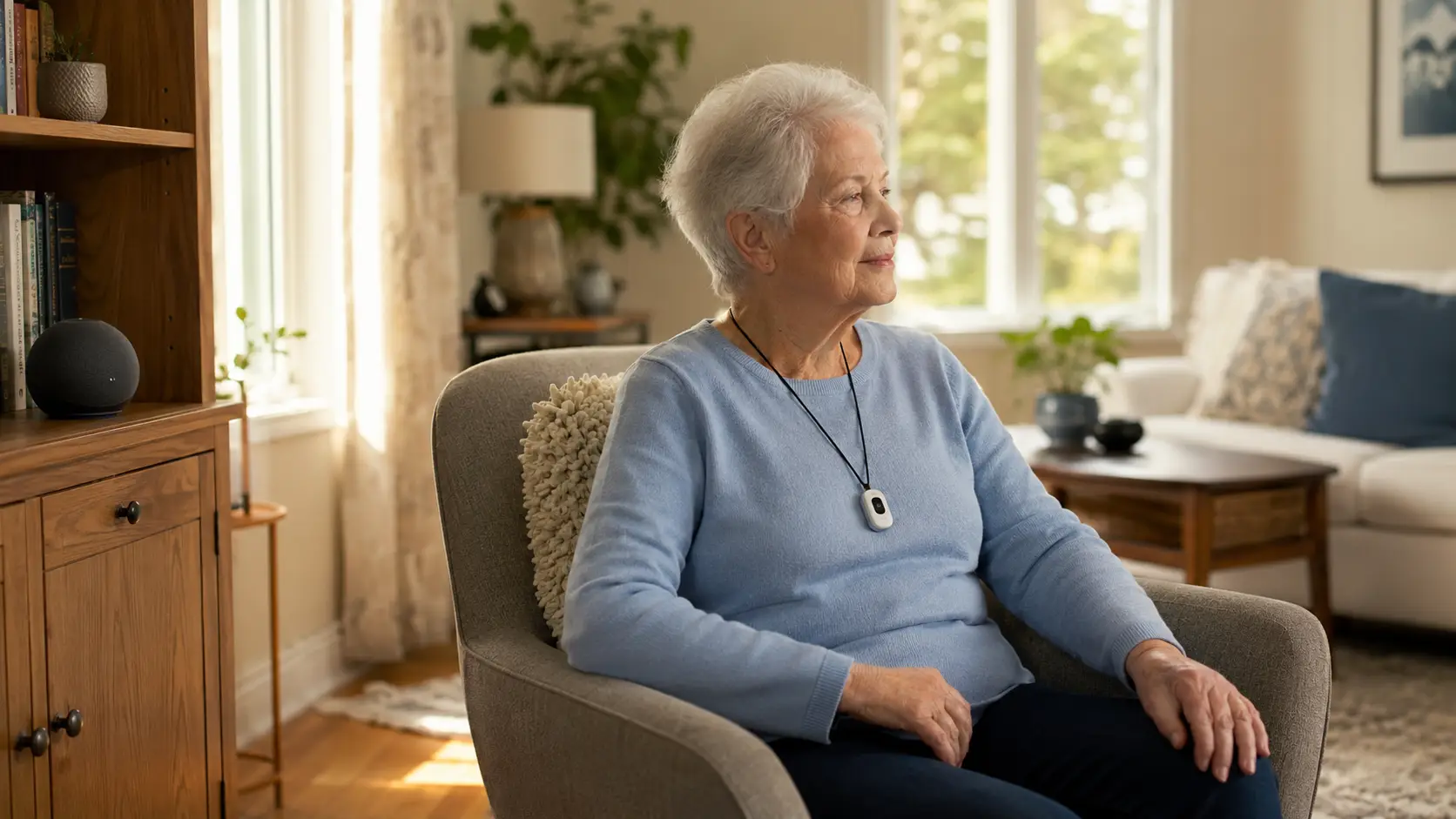
Range. A speaker listens from the kitchen counter, but falls happen in the shower, on basement stairs, in the garden. A person on the bathroom floor behind a closed door may simply be out of earshot, and a wearable button is with you in exactly those places. Ours are waterproof for the shower, which is where a home’s hardest surfaces live.
Voice. The feature assumes the person can speak loudly and clearly. After a bad fall, or for someone with a breathing condition, that is not a safe assumption. A button asks nothing except a press, and automatic fall detection on our devices is designed to call out even when no one can. No sensor on the market catches every fall, which is why we treat detection as a backup to the button rather than a replacement for it.
Power and internet. A speaker is only as awake as the household Wi-Fi and the wall outlet behind it. Routers reboot and power flickers, and a silent speaker looks exactly like a working one until the moment it is needed. Medical alert equipment is engineered around the single job of reaching help, and that focus shows in how the hardware is built and monitored.
Accountability. When an operator answers a Bedford call, a company that brings three generations of experience stands behind what happens next. When a speaker texts a contact, the plan is whatever that one person does with an unexpected buzz.
They are not rivals, so run both
Our answer to the headline question is no, a smart speaker cannot replace a monitored medical alert, and the reverse is also true: a pendant will not turn on your lights or read you the weather. Households that have both tend to use both, the speaker for daily living and the alert for the moments that matter most. The pairing is comfortable in practice: the speaker handles the day and the button handles the emergency, and neither pretends to do the other’s job.
We took the same sober look at mobile phones a few years ago in cell phones vs medical alert devices, and the smart-speaker question is that question’s newer cousin. The pattern holds: general-purpose technology is wonderful until the situation is specific, urgent, and unforgiving.
One more note for families comparing options: adult children often set up a parent’s technology from across the GTA or across the country, and pages like our Brampton medical alert guide exist for exactly that long-distance homework. For homes where nothing worn is realistic, our Silver Shield radar system detects falls with nothing on the body and alerts family and caregivers automatically under protocols the family sets.
The question behind the question
Families rarely ask about Alexa because they love the technology. They ask because a parent had a close call, and a speaker already sitting on the shelf feels like an easy answer. The kinder move is the more thorough one: give the speaker its daily jobs, and give the emergency job to a service designed and staffed for it. We are an OCSA member, trusted by clinicians across Canada, and rated 4.9 stars by Canadian families.
See how a monitored in-home system works: a waterproof help button, 24/7 Canadian monitoring, and the equipment included with the subscription. Explore Bedford Home Freedom, or call 1-888-755-3055 to talk it through. Recommended by doctors and hospitals.