
A pet can trip you. And a pet can keep you from calling for help.
Both of those are worth planning for, and neither is a reason to give up the dog. For a lot of older Canadians who live on their own, the animal at the foot of the bed is the reason to get up in the morning, and the reason to go outside twice a day.
We are Bedford Medical Alert®, a Canadian medical alert provider. This page covers the places at home where pets and falls tend to meet, and the plan that makes sure your dog or cat is looked after if you end up in hospital. It is not veterinary or medical advice.
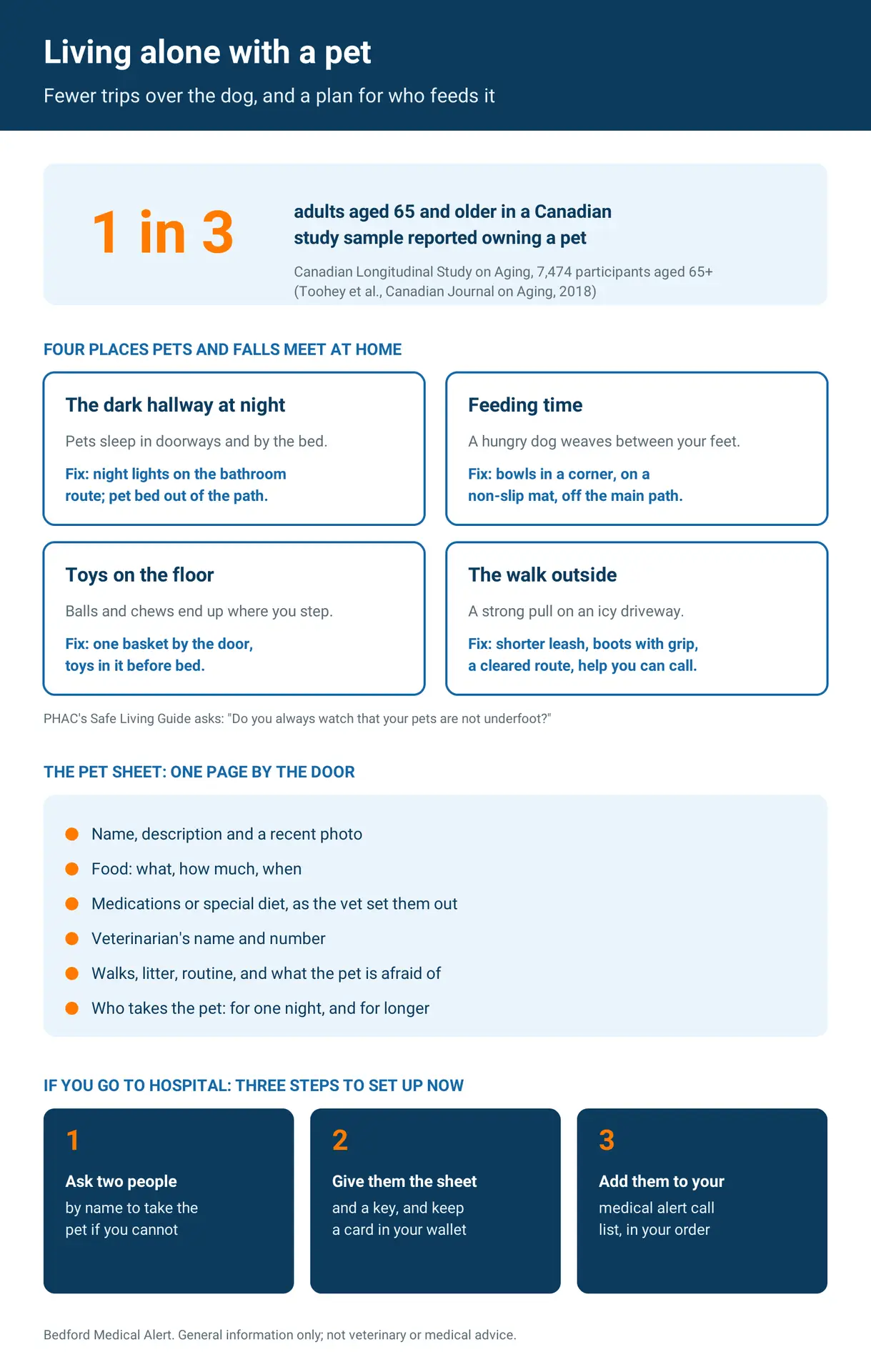
In a 2018 paper in the Canadian Journal on Aging, Ann Toohey and colleagues looked at baseline data from the Canadian Longitudinal Study on Aging. One third of the 7,474 participants aged 65 and older in their sample reported owning a pet.
Some of those owners live alone. Our page on how many Canadian seniors live alone sets out the Census figures. In those homes there is no second person to hold the leash, take the cat to the vet, or notice that nobody has filled the water bowl since yesterday.
The Public Health Agency of Canada’s Safe Living Guide puts it in one line of its indoor checklist: “Do you always watch that your pets are not underfoot?” PHAC gives no Canadian count of falls involving pets, so we will not invent one. The spots below are the ones to look at first, for example.
Cats and small dogs sleep in doorways and at the foot of the bed. The trip to the bathroom at 3 a.m. is where they are hardest to see. A plug-in night light along that route helps, and so does a pet bed placed out of the walking line rather than across it.
A dog that knows dinner is coming will weave between your feet in the kitchen. Food and water bowls on the floor are low, hard to see, and easy to catch with a foot. Moving them into a corner, onto a non-slip mat, takes them out of the path you use most.
Rope toys, balls and chews end up exactly where you step. A basket by the door, and a habit of tossing toys into it before bed, keeps the floor clear.
A strong dog on a long leash pulls in one direction while you are trying to step in another. Add an icy driveway in January and the risk goes up. A shorter leash, boots with real grip, and a route you know is cleared all help. So does carrying a way to call for help that does not depend on reaching your phone.
That is the pet-specific list. For the full room-by-room review of rugs, lighting, stairs and grab bars, see our guide to fall prevention for seniors at home.
Living alone with a dog or a cat? Call the Bedford team at 1-888-755-3055 for a complimentary consultation by phone. We will talk through who should be called if you need help, in what order, and who can look after the animal while you get it.
There is not much Canadian research on this. One small study from the United States points to the pattern. In 2021, Michigan Medicine at the University of Michigan reported a survey of 113 of its patient and family advisers, published in the Journal of Patient Experience. Sixty-three per cent said they had difficulty arranging pet care during their own hospital stay or a loved one’s. Sixteen per cent said they knew someone who had left hospital against medical advice to look after their pets.
It is one survey, of one hospital’s volunteers, in another country. Still, anyone who has lived alone with a dog will recognize the thought. If the ambulance comes, who lets the dog out tonight?
When that question has no answer, people wait. They try to get up on their own, or they decide to see how they feel in the morning. A written plan for the pet takes that reason off the table before it matters.
The Ontario SPCA’s advice on emergency planning for pets starts with a person: someone “who is willing to care for your pet in the event that you are no longer able to.” Ask them directly, and ask a second person too. A neighbour two doors down who can feed the cat for a night is a different job from a son who can take a large dog for three weeks.
The same advice asks owners to write down any special care the animal needs, “such as medications, specific diets, or other special needs,” along with daily care instructions and the caregiver’s contact details. It also suggests checking in with your veterinarian.
One page, kept by the door or on the fridge, with a copy for each person who might step in. Among the things worth writing down:
Some owners also carry a small card in their wallet that says there is a pet at home alone and names the person to call. If you are taken to hospital, it tells whoever finds the card what is waiting at your house. The sheet for you, the one paramedics look for, is covered on our page on emergency information for paramedics; the pet sheet sits beside it.
When you set up Bedford service, we record a response plan for your household. As our page on what happens when you press a medical alert button explains, it holds your emergency contacts in the order you want them called, your medical information and medications, and where a spare key is kept.
That is useful for the pet too. For a minor issue, the operator may call a family member or a neighbour who can come over and help you up. If the first person on your list is the same neighbour who has agreed to feed the dog and who holds the spare key, one phone call covers both of you. Tell them they are on both lists, and keep their number current.
For a possible medical emergency, the operator can dispatch emergency services and stays on the line until help arrives. Your pet plan then picks up from there.
The walk outside is the part that a base unit at home cannot cover. The Bedford Go Anywhere pendant uses built-in LTE and GPS, with a help button and two-way voice, so you can call for help from the end of the block anywhere in Canada where cellular coverage is available. Optional fall detection can place a call automatically when a fall is detected, though no sensor on the market catches every fall. Our page on how GPS medical alert devices locate you explains how the location is found.
Bedford Medical Alert is Canadian owned and operated, with 24/7 monitoring based in Canada, and our operators follow a personalized response plan for every client. We are a member of the Ontario Community Support Association. We are trusted by clinicians across Canada and have supported hospital education programs and research initiatives from UHN Toronto Rehab to Trillium Health. Canadian families have given us a 4.9-star Google rating, and Bedford brings three generations of experience to this work.
Equipment is included with the subscription, so there is no device to buy. Plans typically run month to month after a three-month minimum at the start, with optional six or twelve month initial terms if the savings suit you. Service reverts to month to month afterwards, and there are no cancellation fees. Easy Setup means the system is ready to use quickly.
For the daily walk and everything past the front door, the Bedford Go Anywhere mobile medical alert puts a help button and two-way voice on you, with GPS to help locate you. Call 1-888-755-3055 and we will set up a call list that includes the person who looks after your pet.