
In 1981, a Canadian aged 80 to 84 was more likely to live alone than someone the same age in 2021. The 2021 Census put the share for that age group at 32.0 per cent, down from 37.3 per cent forty years earlier. Past 85 the direction reverses. That oldest group has also doubled in size since 2001, so both facts matter if you are planning for a parent’s household, and they are easy to blur together.
This page is a reference built from Statistics Canada’s own tables. Every figure is dated to the census or study that produced it and given at the precision the source published, with the full source list at the end. We are Bedford Medical Alert®, a Canadian monitoring company and an OCSA member, so we have an interest in the subject. The household of one is the household our operators plan around: when the person who presses the button is the only person in the house, the response plan on file has to answer the questions a second person in the room would otherwise answer.
Statistics Canada’s July 2022 release on households, “Home alone: More persons living solo than ever before, but roomies the fastest growing household type,” includes a table of living arrangements by age for three census years. These are its rows for people aged 65 and older. The base is everyone in each age group who lives in a private household.
| Age group | Living alone, 1981 | Living alone, 2016 | Living alone, 2021 |
|---|---|---|---|
| 65 to 69 | 19.6% | 20.2% | 20.7% |
| 70 to 74 | 26.0% | 22.8% | 23.1% |
| 75 to 79 | 32.4% | 26.7% | 26.7% |
| 80 to 84 | 37.3% | 33.0% | 32.0% |
| 85 and older | 35.9% | 43.3% | 41.8% |
Source: Statistics Canada, Census of Population 1981, 2016 and 2021, Table 1 in The Daily, 13 July 2022.
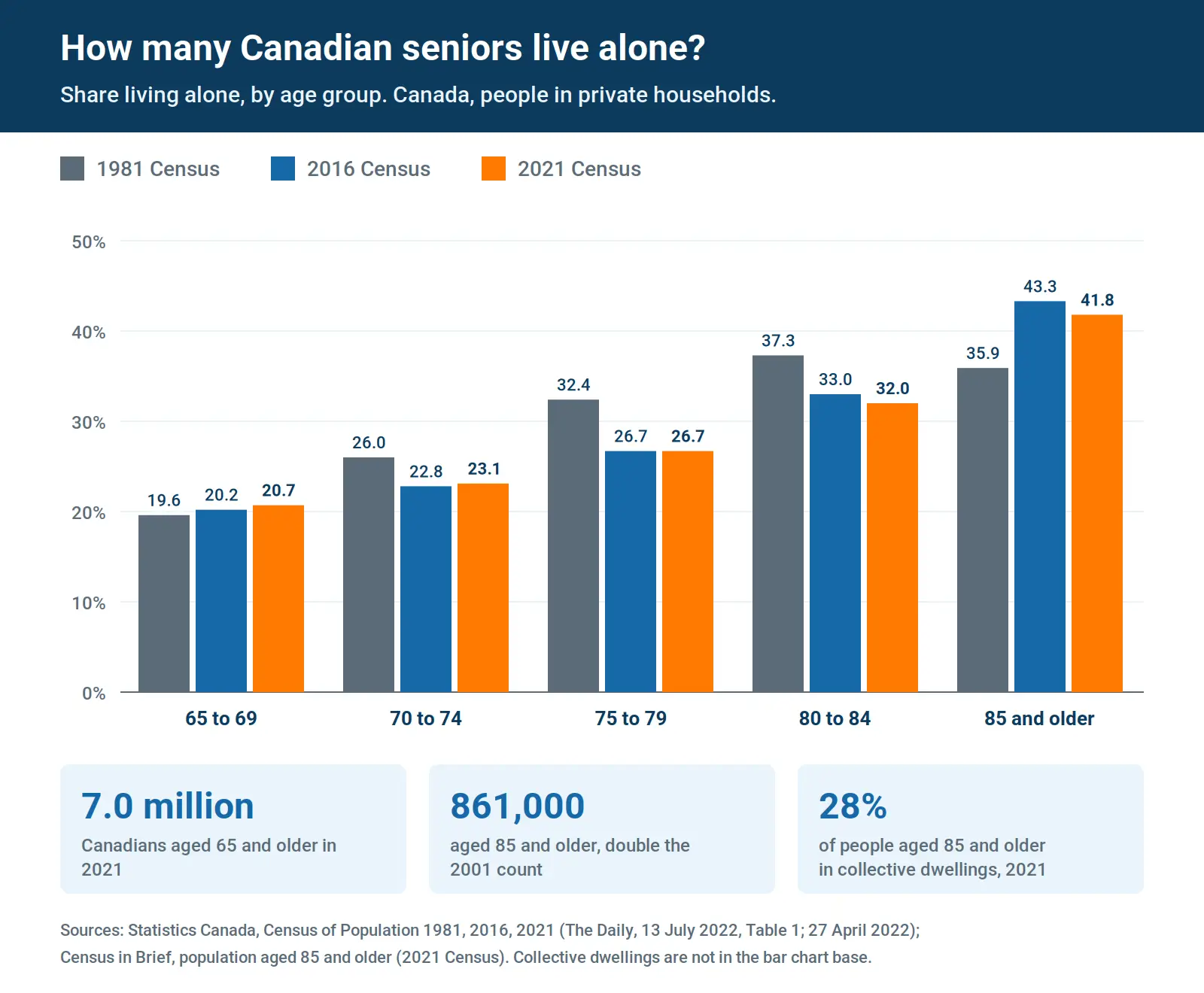
Read down the 2021 column and the share climbs at every step, from about one person in five at 65 to 69 to about two in five at 85 and over. Read across the rows and something less obvious appears. For every group from 70 to 84, fewer people lived alone in 2021 than in 1981. The two ends of the table moved the other way: 65 to 69 edged up by about a point, and 85 and older rose by almost six points.
The same table shows where the difference went. In 1981, 30.5 per cent of people aged 85 and older in private households lived with relatives or non-relatives outside a census family. By 2021 that had fallen to 10.9 per cent, while the share living in a census family (a couple, or a parent with a child) rose from 33.6 to 47.3 per cent. Statistics Canada’s own explanation is that the life expectancies of men and women have been converging since the 1980s, which has let more people, particularly women, keep living as part of a couple at older ages.
The private-household table leaves one group out. Statistics Canada’s Census in Brief on the population aged 85 and older counts them: almost 238,000 people in that age group lived in collective dwellings in 2021, close to 3 in 10 (28 per cent). The share rises steeply with age, from 20.5 per cent at 85 to 89, to 36.4 per cent at 90 to 94, 45.8 per cent at 95 to 99 and 53.7 per cent among centenarians.
Those two numbers, 41.8 and 28, sit on different bases and cannot be added together. The first is a share of people aged 85 and older who live in private homes. The second is a share of everyone aged 85 and older. Women carry most of the living-alone figure at this age: 53 per cent of women aged 85 and older in private households lived alone in 2021, according to the July 2022 release, down from 60 per cent in 2001.
For the breakdown by sex and marital status, the most recent figures we could find on screen are from the 2016 Census, analysed in the 2019 Statistics Canada article “Living alone in Canada” by Jackie Tang, Nora Galbraith and Johnny Truong. We have not found the same breakdown published for 2021, so treat these as 2016 numbers.
In 2016, 25.7 per cent of Canadian seniors lived alone, down slightly from 26.4 per cent in 1981 (the article’s own chart data; its text rounds the 2016 figure to 26 per cent). What changed underneath was who they were. In 1981 more than three times as many senior women as senior men lived alone; by 2016 the ratio was 2.2 to 1, and men made up 32 per cent of seniors living alone, up from 23 per cent. Among senior women living alone, 60 per cent were widowed. Among senior men living alone, the most common situation was being separated or divorced, at 41 per cent.
That last shift is the largest in the article. The share of seniors living alone who were separated or divorced more than tripled between 1981 and 2016, from 9 per cent to 32 per cent.
Working out who would be called first if a parent who lives on their own needed help? Our complimentary consultations happen by phone, at 1-888-755-3055, and we can walk you through how a response plan is set up for a household of one.
Shares hide scale. The 2021 Census counted 7.0 million people aged 65 and older, nearly 1 in 5 Canadians (19.0 per cent), up from 16.9 per cent in 2016; their number rose 18.3 per cent in those five years alone. The group aged 85 and older reached 861,000, double its 2001 size.
Across all adult ages, 4.4 million people lived alone in 2021, up from 1.7 million in 1981. That was 15 per cent of everyone aged 15 and older in private households, the highest share on record. Where people live changes the figure too. Among the provinces, Quebec had the highest share of people living alone in 2021, at 19 per cent, while Nunavut has had the lowest share of any province or territory since 2001, at 8 per cent in 2021. Both of those are all-ages figures, not figures for seniors.
For income, health and other twenty-year trends among older Canadians, see our roundup of Canadian seniors statistics.
The census cannot say what happens in a house with one person in it on the afternoon something goes wrong. That is a planning question, and it is the one we work through with a family when a parent is about to live on their own, whether after losing a spouse or after a move to a smaller place.
With our Home Freedom setup, a base station sits in the home and the person wears a pendant. A press reaches our monitoring centre in Canada, staffed around the clock, and the operator works from a personalized response plan held on file for that household. For someone who lives alone, that plan does the job a second person in the house would do: who to call and in what order, and who holds a key. Some of our pendants offer automatic fall detection as an option. It is a backup to the button, and no sensor on the market catches every fall.
The time spent on the floor before anyone knows is the risk a household of one carries most directly, and we have written separately about the long lie after a fall. Whatever you set up, try it from the rooms that worry you, the bathroom and the basement stairs especially. Our guide on how to test a medical alert system walks through a test press and what the operator may ask you to confirm.
Planning for a parent who lives on their own? The Home Freedom system connects a press of the pendant to an operator in Canada, day and night, working from the response plan your family sets. It comes with the equipment included, Easy Setup and no long-term contract. Call 1-888-755-3055 to talk through the household you are planning for.
Each was read on 1 October 2026. Statistics Canada is not affiliated with Bedford and did not review this page.