Black Friday to Cyber Monday: six months of service for the price of four.Black Friday to Cyber Monday: six months for the price of four. See the offer
In Peterborough, Ontario, about one resident in thirty is 85 or older. The 2021 Census put the share at 3.4 per cent, tied with Trois-Rivières, Quebec, for the highest of any large urban centre in the country.
Across Canada the share is lower, 2.3 per cent, but the group behind it has been growing for twenty years. This page gathers what Statistics Canada and the Public Health Agency of Canada have published about people aged 85 and older: how many there are, where they live, how often they fall, and what the projections suggest. Every figure carries its source and year, and the full list of sources is at the bottom.
The 2021 Census counted 861,000 people aged 85 and older. Statistics Canada’s age release of April 27, 2022 says that number has doubled since 2001.
Statistics Canada’s population estimates for July 1, 2026 run higher: the four age bands from 85 up add to 991,172 people. The sum is ours, and it is an estimate, not a census count.
Growth has not slowed. Between 2016 and 2021 the 85 and older population grew by 12 per cent, according to Statistics Canada’s Census in Brief on this age group, more than twice the 5.2 per cent growth of the population as a whole. The age release gives the same increase to one decimal place: 11.8 per cent.
Statistics Canada calls the 85 and older group one of the fastest-growing age groups in the country. It is not the fastest: centenarians grew faster.
Just over 9,500 Canadians were 100 or older in 2021, about 0.03 per cent of the population. Their numbers rose 15.9 per cent from 2016, against 11.8 per cent for everyone 85 and older. Statistics Canada’s estimate for July 1, 2026 puts the number at 12,505, an estimate and not a census count.
That is still a small number of people. It does mean that a family planning for a parent in their late eighties is not planning for a rare case, and should not assume the plan only has to last a few years.
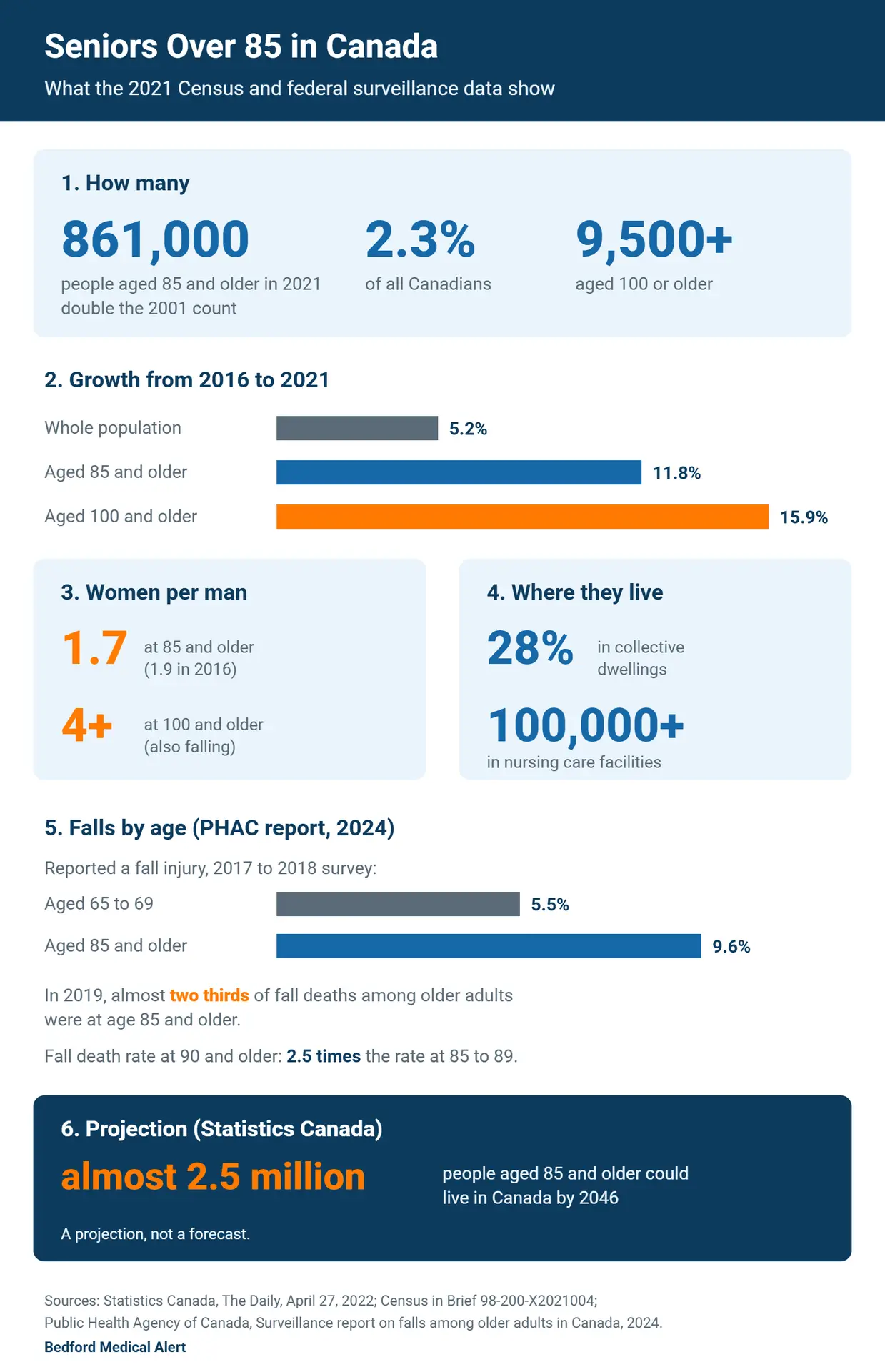
In 2021 there were 1.7 women for every man aged 85 and older, down from 1.9 in 2016. Among centenarians the ratio was just over four women for every man, and Statistics Canada notes that it, too, has been falling.
For families, the practical side of that ratio is widowhood. Many women in this age group have outlived a spouse, and a good share of them live on their own. Our page on how many seniors live alone in Canada breaks those census figures down by age and sex.
By province, the share of people aged 85 and older was highest in Quebec, New Brunswick, Saskatchewan and British Columbia. In three British Columbia municipalities, people 85 and older made up more than 9 per cent of residents.
The type of home changes sharply with age. Almost 238,000 people aged 85 and older lived in collective dwellings in 2021, close to 3 in 10 of the age group, and more than 100,000 of them lived in nursing care facilities. The rest lived in private homes, alone or with family; the living alone page linked above covers that split in detail, so we do not repeat it here.
Is your parent in their eighties and still at home? Call us at 1-888-755-3055 for a complimentary consultation by phone. We can talk through who should be called first, and in what order, if your parent ever presses for help.
The Public Health Agency of Canada’s Surveillance report on falls among older adults in Canada, published February 20, 2024, breaks its data down by age. The oldest groups stand out in nearly every table.
The report’s own suggestion is that future prevention efforts may target those most at risk: women, people aged 80 or older, and older people who live alone or have low income. Our statistics page on seniors’ falls in Canada covers the national totals; this section is only the age break.
The Public Health Agency of Canada’s Canadian Chronic Disease Surveillance System puts the prevalence of dementia, including Alzheimer disease, at 18.32 per cent among Canadians aged 85 to 89 and 28.55 per cent among those aged 90 and older. Those are crude prevalence figures for the 2023 to 2024 fiscal year, from the agency’s data tool (data as of April 2025). The tool cautions that Quebec’s figures from 2016 to 2017 onward may be slightly underestimated.
The same table shows how steeply prevalence climbs with age: 5.17 per cent at 75 to 79, 10.61 per cent at 80 to 84, 18.32 per cent at 85 to 89, then 28.55 per cent at 90 and older. Our guide to living alone with dementia covers what that means day to day.
Statistics Canada’s Census in Brief says the 85 and older population could triple to almost 2.5 million by 2046, and could pass 2.7 million by 2050. The April 2022 age release words it a little differently, as a tripling from 861,000 to 2.7 million over the next 30 years.
Both are projections. Statistics Canada frames them with “could”, and so do we. They depend on assumptions about life expectancy and migration, and none of them is a forecast for any one family.
What is not a projection: everyone who will be 85 in 2036 is already in their mid seventies today.
Two questions tend to arrive with an 85th birthday. Is it too late to plan? And who checks on Mom between visits? The census answers neither, but the federal falls data makes one point clearly: past 85, a fall is more likely to cause an injury, more likely to end in a long hospital stay, and far more likely to be fatal. Getting help quickly matters more at this age, not less. Our guide to planning ahead for aging parents is a place to start the rest of that conversation.
Bedford Medical Alert® is Canadian owned and operated, with 24/7 monitoring in Canada, and we are a member of the Ontario Community Support Association. Our Home Freedom system pairs a waterproof Mini button, worn as a pendant or wristband with a battery rated for five years, with a base unit that has two-way voice, its own large help button and a backup battery, and the button is rated for a 600 to 800 foot line-of-sight range from the base. When it is pressed, a trained operator answers and follows the response plan your family set up. An optional fall detection pendant can place a call without a press; no sensor on the market catches every fall, so pressing the button stays the habit to keep.
Planning for a parent over 85? Bedford’s Home Freedom system keeps a help button within reach around the house and connects your parent to our Canadian monitoring centre 24/7, with no long-term contracts. See how Home Freedom works or call 1-888-755-3055.
