
Who should we call first?
When a household sets up Bedford service, we record a response plan, and that question sits near the top of it. The plan holds the emergency contacts and the order the person wants them called. In a family with one adult child, the answer takes a few seconds. With three adult children in three different postal codes, it opens a bigger conversation: who is close enough to come over, who is good on the phone with a pharmacist, who should hear about a fall at 2 a.m. and who would rather hear about it at breakfast.
We are Bedford Medical Alert®, a Canadian medical alert provider. This page is about dividing a parent’s care between brothers and sisters so the work is visible, the information lives in one place, and the parent stays at the centre of the decisions. It is not legal, financial or family counselling advice.
Statistics Canada’s release Caregivers in Canada, 2018 (The Daily, 8 January 2020) reported that about one in four Canadians aged 15 and older, roughly 7.8 million people, provided care in 2018. Almost half of those caregivers (47 per cent) said they were caring mainly for a parent or parent-in-law. Among caregivers aged 45 to 64, the share was 61 per cent.
The same release found that about 70 per cent of caregivers received some kind of support with their caregiving duties. Support is not the same as an even split, and the release does not measure how care was divided between siblings.
What the load does to the person carrying it shows up in the Ontario Caregiver Organization’s Spotlight Report 2025, published in December 2025 from an online survey of 903 Ontario caregivers: 75 per cent said they felt they could not take on any more responsibility than they already had. Our page on caregiver burnout in Canada covers that research in full.
Bonnie Lashewicz and Norah Keating looked at this directly, using Canadian families and Canadian court cases. Their 2009 paper in the European Journal of Ageing, “Tensions among siblings in parent care,” drew on interviews with 11 adult siblings from eight families and on six legal cases filed between 1995 and 2004. Their finding, in their words: “disputes occur when siblings perceive others as dominating parent care and assets.” Two behaviours stood out. One sibling separating the parent from the others. One sibling keeping the others out of decisions.
It was a small qualitative study, not a survey, so it shows how disputes form rather than how often. The pattern it describes has a practical answer. Information that only one person holds starts to look like control, even when nobody means it that way. A shared record, and a habit of deciding things together with the parent, takes a lot of that heat out.
Counting hours can start arguments, because an hour of driving and an hour of sorting out a pharmacy refill do not feel the same to the people doing them. Naming jobs works better. Here is one way to split them. Your family will draw the lines differently.
| Job | What it covers | Can it be done from a distance? |
|---|---|---|
| The one nearby | Visits, groceries, being the person who can be at the door in 20 minutes | No |
| The appointment keeper | Booking, reminders, rides or arranging rides, notes from the doctor | Partly: booking and reminders, yes |
| The list keeper | Owns the shared list and keeps it current | Yes |
| The money and paperwork lead | Bills, receipts, tax credits, the legal documents the parent has chosen | Mostly yes |
| The relief shift | Takes over for the nearby sibling for a weekend, a week, a holiday | Needs travel |
A sibling who lives in Calgary while the parent lives in Peterborough can still own two of those five jobs. Our page on caring for a parent in another city goes further into what works from far away.
Money is its own conversation. Our post on the cost of caring for elderly parents walks through who pays for what and how siblings can share costs without a standing argument, so we will not repeat it here. Powers of attorney and wills belong with a lawyer or notary in your parent’s province.
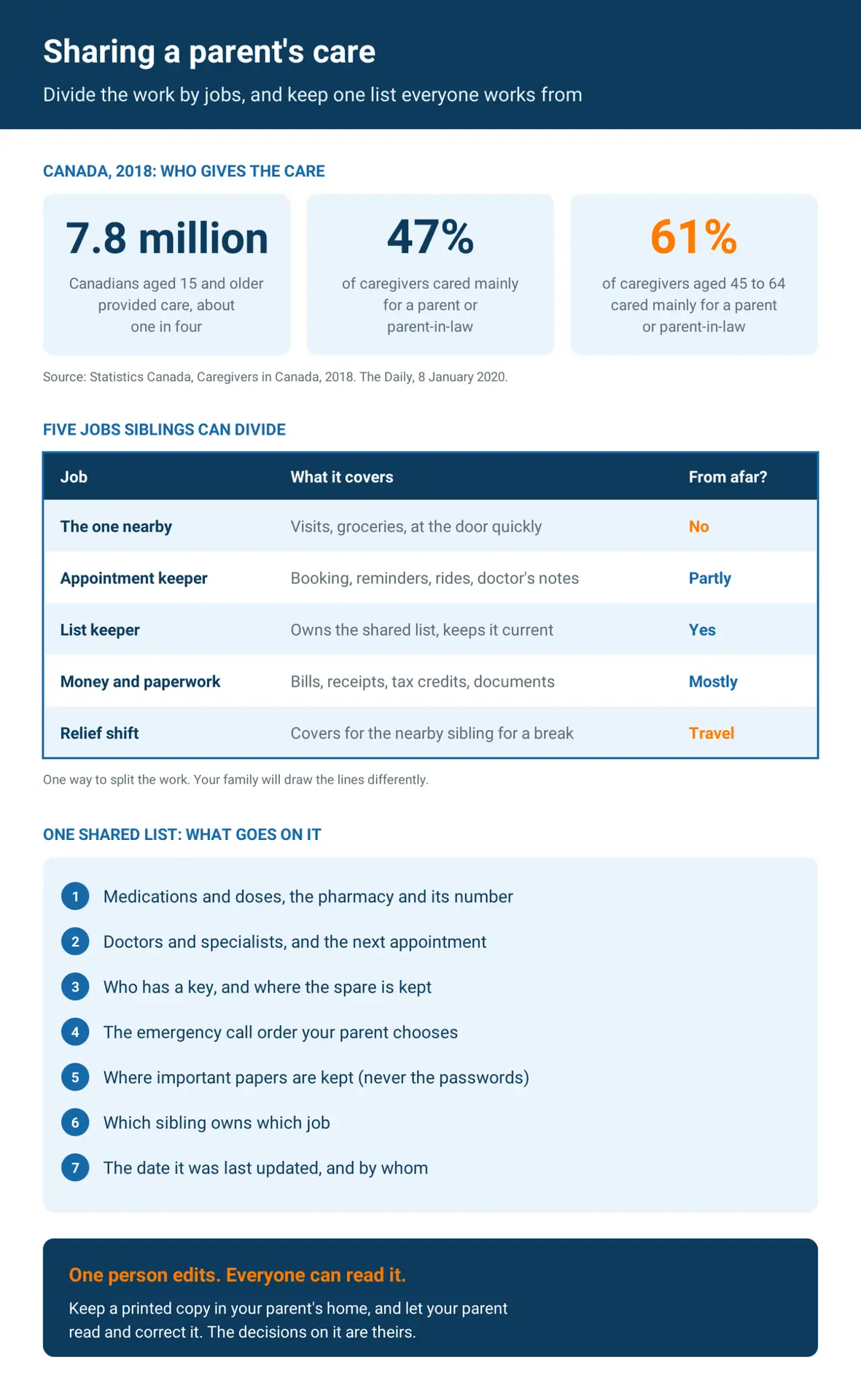
Families who share care often end up with three versions of the same list: one in Mom’s kitchen drawer, one in a sister’s phone, one in a brother’s memory. Pick one. A shared document that every sibling can open, with a printed copy in the parent’s home, is enough.
One person edits. Everyone else sends changes to that person. It sounds rigid until two people update the medication list on the same afternoon with different doses. Your parent should be able to read the list and correct it. The list is theirs.
A medical alert response plan is that list, in the form an operator can act on. When the button is pressed, Bedford operators follow the plan on file rather than a generic script. That file can include medical information, medications, where a spare key is kept, the emergency contacts and the order they should be called. For a minor issue, such as needing help up from a chair, the call might go to a family member or a neighbour who can come over. For a possible emergency, the operator can dispatch emergency services and pass along what is in the file. If a family member needs directions, a buzzer code or the location of a key, the operator can share what is on file. We describe the full sequence in what happens when you press a medical alert button.
Three things siblings should settle before that call order is written down:
Setting up a response plan with your brothers and sisters? Call us at 1-888-755-3055 for a complimentary consultation by phone. We can walk the family through how contacts and call order work before anyone signs up.
It can happen slowly. The sibling who lives closest picks up one more errand, then another, and a year later is doing most of it. The fix is to look at the table again on a schedule your family chooses, after a hospital stay, or whenever one person says it out loud. Rotate the relief shift. Move a job from the nearby sibling to a distant one. Write the change on the list.
If one of you is already worn out, the Ontario figures above are a reason to act before that person stops coping. That is also the moment to make sure a second and third person know everything the first person knows. Our page on a backup plan for caregivers is about that handover.
Keep it to an hour, and invite your parent.
Bedford Medical Alert is Canadian owned and operated, with 24/7 monitoring based in Canada, and our operators follow a personalized response plan for every client. We are a member of the Ontario Community Support Association. We are trusted by clinicians across Canada and have supported hospital education programs and research initiatives from UHN Toronto Rehab to Trillium Health. Canadian families have given us a 4.9-star Google rating, and Bedford brings three generations of experience to this work.
Equipment is included with the subscription, so there is no device to buy. Plans typically run month to month after a three-month minimum at the start, with optional six or twelve month initial terms if the savings suit you. Service reverts to month to month afterwards, and there are no cancellation fees. Easy Setup means the system is ready to use quickly.
One call order, agreed by the family. Bedford’s Home Freedom system pairs a waterproof help button with a two-way voice base, and our Canadian monitoring centre answers 24/7 using the call order your parent chooses. There are no long-term contracts. See how Home Freedom works or call 1-888-755-3055.