Black Friday to Cyber Monday: six months of service for the price of four.Black Friday to Cyber Monday: six months for the price of four. See the offer
Picture a healthy Canadian woman of 77 squeezing a grip dynamometer as hard as she can. If she is typical for her age, the dial stops near 21 kilograms.
Her son, at 52, would likely reach about 47.
Both numbers are medians from Statistics Canada’s national reference values, measured in the Canadian Health Measures Survey. We are Bedford Medical Alert®, a Canadian medical alert provider, and we wrote this page because grip strength comes up whenever families start asking how a parent is really doing. Below: what the test measures, the Canadian reference values by age, where “low” begins, and what the research does and does not link a weak grip to. It is general information, not medical advice.
A dynamometer is a hand-held gauge with a handle you squeeze. It reads your force in kilograms.
Statistics Canada used a Smedley III dynamometer in the survey and followed a fixed protocol: the person stands with the elbow straight, squeezes twice with each hand, alternating hands, and the best single result from either hand counts as their maximum grip strength. Statistics Canada researcher Suzy L. Wong published the reference values in Health Reports in October 2016, from 11,108 people aged 6 to 79 measured between 2007 and 2013.
Researchers like grip strength because it is quick and cheap to measure the same way every time. The PURE investigators below called it “a simple, inexpensive risk-stratifying method.” A hand is easy to measure. A thigh is not.
These are Statistics Canada’s reference values for maximum grip strength, in kilograms, for the age groups this site is mostly about. The 5th percentile is the strength that only 5 in 100 healthy people of that age and sex fall below.
| Age | Men, 5th percentile | Men, median | Women, 5th percentile | Women, median |
|---|---|---|---|---|
| 50 to 54 | 35.9 | 47.3 | 21.0 | 27.8 |
| 55 to 59 | 34.2 | 45.9 | 20.0 | 27.0 |
| 60 to 64 | 31.8 | 43.8 | 18.7 | 25.9 |
| 65 to 69 | 28.8 | 41.1 | 17.2 | 24.6 |
| 70 to 74 | 25.1 | 37.7 | 15.3 | 23.0 |
| 75 to 79 | 20.7 | 33.7 | 13.1 | 21.1 |
Source: Statistics Canada, Health Reports 82-003-X, 2016, Table 3 (Canadian Health Measures Survey, 2007 to 2013).
Grip strength peaked between 35 and 45 for men and between 30 and 50 for women, then declined. Across the table, the median for men drops from 47.3 kg in their early fifties to 33.7 kg in their late seventies. For women it drops from 27.8 kg to 21.1 kg.
Read the table with three limits in mind. The reference group left out people with chronic conditions such as arthritis, type 2 diabetes, heart disease or the effects of a stroke, so these are norms for healthy people. The equations were fitted at median height and weight. And they stop at 79, so there is no Canadian survey norm for anyone 80 or older.
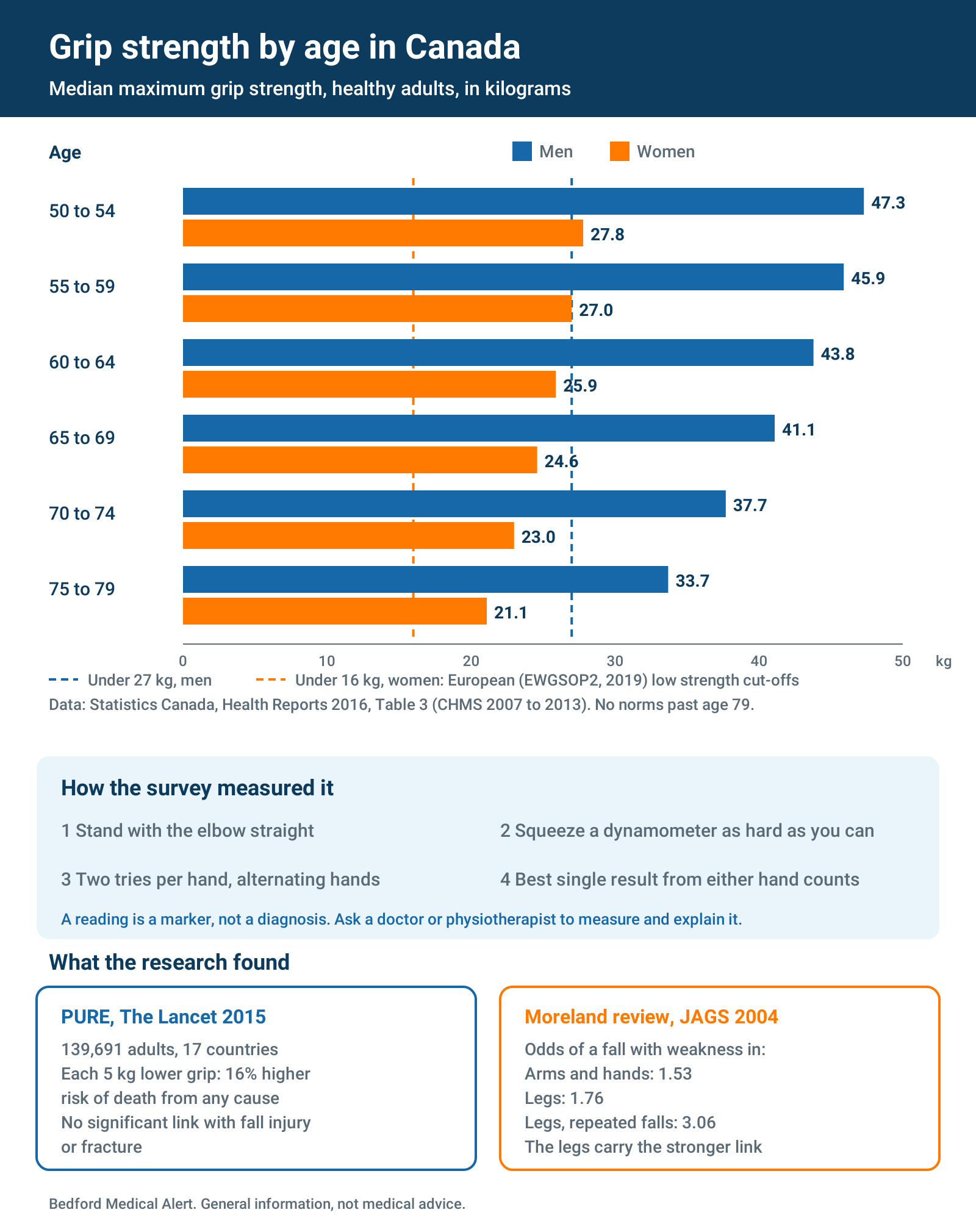
There is no single Canadian cut-off. Two published reference points get used.
The first comes from the Canadian survey itself. The Health Reports article notes that the 5th percentile has been proposed as a marker of abnormally low grip strength, and adds that more research is needed to establish its clinical value.
The second comes from the European Working Group on Sarcopenia in Older People. Its 2019 consensus (Cruz-Jentoft and colleagues, Age and Ageing) put low muscle strength at the centre of how sarcopenia, the age-related loss of muscle, is identified. Its grip cut-offs are under 27 kg for men and under 16 kg for women. Setting those numbers beside the Canadian table is our own comparison: at 75 to 79, both cut-offs fall between the 10th and 25th Canadian percentiles.
A low grip on its own is not a diagnosis. In the European approach, low strength makes sarcopenia probable, and confirming it takes other measurements done by a clinician. If a reading worries you, take it to a doctor or a physiotherapist rather than to a search engine.
The biggest study is PURE, published in The Lancet in 2015 by Leong and colleagues. It measured grip strength in 139,691 adults across 17 countries and followed them for a median of four years. Each 5 kg lower grip was associated with a 16 per cent higher risk of death from any cause. The authors wrote that grip strength was “a stronger predictor of all-cause and cardiovascular mortality than systolic blood pressure.”
Then the part that rarely makes the headlines. PURE also looked at falls, and among the outcomes with no significant association it lists “injury from fall, or fracture.” In that study, a weak grip predicted death better than it predicted a fall injury.
That does not mean strength and falls are unrelated. A 2004 systematic review from McMaster (Moreland and colleagues, Journal of the American Geriatrics Society) pooled the studies it could use and found:
So grip is best read as a window on overall strength. The legs are where the falls link is strongest. For the falls numbers themselves, our page on seniors’ falls in Canada gathers the national figures.
Here is where we see grip strength from our side of the call.
The Public Health Agency of Canada’s 2024 surveillance report found that about 52 per cent of falls that put an older adult in hospital happened at home. Getting back up after one of those falls is a strength task. You push with your arms, you grip the edge of a chair or a bed frame, and you drive up with your legs. When the strength is not there, a fall becomes a long wait on the floor, and our page on the long lie after a fall explains why the length of that wait matters.
A help button changes the wait. It does not change the strength. On a Bedford Home Freedom system, a single press of a waterproof pendant or wristband connects you to our 24/7 monitoring centre, and the two-way voice base lets you talk to the operator from across the room. An optional fall detection pendant can call without a press, though no sensor on the market catches every fall.
Worried about a parent who could not get up alone? Call us at 1-888-755-3055 for a complimentary consultation by phone. Tell us where the day is spent and who should be called, and we will walk you through how a response plan is set up.
Grip strength is a marker. Nothing in the studies above suggests training the hand alone is the answer.
What the guidelines point to is whole-body strength and balance. The Canadian 24-Hour Movement Guidelines for adults 65 and older, released by the Canadian Society for Exercise Physiology in October 2020, call for “muscle strengthening activities using major muscle groups at least twice a week” and for physical activities that challenge balance. The Moreland review concluded that muscle strength, “especially lower extremity”, should be assessed and treated in older adults at risk of falls, while noting that more trials were needed on whether strengthening exercises prevent them.
Which programme is right depends on the person, so a physiotherapist is the best first stop. Our review of what fall prevention research shows covers the trial evidence, and our chair exercises for seniors post has seated ideas to raise with them.
If you or a parent want to know where you stand, a family doctor or a physiotherapist can measure grip with a calibrated dynamometer and put the result in context. A few questions worth asking:
We would add the last question to any list. If the answer is “probably not,” plan for that now, while nothing has happened yet.
Bedford Medical Alert is Canadian owned and operated, with 24/7 monitoring based in Canada, and our operators follow a personalized response plan for every client. We are a member of the Ontario Community Support Association. We are trusted by clinicians across Canada and have supported hospital education programs and research initiatives from UHN Toronto Rehab to Trillium Health. Canadian families have given us a 4.9-star Google rating, and Bedford brings three generations of experience to this work.
Equipment is included with the subscription, so there is no device to buy. Plans typically run month to month after a three-month minimum at the start, with optional six or twelve month initial terms if the savings suit you. Service reverts to month to month afterwards, and there are no cancellation fees. Easy Setup means the system is ready to use quickly.
Help that does not depend on getting up. Bedford’s Home Freedom system pairs a waterproof help button, worn as a pendant or on the wrist, with a two-way voice base, and our Canadian monitoring centre answers 24/7. There are no long-term contracts. See how Home Freedom works or call 1-888-755-3055.
