A broken hip arrives without warning. A planned hip or knee replacement comes with notice.
That notice is the biggest advantage a person living alone has. There are weeks, sometimes months, to set the house up, line up help and decide who gets the phone call if something goes wrong on the walk to the bathroom. This post is about using that time well.
It is written for the person who is booked for surgery and lives on their own, and for the son or daughter who lives forty minutes away and is already doing the arithmetic. It is not medical advice. Your surgeon, your physiotherapist and your hospital’s own patient guide govern every instruction about movement, exercise and wound care. If your parent’s hip was broken in a fall rather than replaced on schedule, our page on life after a hip fracture is the better read. If the surgery is booked at Sunnybrook’s Holland Centre, our Sunnybrook discharge resource counts backwards from surgery day.
How many Canadians go through this, and how fast they go home
The Canadian Institute for Health Information (CIHI) runs the Canadian Joint Replacement Registry. Its annual report released in January 2026 counts 175,242 hip and knee replacements performed in Canadian public hospitals in 2024-2025.
The figure in that report that matters most for someone living alone is a different one. In 2024-2025, 35.8% of hip replacements and 31.1% of knee replacements done for osteoarthritis were performed as day surgery. Home the same day.
Some hospitals now plan for that from the start. North York General Hospital’s total hip replacement patient guide tells patients to “expect to go home the same day of your surgery.” Alberta Health Services, on its MyHealth.Alberta.ca pages for both hip and knee replacement, says patients go home one or two days after surgery, once the healthcare team judges them ready.
Either way, the hospital stay is short. Most of the recovery happens in your own house.
The wait is planning time
CIHI measures joint replacement waits against a benchmark of 26 weeks (182 days) from the date a patient is ready for treatment. Waits vary by province and by hospital, and your surgeon’s office is the only source for yours. What does not vary is that a scheduled operation gives you a window, and the patient guides all ask you to use it.
MyHealth.Alberta.ca asks patients to have their equipment ready one to two weeks before surgery so they can practise with it. For a hip, North York General’s guide lists a low wheeled walker and a single point cane as needed for about one month, and says you will need the walker the day you are discharged home.
Its checklist for the house is short and practical. In brief:
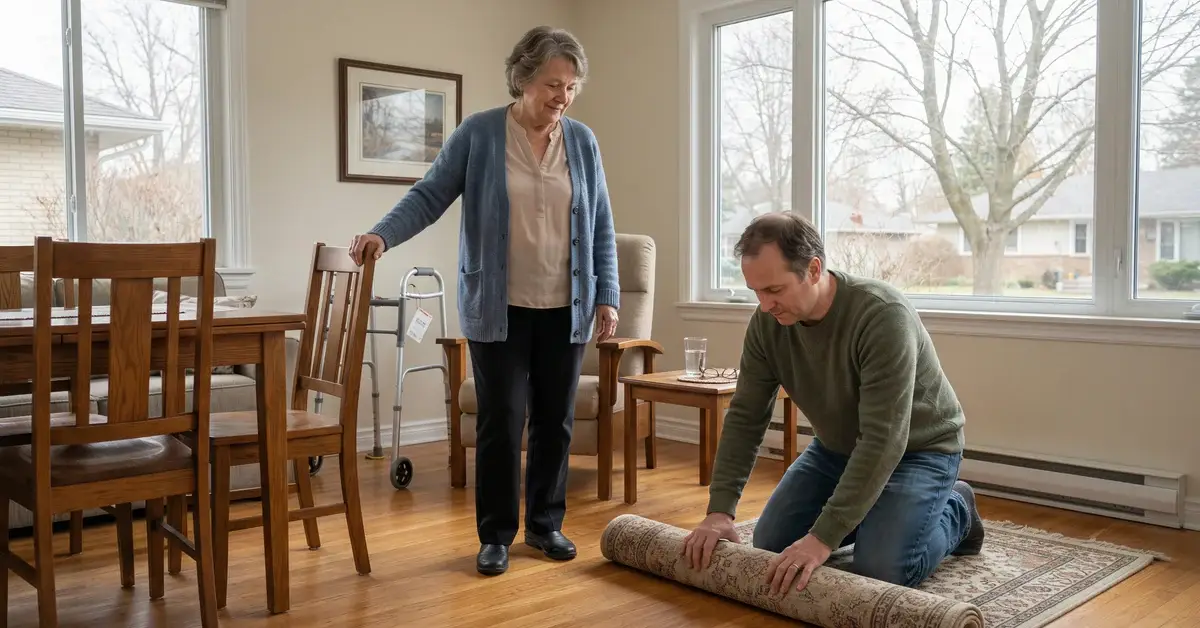
- Move furniture so there is a clear path for the walker.
- Remove loose rugs and other things you could trip on.
- Put frequently used items at waist to shoulder height, to cut down on bending.
- Set up a high chair with a firm cushion and arm rests.
- Make sure stair handrails are securely fastened to the wall.
- Set up the equipment at home and practise using it.
Do these before the surgery date, not the evening you come home. You will not be moving a sofa on a walker.
Who is your Coach?
North York General’s guide suggests patients may wish to arrange for a family member or friend to be their “Coach,” and it asks every patient to have a discharge plan in place, which it says may include assistance in the home. It also asks you to plan for someone to drive you to and from the hospital.
For a person who lives alone, the Coach question deserves a real answer before the booking is confirmed. Who drives you home? Who stays the first night? Who can come by on day three when the groceries run out?
North York General’s guide takes up the living-alone question in its own FAQ. Its answer: a number of its patients live alone and manage independently after surgery, with the right equipment and with community services such as Meals on Wheels, grocery delivery, private home care agencies and respite care.
MyHealth.Alberta.ca adds a detail that is easy to skip: bring someone along on your first few walks, and carry a cell phone in case you need to call for help.
If family cannot cover the gaps, publicly funded and private home care are both worth asking about early. Our guide to home care after a hospital stay in Ontario sets out who arranges publicly funded care and what the assessment decides, and our page on hiring private home care covers the questions to ask before you sign. The general discharge checklist (questions for the team, the first 72 hours, medications) lives in our page on coming home from the hospital. We will not repeat any of them here.
Booked for a hip or knee replacement and living on your own? Call our care team at 1-888-755-3055 for a complimentary consultation by phone. Tell us the surgery date and who your Coach is, and we will walk you through how a monitored medical alert and its response plan are set up before you go in.
On a walker until your team says otherwise
Both Alberta pages say the same thing about walking aids: keep using the walker or crutches until your healthcare team says it is safe to walk without them. MyHealth.Alberta.ca says the equipment it lists protects the new joint and lowers your risk of falling.
That is the shape of the first weeks. You are steady enough to go home, but not yet steady enough to take risks, and the risky moments at home are ordinary ones:
- the first trip to the bathroom in the middle of the night
- stepping into or out of the shower
- reaching for something that ended up on a low shelf after all
- answering the door before the walker is in front of you
None of these is a reason to delay surgery. They are reasons to plan for the moment when something goes wrong and nobody else is in the house.
If you fall, or cannot get up
How you get up after a fall in these weeks, and who should help, is a question to put to your physiotherapist before it happens. We have written separately about lift assistance for seniors in Canada, including when to call for help instead of trying to get up.
For anything about the joint itself, your hospital’s discharge instructions say who to call and when to go to emergency. North York General’s guide, for one, prints two lists: the signs that mean the nearest emergency department or 911, and the ones that mean a call to the surgeon or the patient navigator. Keep that sheet by the phone, not in the bag from the hospital.
When the Coach has gone home: what a help button covers
A medical alert does not speed up healing, and it does not replace the Coach, the physiotherapist or the follow-up appointments. What it does is close the gap between something going wrong and a person knowing about it, on the days when you are alone in the house.
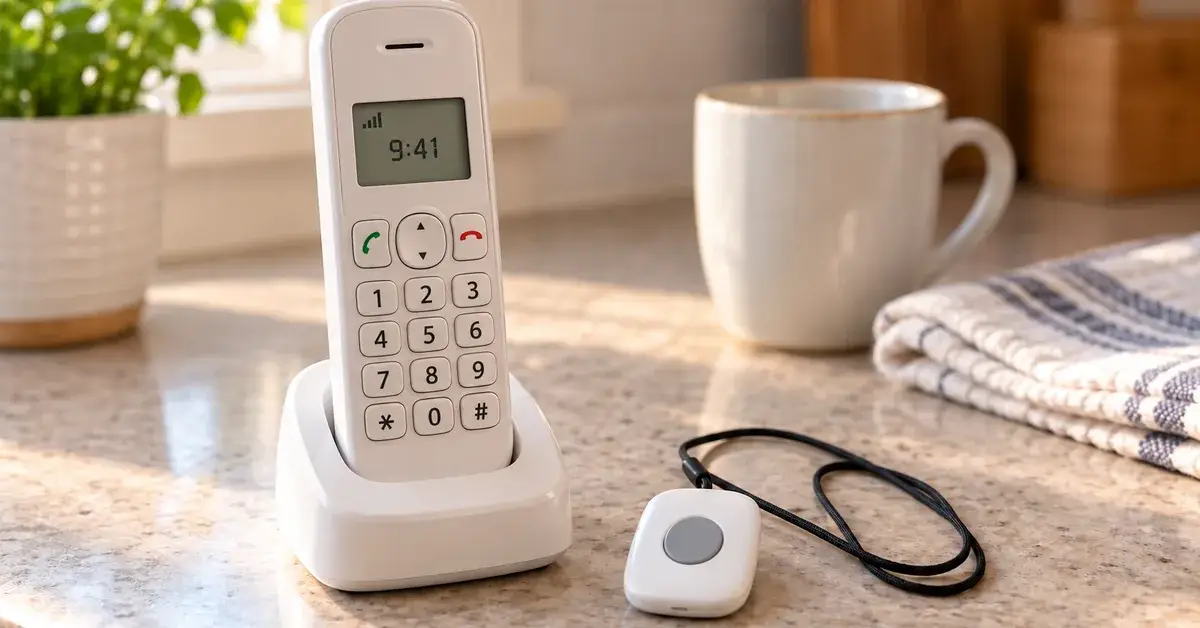
With our Home Freedom system, a base unit sits in the home and the help button is worn as a pendant or on the wrist. The button is waterproof, so it can stay on in the shower, which is one of the places a walker cannot follow. The button is rated for a 600 to 800 foot line-of-sight range from the base. One press connects through the base unit’s two-way speaker to our 24/7 monitoring centre in Canada.
The part that suits a planned surgery is the response plan. When service is set up, Bedford Medical Alert® records the details our operators use on every call: medical information, medications, where a spare key is kept, and the order in which your contacts are called. Your Coach goes on that list. So does the neighbour with the key. Set it up before the surgery date and it is ready the afternoon you come home.
An optional fall detection pendant, worn as a necklace, is designed to sense the motion pattern of a fall and place a call automatically. It is a backup to the button, not a guarantee. No sensor on the market catches every fall.
Plans typically run month to month after a three-month minimum at the start, with optional six or twelve month initial terms if the savings suit you. Service reverts to month to month afterwards, and there are no cancellation fees. The equipment is included with the subscription, and Easy Setup means it can be plugged in and tested well before the surgery date.
About us
Bedford is Canadian-owned and operated, an OCSA member, and brings three generations of experience. We have supported hospital education programs and research initiatives from UHN Toronto Rehab to Trillium Health. We are not clinicians. Every question about the new joint belongs with your surgical team.
Getting the house ready before a hip or knee replacement? See how our Home Freedom in-home medical alert systems put a 24/7 Canadian monitoring centre one press away, or call 1-888-755-3055 to talk it through with our care team.
Sources (read on 23 November 2026)
- Canadian Institute for Health Information, “CJRR annual report: Hip and knee replacements in Canada, 2024-2025” (January 27, 2026): cihi.ca
- Canadian Institute for Health Information, “Wait Times for Hip Replacement (Percentage Meeting Benchmark)” and “Wait Times for Knee Replacement (Percentage Meeting Benchmark)” indicators (data updated June 2026): hip, knee
- Alberta Health Services, MyHealth.Alberta.ca, “Having a Hip Replacement”: “Going home” and “Equipment you’ll need” (both current as of July 18, 2025): going home, equipment
- Alberta Health Services, MyHealth.Alberta.ca, “Having a Knee Replacement”: “Going home” and “Equipment you’ll need” (both current as of October 7, 2025): going home, equipment
- North York General Hospital, “Total Hip Replacement Surgery Patient Guide” (no date printed in the guide; the PDF is dated February 29, 2024 and is the copy linked from the hospital’s Total Joint Assessment Centre page on the day of reading): nygh.on.ca
- Bedford Medical Alert, the Home Freedom page linked above (device features as published on the day of reading)