
People sometimes reach our website by searching for an epilepsy watch.
We do not sell a seizure-detection watch, and nothing in our range detects a seizure. Whoever typed those words deserves a straight answer before anything else, so this page starts there. It is written for adults living with a disability or a long-term health condition who want a dependable way to call for help on their own terms, and for the people who help them think it through.
We are Bedford Medical Alert®, Canadian-owned and operated, with 24/7 monitoring based in Canada. We are an OCSA member and bring three generations of experience. Most of the people we serve are older. Plenty are not. The equipment works the same way for both, and so do its limits.
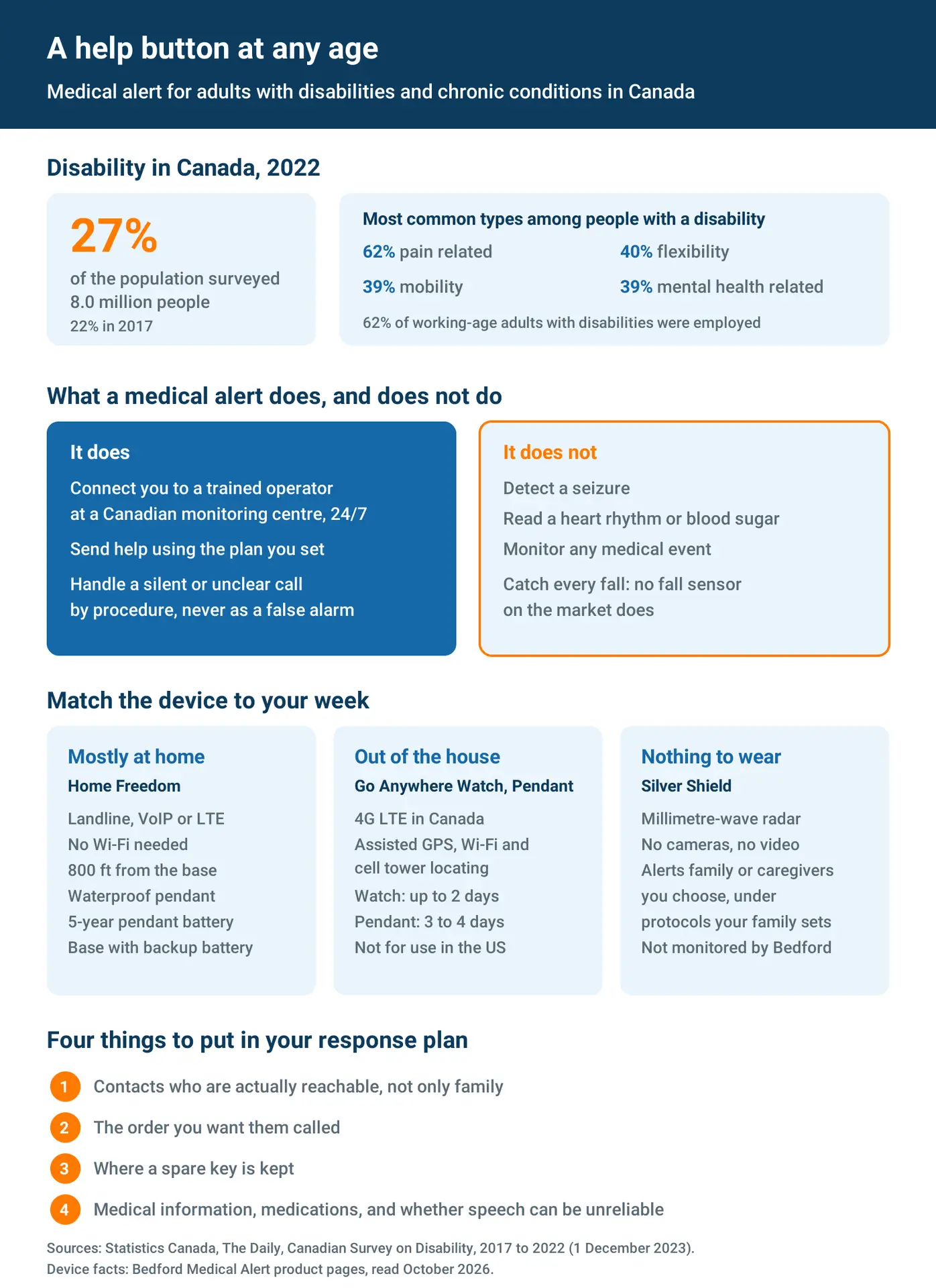
Statistics Canada’s release of 1 December 2023 on the Canadian Survey on Disability, 2017 to 2022, found that 8.0 million people, 27 per cent of the population the survey covered, had one or more disabilities that limited them in their daily activities. In 2017 the share was 22 per cent.
Pain-related disability was the most common type, reported by 62 per cent of people with a disability. Flexibility (40 per cent), mobility (39 per cent) and mental health-related disabilities (39 per cent) followed.
Most of those people are not retired. In the same release, 62 per cent of working-age adults with disabilities were employed in 2022, compared with 78 per cent of people without disabilities.
Some conditions are common enough here to be worth naming on their own. MS Canada, summarizing the Atlas of MS (3rd edition, September 2020) in December 2020, counted over 90,000 Canadians living with multiple sclerosis, about 1 in every 400, and noted that Canada has one of the highest rates of MS in the world.
Our own product pages were never written for one age group. The Go Anywhere Watch page describes it as designed for anyone who values safety and independence, and names hikers, solo travellers and people who work alone among the people who wear one.
A Bedford medical alert does one job. You press a button, a trained operator at our Canadian monitoring centre answers through the device’s two-way speaker, and help is sent according to a plan you set up in advance.
It does not monitor your body. None of our devices detects a seizure, reads a heart rhythm, measures blood sugar or watches for any other medical event.
Some of our devices offer automatic fall detection. It responds to the movement of a hard fall and calls the monitoring centre when you cannot press the button yourself. That is useful, and it is also imperfect: no sensor on the market catches every fall, and a fall detector is not a seizure monitor. If seizure detection is what you need, raise it with your neurologist or epilepsy clinic. It is a separate category of product, and not one we sell.
One more mix-up is worth clearing early. A MedicAlert ID bracelet, from the MedicAlert Foundation, is engraved with your conditions and medications so that first responders can read them once they reach you. It informs. It does not call anyone. A medical alert system is the thing that brings someone to you in the first place. The two do different jobs and some people wear both; our page on MedicAlert versus a medical alert system sets out the difference in full.
If you work from home, or spend most days there for any reason, the home system is usually the place to start. The risky moments tend to happen in the same rooms all week.
Bedford’s Home Freedom system works with a traditional landline or a VoIP line, and there is an LTE option if the home has neither. It needs no Wi-Fi. The base unit has a backup battery.
The button works up to 800 feet from the base. The Mini Pendant can be worn on a cord or on a wristband, in Velcro or hypoallergenic silicone, and it is fully waterproof, so it stays on in the shower or bath. Its battery is rated for five years.
The speaker sits in the base, which means placement matters more than people expect. Put the base where you actually spend the day. If that is a desk in a spare room, test it from there: press the button, then check that you can hear the operator and be heard.
If hearing, vision, grip strength or memory makes a standard setup hard to use, our page on accessible medical alert devices covers the adjustments, including help buttons that are easier to trigger.
Working out what fits a household where nobody is retired? Call the Bedford team at 1-888-755-3055 for a complimentary consultation by phone. Tell us what your week looks like, and we will tell you plainly which device suits it and which does not.
The Go Anywhere Pendant and the Go Anywhere Watch take the same help button out the door. Both connect over 4G LTE in Canada. Both locate you with assisted GPS, which also indexes nearby Wi-Fi networks and uses cell tower triangulation. Both are IP67 rated and can be worn in the shower.
Battery life is where they differ, and where your routine decides:
If charging every night is already part of your day, either works. If it is not, that difference matters more than any feature list.
The pendant is usually worn as a necklace, and it can be carried in a belt pocket on request. If you have a pacemaker, our product page does not recommend wearing the Go Anywhere Pendant as a necklace, because it has built-in magnets; a belt-worn option is offered instead. For the Home Freedom system, we provide the device specifications for you to give your doctor or cardiologist, who can confirm compatibility.
One limit to know before you book a trip: Bedford devices are not for use in the United States.
A medical alert call is a voice call. Some days, for all sorts of reasons, speaking is harder than others.
At Bedford, an operator does not assume that a silent or unclear call is a false alarm. They follow a set procedure for it, and your personalized response plan takes over. That plan can hold your medical information, the medications you take, where a spare key is kept, who your emergency contacts are and the order you want them called. Our page on what happens when you press a medical alert button walks through the sequence step by step.
So write it down. If there are days when speech is unreliable for you, put that in the plan, and the operator will work from what the plan says rather than from what you can manage to say at that moment.
Medical alert advertising tends to picture an adult daughter as the first call. Your plan can name whoever is actually reachable: a partner at work across town, a sibling, a friend two streets over, a neighbour who keeps a key. Each person should know they are on the list and know where they sit in the order.
Someone who wants more visibility than a phone call can use the Bedford Medical Alert app, available for iPhone and Android. A designated caregiver can see the device’s location on demand, along with its status and battery level, which is handy when the person wearing it is out for the day.
Some people take a wristband off to type, or cannot tolerate anything on the skin for long. For them, Silver Shield may be the better fit. It is a non-wearable sensor that uses millimetre-wave radar, without cameras or video, to recognize hard falls in the room it covers, and several sensors can cover one home.
It works differently from everything above. Silver Shield is not monitored by Bedford staff. It alerts the family members or caregivers you choose, automatically, under protocols your family sets. Like any fall sensor, it will not catch every fall, and it is only as good as the people on its alert list are reachable.
Every Bedford plan includes the medical alert equipment, so there is no separate device to buy. Plans typically run month to month after a three-month minimum at the start, with optional six or twelve month initial terms if the savings suit you. Service reverts to month to month afterwards, and there are no cancellation fees.
Some people pay for a medical alert through a funding program rather than out of pocket. In Ontario, the Ontario Disability Support Program and the Passport Program for adults with a developmental disability are two that adults with disabilities deal with. Whether either pays toward a medical alert depends on the program and on your own circumstances, and applications go through the program itself, usually with a case worker. We cannot complete them on your behalf. Our guide to medical alert funding in Canada sets out the main kinds of help across the country.
Canadian families rate us 4.9 stars on Google. We are trusted by clinicians across Canada and have supported hospital education programs and research initiatives from UHN Toronto Rehab to Trillium Health. None of that changes the plain fact this page started with: a help button gets a person to you. Choosing the right one comes down to how your week runs and who you would want called.
Spending your days out at work, appointments or errands? See how the Bedford Go Anywhere systems work outside the home, or call the Bedford team at 1-888-755-3055. Easy Setup, equipment included, and a Canadian monitoring centre answering 24/7.