
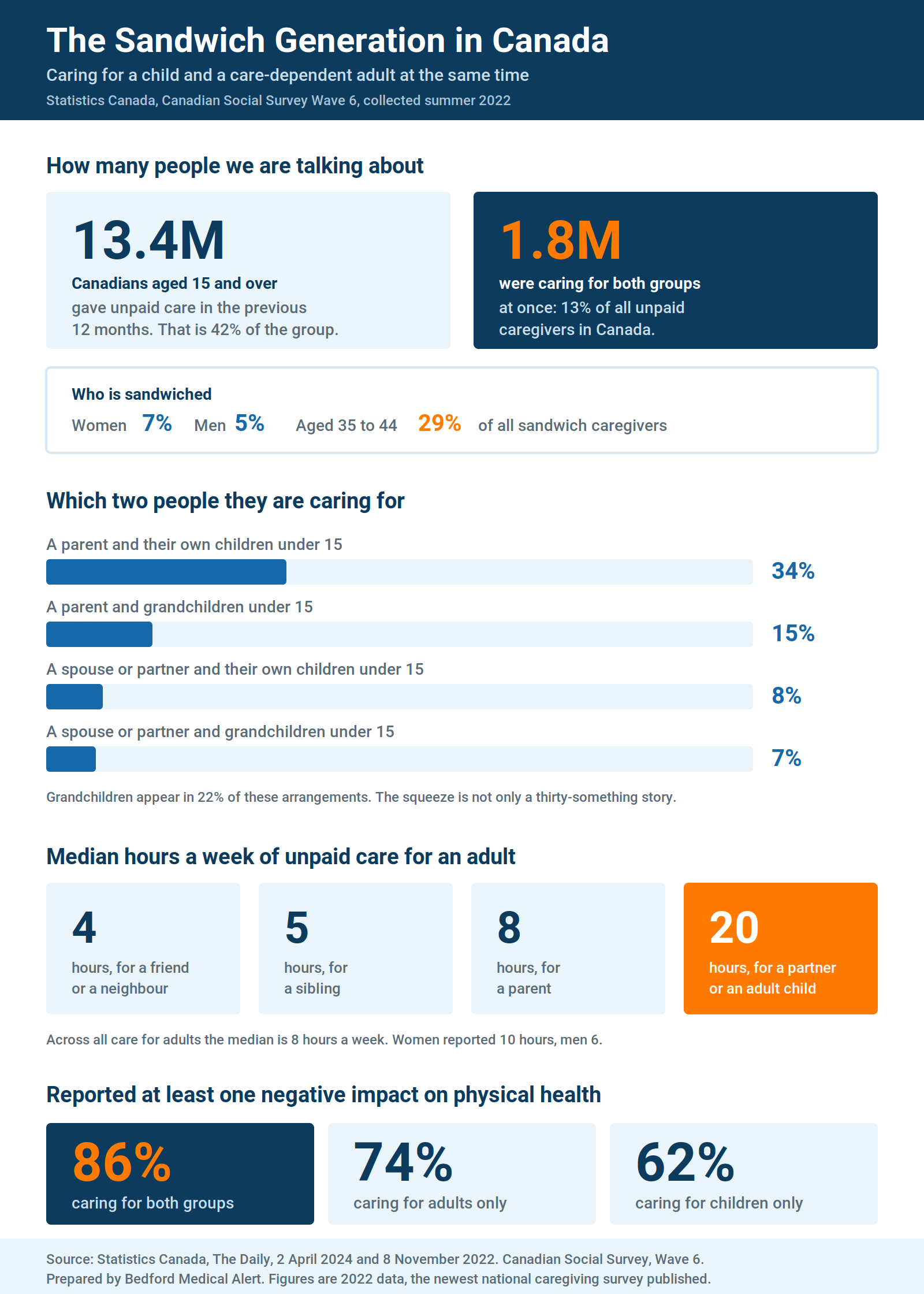
Statistics Canada has a definition for this, and it is narrower than the way the phrase usually gets used. A sandwich caregiver is someone who, in the twelve months before the survey, gave unpaid care both to a child under 15 and to a youth or adult living with a long term condition or disability. Counted that way, 1.8 million Canadians were sandwiched in 2022.
This page is a reference. Every figure below carries the survey it came from and the year it was collected, and where the newest national number is four years old, it says so.
We publish it because of who calls us. A large share of the people who set up a system with Bedford Medical Alert® are adult children in exactly this position, arranging safety for a parent between a work call and a school pickup. The numbers below are the shape of that group.
The source for the national picture is the Canadian Social Survey, Wave 6, on well-being and caregiving, collected by Statistics Canada in the summer of 2022.
In that survey, 13.4 million Canadians aged 15 and older, or 42 per cent of that age group, had given unpaid care in the previous twelve months, either to children under 15 or to youth and adults with a long term condition or disability. Of those caregivers, 13 per cent were caring for both groups. That is the 1.8 million figure.
Broken out by gender, 7 per cent of women and 5 per cent of men were sandwich caregivers. The concentration is in the middle of working life: nearly 3 in 10 sandwich caregivers, 29 per cent, were between 35 and 44.
One number that surprises people: Statistics Canada released this as the first detailed portrait of sandwich caregivers in Canada in close to twenty years. The group is talked about constantly and measured rarely.
The stock image is a parent in their forties with a toddler and an aging mother. That combination is the largest single one, but it is a third of the picture, not the whole of it.
Among sandwich caregivers in 2022:
The grandparent slice matters. A meaningful share of the people being squeezed are not thirty-somethings at all; they are in their sixties, helping with grandchildren while also supporting a parent or a partner.
Care hours are where the abstraction becomes a schedule.
In 2022, unpaid caregivers looking after care-dependent adults spent a median of 8 hours a week on that care. The split by gender is wide: women reported a median of 10 hours, men 6.
The hours track the relationship more than anything else. Caring for a friend, colleague or neighbour ran to a median of 4 hours a week. A sibling, 5 hours. A parent, 8 hours. A spouse or partner, or an adult child, 20 hours a week, which is a half-time job on top of whatever else the week holds.
Most of that care is for a parent. Among Canadians giving unpaid care to a care-dependent adult, 53 per cent were caring for a parent, ahead of a spouse or partner at 18 per cent.
If you are arranging safety for a parent while your own week is already full, the setup is meant to take one phone call, not a project plan. Equipment is included with the service, there is no long-term contract, and our team walks you through the response plan: who gets called, in what order, and what happens if nobody picks up. Call 1-888-755-3055 and we can work out what fits.
Statistics Canada compared sandwich caregivers against caregivers who were looking after only one group, and the gap is consistent.
In 2022, 86 per cent of sandwich caregivers reported at least one negative impact on their physical health and well-being. For people caring only for adults the figure was 74 per cent, and for people caring only for children, 62 per cent.
The specific impacts sandwich caregivers reported most: feeling tired, 69 per cent. Worried or anxious, 65 per cent. Overwhelmed, 50 per cent.
For context, across all unpaid caregivers in the same survey, 56 per cent reported feeling tired, 44 per cent worried or anxious, and 37 per cent overwhelmed. Roughly 3 in 10 reported disturbed sleep. And 30 per cent reported no impact on their physical or mental health at all, which is worth stating plainly, because a page like this can otherwise read as though strain is universal. It is not.
Work and money show up too. Just over one third of sandwich caregivers, 35 per cent, reported financial hardship in the previous twelve months because of their caregiving responsibilities. Among sandwiched caregivers who had not retired, 66 per cent said caregiving had affected their employment or their job-seeking: adjusting a schedule, cutting hours, or letting an opportunity go. Household costs are a separate question with its own answers, and we cover those in the cost of caring for elderly parents in Canada.
The Statistics Canada data is the authoritative national count. For something more current, the Canadian Centre for Caregiving Excellence published Caring in Canada 2026 on 6 May 2026, drawing on survey responses from more than 2,600 unpaid caregivers and paid care providers.
From that report: 49 per cent of caregivers face financial strain, and one in five spend more than $12,000 a year out of pocket. More than 20 per cent have stopped saving entirely. Fifty-nine per cent are balancing paid work with care, and of those, 36 per cent said their productivity suffered or they lost earnings. Seventy-seven per cent reported negative impacts on their well-being. Sixty-one per cent do not feel supported by government.
CCCE puts the number of caregivers in Canada at more than eight million, with one in four Canadians currently a caregiver and at least half expected to take on the role at some point.
That eight million sits next to Statistics Canada’s 13.4 million, and the gap is a definitional one rather than a contradiction: the two organizations count different things over different windows. If you are citing either number, cite the definition with it.
In Ontario specifically, the Ontario Caregiver Organization describes four million Ontarians caring for a loved one, of whom 69 per cent say they are not sure they can continue. Its annual Spotlight Report, last published in December 2025, tracks the same ground province by province.
The newest published national caregiving data in Canada is still from 2022. That is worth knowing before anyone quotes it as today’s picture.
A fresher one is on its way. Statistics Canada is running the 2026 General Social Survey on Well-being and Unpaid Care, with collection scheduled from 1 April to 31 December 2026. When those results publish, the figures on this page will be revised against them rather than left to age quietly.
Worth being straight about this. Nothing in the research above suggests that a medical alert system reduces caregiving hours, and we are not going to claim it does. The 8 hours a week stay 8 hours a week.
What changes is narrower and specific: the hours you are not there. A monitored pendant or watch gives the person you care for a way to reach a live operator without finding a phone, and it gives you a defined place in the response. When a family sets up service with us, we build a response plan: who the operator calls, in what order, and what happens if nobody answers. You can sit at the top of that list or further down it, which is a real decision families make differently depending on who lives closest. That process is described in more detail in what happens when you press a medical alert button.
Fall detection is worth a plain sentence too. The technology works by sensing patterns of movement and impact, and it can place a call without the button being pressed. No sensor on the market catches every fall, and we would rather say that than imply otherwise.
If you are managing this from another city or another province, the practical arrangements change enough to be worth reading separately: we cover them in long distance caregiving in Canada. And for the demographic backdrop, why this squeeze is arriving for so many households at once, see Canada’s aging population and the shift from child care to elder care.
Three places worth knowing about, none of them ours.
The Ontario Caregiver Organization runs a free provincial helpline at 1-833-416-2273, with counselling, peer support and coaching programs behind it. The Canadian Centre for Caregiving Excellence publishes caregiver resources and the national research quoted above. And Statistics Canada’s caregiving releases are public and free to read, which is where every figure on this page came from.
Bedford is a member of the Ontario Community Support Association, and a good part of what our team does on the phone is point families toward the community supports that already exist near them. Ask.
Caring for a parent at home, from a week that is already full? Our Home Freedom system covers the house with a pendant or wristband and a base unit, monitored 24/7 from Canada, with equipment included and no long-term contract. See Home Freedom systems or call 1-888-755-3055 and we will talk through what your parent’s home actually needs.