
Almost one in five Ontario caregivers took the person they care for to a hospital emergency room because they needed a break. That figure is from the Ontario Caregiver Organization’s Spotlight Report of December 2025, and the report puts the total at an estimated 1.9 million emergency visits in a single year for caregiver respite.
Read that again, because it is a strange and specific thing to measure. It says that for a large number of families, the only door that reliably opens at 2 a.m. is the hospital one.
The Ontario Caregiver Organization surveyed 903 self-identified caregivers in Ontario for that December 2025 report. Sixty-nine per cent said they felt so burnt out they were not sure how they could continue, which was down from 72 per cent in its 2024 survey. Sixty-eight per cent said they had hit their breaking point, down from 72 per cent. In the year covered, 28 per cent stopped or reduced their caregiving because of the stress, and another 18 per cent said they needed to stop but could not, because nobody else would step in.
Nationally, the Canadian Centre for Caregiving Excellence’s Caring in Canada 2026 report, drawn from a 2025 survey of more than 2,600 caregivers and care providers conducted by Leger, found that 77 per cent reported negative effects on their well-being, including stress, fatigue and burnout. The Canadian Institute for Health Information, working from home-care assessment records rather than a survey, reported in 2018 that 45 per cent of unpaid caregivers of seniors with dementia showed symptoms of caregiver distress, against 26 per cent for caregivers of other seniors.
Three organizations, three methods, one direction.
Here the ground changes. Prevalence is well measured in Canada. Whether the supports we offer caregivers work is measured much less well, and the honest way to show that is to name the reviews and say what each one found.
Cochrane reviews are a reasonable place to look, because Cochrane publishes not only the result but its own confidence in the result. Four of its reviews are relevant, and one caution applies to all four: every single one studies carers of people with dementia. None of them is a study of caregiving in general. If you are caring for a parent after a stroke or a hip fracture, these findings are the closest evidence available to you, and they are not evidence about you.
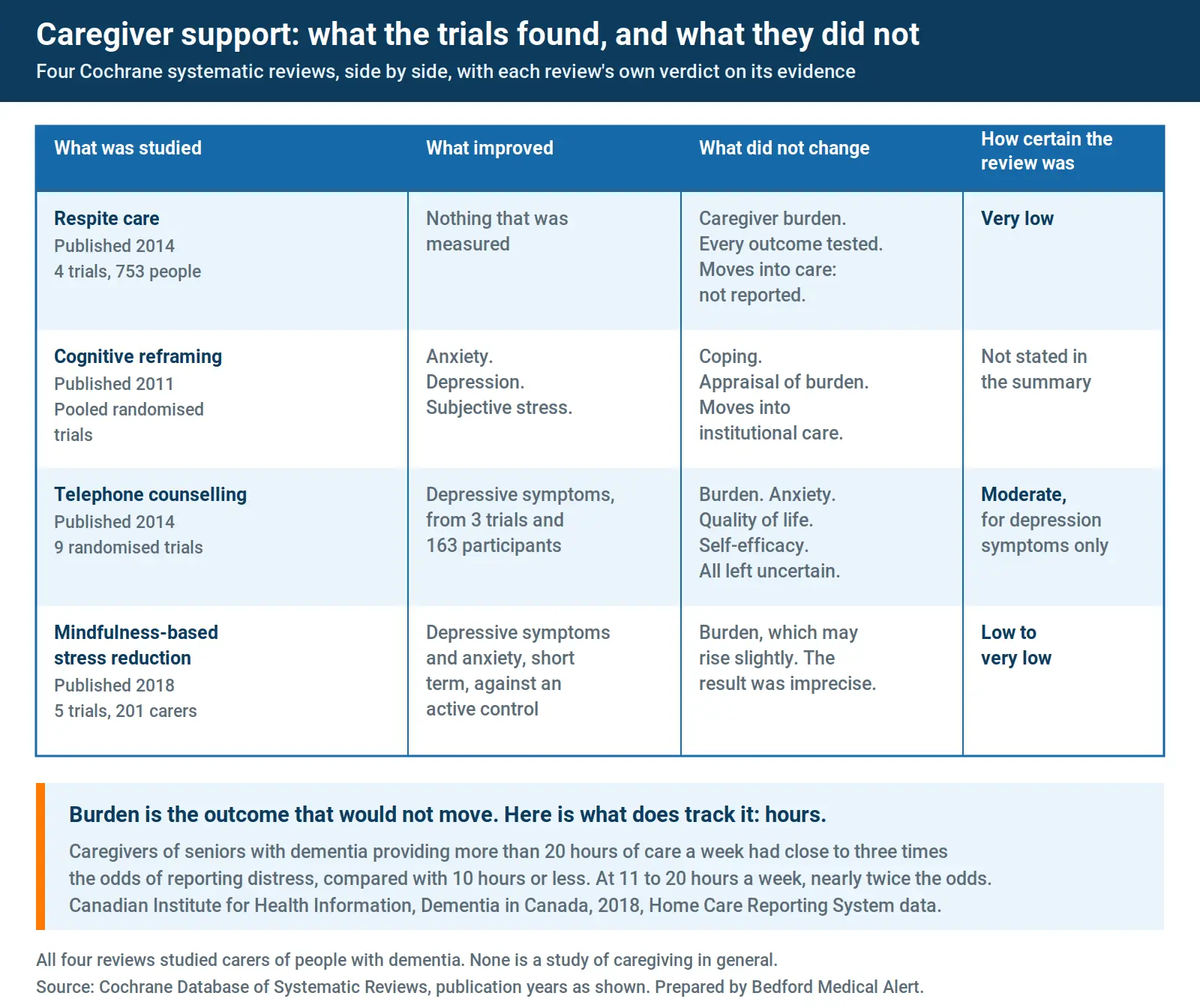
Respite is the support caregivers ask for most often, and it is the one with the thinnest evidence behind it.
The Cochrane review of respite care for people with dementia and their carers, by Maayan, Soares-Weiser and Lee, published on 16 January 2014, found four trials covering 753 people. Comparing respite care with no respite care, it found no significant effect on any caregiver outcome that was measured, including caregiver burden. None of the trials reported the rate at which the person being cared for moved into an institution, which was the question the review set out to answer. The review rated the overall quality of that evidence as very low.
The authors were careful about what this means, and so should anyone quoting them be. Their conclusion states that the results may reflect the lack of high-quality research in the area rather than an actual lack of benefit, and that given how frequently respite care is advocated and provided, well-designed trials are needed. So the finding licenses one claim and only one: respite has never been properly tested. Any stronger reading goes beyond what four small trials can carry.
The interventions built around structured conversation have held up better, though none of them dramatically.
Cognitive reframing, which works on a carer’s beliefs about their responsibilities and about why the person they care for behaves as they do, was reviewed by Vernooij-Dassen, Draskovic, McCleery and Downs, published 9 November 2011. Pooled data showed a beneficial effect on anxiety, depression and subjective stress. It showed no effect on carers’ coping, on their appraisal of the burden, or on institutionalisation. Telephone counselling was reviewed by Lins and colleagues, published 1 September 2014, across nine randomised trials. It reduced depressive symptoms, on moderate-quality evidence from three trials and 163 participants, and the estimated effects on burden, distress, anxiety and quality of life were all uncertain.
Mindfulness-based stress reduction was reviewed by Liu, Sun and Zhong, published 14 August 2018, across five trials and 201 carers. Compared with an active control, it may reduce depressive symptoms and anxiety in the short term. It may also slightly increase carers’ sense of burden, although that result was imprecise. The review graded its own evidence as low to very low.
Put the four reviews beside each other and the same line appears in three of them, in different words. Anxiety moved. Depression moved. Stress moved. Burden did not.
That is not a small detail. It suggests that the supports we have tested change how a caregiver feels about the week without changing the week, and there is Canadian data pointing at what does track burden: hours. The Canadian Institute for Health Information’s 2018 analysis of home care records found that caregivers of seniors with dementia who provided more than 20 hours of care a week had close to three times the odds of reporting distress compared with those providing 10 hours or less, and those providing 11 to 20 hours had nearly twice the odds. The Ontario Caregiver Organization found that the share of Ontario caregivers giving more than 10 hours a week rose from 34 per cent in 2024 to 38 per cent in 2025.
Both kinds of support matter. Only one of them has been properly studied.
If the hours nobody is in the house are the part that keeps you awake, that is a practical problem with practical answers, and it is worth half an hour on the phone before you decide anything. Bedford’s Canadian care team will walk through a parent’s actual daily routine with you over the phone, a complimentary phone consultation with no obligation. Call 1-888-755-3055.
The Ontario Caregiver Organization asked its 2025 respondents what support they wanted for burnout and stress, and the answers are worth reading in order. Support for their own physical health came first at 30 per cent. Respite care for the person they care for, so they could have a break, came next at 28 per cent, tied with mental health counselling services. Caregiver support groups followed at 21 per cent, then coaching services and education on caregiving topics at 19 per cent each, and being matched with another caregiver at 16 per cent.
Set that against the evidence and the mismatch is uncomfortable. The support caregivers name most is the one with the weakest trial base. The supports with the better trial base, the structured education and counselling and peer arrangements, sit lower on the list, partly because a lot of caregivers have never been offered them.
Asked more broadly what would make them successful, the same respondents put financial support first at 24 per cent and faster access to health services second at 18 per cent.
If you are going to ask for help, the evidence and the survey data point the same way about how. Ask for hours rather than for sympathy, name the specific block of time and the specific task, and ask the care team as well as the family, because home care coordinators and hospital discharge planners can sometimes find respite hours that relatives cannot. The Ontario Caregiver Organization, which is funded by the Ontario Ministry of Health, runs a helpline, peer support and free education programs, and its number and programme list are published on its own site.
Bedford Medical Alert® is in the business of answering calls for help, and it is worth being exact about where that sits in everything above. No study named on this page tested a medical alert system, and nothing here should be read as evidence that a device reduces caregiver burnout or distress. It would be easy to write that sentence the other way, and it would not be true.
What monitoring does is narrower and more honest to describe. It covers the hours when nobody is in the house. Bedford is Canadian-owned, its monitoring is based in Canada and runs 24 hours a day, and its operators work from a personalized response plan for each client, so the person answering already has the address, the medications that matter and the order in which family should be called. Equipment is included with the subscription, setup is Easy Setup, and plans are month to month or annual with a three-month minimum at the start and no cancellation fees. Bedford is a member of the Ontario Community Support Association and has supported hospital education programs and research initiatives from UHN Toronto Rehab to Trillium Health, and the company brings three generations of experience to the work.
Some devices also offer automatic fall detection, which is worth understanding in general terms rather than relying on: no sensor on the market catches every fall, and it is best treated as a backup to the help button.
None of that reduces a caregiver’s hours. It changes what happens during the hours they are not there, which is a different claim, and a smaller one, and one Bedford can actually stand behind.
Ontario Caregiver Organization, Spotlight on Ontario Caregivers, December 2025 (online survey, 903 Ontario caregivers aged 16 and over). Canadian Centre for Caregiving Excellence, Caring in Canada 2026, from the 2025 National Caregiving Survey of more than 2,600 caregivers and care providers, conducted by Leger. Canadian Institute for Health Information, Dementia in Canada, unpaid caregiver chapter, published June 2018, using Home Care Reporting System data. Cochrane Database of Systematic Reviews: Maayan, Soares-Weiser and Lee on respite care, 2014; Vernooij-Dassen, Draskovic, McCleery and Downs on cognitive reframing, 2011; Lins and colleagues on telephone counselling, 2014; Liu, Sun and Zhong on mindfulness-based stress reduction, 2018.
If you are caring from another city or province, long distance caregiving in Canada covers the visibility problem specifically. For the device-fit question, medical alert systems for family caregivers is the practical guide, and because every review above concerns dementia caregiving, living alone with dementia is the closest companion piece on this site. Our twenty-year data reference, Canadian seniors statistics, sets the wider trend context.
Covering the hours you cannot be there is one practical piece of a much larger problem, and it is the piece we can help with. Bedford Home Freedom brings 24/7 Canadian monitoring into your parent’s home, with equipment included, Easy Setup and no long-term contract. Call 1-888-755-3055 to talk it through with our Canadian care team.