
We went looking for the number first, the way any family would: something official and Canadian that Bedford Medical Alert® could point people to. Call twice a week. Visit every ten days. Some published figure a daughter could measure herself against. It does not appear to exist. Statistics Canada measures how many older Canadians feel lonely. The National Seniors Council maps who is most at risk of becoming isolated. Neither one publishes a recommended contact frequency, and after a morning spent in the sources listed at the end of this page, we could not find a Canadian body that does.
So nobody can tell you that you are calling enough. What the research can do is show which parents are actually at risk, and that turns out to be more useful than a number would have been.
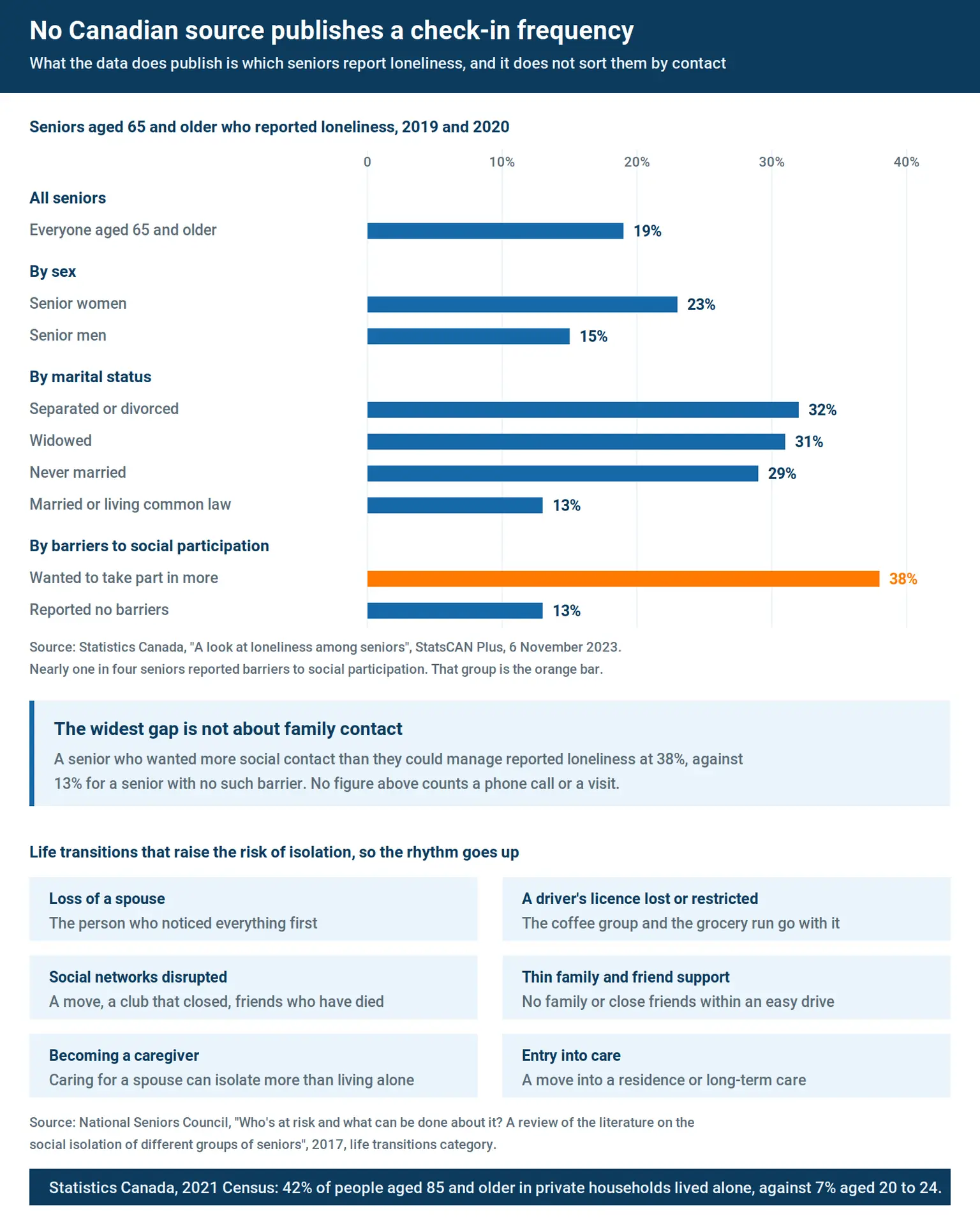
Statistics Canada reported in November 2023 that 19 per cent of Canadians aged 65 and older experienced loneliness in 2019 and 2020. Senior women reported it at 23 per cent, senior men at 15 per cent.
Sort those same seniors by circumstance and the gaps open up. In the same Statistics Canada figures for 2019 and 2020, widowed seniors reported loneliness at 31 per cent. Separated or divorced, 32 per cent. Never married, 29 per cent. Married or living common law, 13 per cent. Income moved it as well, from 25 per cent in the lowest income group to 15 per cent in the highest. Age moved it least of all: 23 per cent among those 85 and older, against 19 per cent among those 65 to 74.
The widest gap in that Statistics Canada study has nothing to do with family at all. Nearly one in four seniors said they faced barriers to social participation, meaning they wanted to take part in more social and recreational activities than they were able to. Among those seniors, 38 per cent reported loneliness. Among seniors who reported no such barriers, 13 per cent. Nearly three times the rate, on the same survey, in the same two years.
Sit with that pair for a second. Not one of these figures counts a phone call or a visit. What the data sorts on is whether a person still has a route into other people: a spouse at the breakfast table, an income that covers the taxi, a knee that manages the stairs at the community centre.
Statistics Canada tracks the same question quarterly through its Quality of Life Hub, updated on 23 January 2026, and had 13.2 per cent of the population reporting loneliness often or always in the second quarter of 2025. That figure covers everyone, not seniors, and it is included here only to show the measurement is ongoing rather than a one-off. What prolonged isolation does to health is a separate subject, and we wrote it up in our note on the health risks of loneliness for seniors.
One more figure, and this one is about houses rather than feelings. In the 2021 Census, reported by Statistics Canada in July 2022, people living alone made up 42 per cent of everyone aged 85 and older in private households. The full age ladder, from 65 to 69 up to 85 and older across three censuses, is on our page on how many Canadian seniors live alone. Among people aged 20 to 24, the figure was 7 per cent.
Living alone is not the same as being lonely, and the two are counted separately: one is a household on a census form, the other is an answer to a survey question about how often you feel lonely. Plenty of people live alone by preference and are perfectly content. What living alone changes is the arithmetic of an ordinary bad afternoon. In a house with two people in it, the time between something happening and somebody noticing is measured in minutes. In a house with one, it is measured by whatever the contact rhythm happens to be.
That is the question underneath the question. “Am I calling enough” usually stands in for “how long would it be before I knew”.
If there is no general number, there are specific moments, and the National Seniors Council named them in its 2017 review of the literature on social isolation. The review groups risk factors into nine categories. One of those categories is life transitions, and its list is unusually concrete. It includes loss of a spouse, disruption of social networks, lack of family and friend supports, loss or restriction of a driver’s licence, entry into care, and the demands of caregiving itself.
Read that as a calendar rather than a risk register. A licence surrendered in March makes for a different house by June, because the coffee group, the grocery run and the Thursday drive to a friend’s place all went with it. Bereavement removes the person who noticed everything first, and usually a good deal of the household’s social calendar with them. Caregiving is on that list too, which catches families by surprise: a parent caring for a spouse with dementia can be more isolated than a parent living alone, and needs more contact rather than less.
Each of these is visible in advance. Each is a reason to move the rhythm up for a while, and none of them requires a diagnosis or a crisis to justify it. Deciding how a family will respond before the transition arrives is easier than deciding during it, which is the argument of our guide to planning ahead for aging parents.
Here is what we would suggest, and it is deliberately unambitious.
Set the rhythm at what you can hold in your worst week, not your best. Two ten-minute calls that happen every week beat an hour every Sunday that gets missed twice a month, because the value of a rhythm is that its absence is noticeable. If Tuesday goes quiet, somebody wonders why. An hour that floats has no Tuesday to go quiet.
Name who has which day out loud if there is more than one of you. An unnamed rota tends to collapse into a single Sunday call and four days of silence in the middle of the week, with every sibling assuming another one covered Wednesday.
Attach it to something already in your week. The drive home on Tuesdays. The twenty minutes after the school run. A rhythm hung on a habit survives a busy month; a rhythm that depends on remembering does not.
Change the channel sometimes. A call tells you how somebody sounds. A visit tells you what the kitchen looks like, whether the mail is opened, whether the laundry has moved since the last time, whether the stairs have started coming up in conversation.
And ask a better question. “How are you feeling” invites one word, and the word is almost always “fine”. “Who did you see this week?” produces information. It also lands squarely on the strongest finding in the Statistics Canada data, because the seniors reporting the most loneliness were the ones who wanted to take part in more than they could manage. An answer of “nobody, really” is worth more of your attention than a fall on the stairs that did not happen, and it points at things a family can act on: a ride to the community centre, a neighbour asked to knock, a standing lunch that somebody else drives to.
Not sure whether your parent’s situation calls for more than a rhythm? Our Canadian care team will walk through an ordinary week at your parent’s house with you, on the phone, with no obligation and nothing to sign. Call Bedford at 1-888-755-3055 and ask.
Being straight about this is the only thing that makes the rest of the page worth reading. Two ten-minute calls a week come to twenty minutes. The week has a hundred and sixty-eight hours in it, and nobody can be on the phone at three in the morning on the off chance. Families who end up looking at a monitored device are usually looking at that gap rather than at their own call log.
This is the part we can speak to directly, and the part where we will not stretch a claim. A help button does not make anybody less lonely. It does not replace a visit. It does not notice an empty fridge, and it is no substitute for anybody’s Tuesday call. What it covers is the one gap a rhythm cannot: the hours when nobody is there and something happens.
With the Home Freedom system that means a lightweight button worn as a pendant or on the wrist, and a base unit in the house. Press it and a live operator at a monitoring centre based in Canada answers, around the clock, then works through a response plan your family set up in advance. That plan records who gets called and in what order, and when emergency services go instead. Equipment is included with the subscription. Easy Setup means it is working within minutes of the box arriving. Plans typically run month to month after a three-month minimum at the start, and there are no cancellation fees, so it never becomes a decision anybody has to defend for a year. We set out the sequence of a real call in plain language in what happens when you press a medical alert button.
Living in another city or another province changes the answer in ways worth their own page, and we wrote that one separately: caring for a parent in another city. The compressed version is that the further away you are, the more of the rhythm has to be shared with somebody local, and the more weight sits on what your parent’s own week tells you.
One practical note for families spread across provinces, because it comes up in setup. A Bedford response plan is not restricted to people who live nearby. The call order is whatever your family writes down, so a daughter in Halifax can sit above a neighbour two doors away, or below her, depending on who is actually likely to answer at two in the afternoon on a Wednesday.
There is no published number, so build one you can keep, put it on named days, and move it up when one of the transitions arrives. Then ask who your parent saw this week, and listen to the answer rather than the tone.
If what keeps you awake is the stretch between check-ins, that is the specific thing we cover. Bedford Home Freedom puts 24/7 Canadian monitoring in your parent’s home, with equipment included, Easy Setup and no long-term contract. Call 1-888-755-3055 and our Canadian care team will talk it through with you.