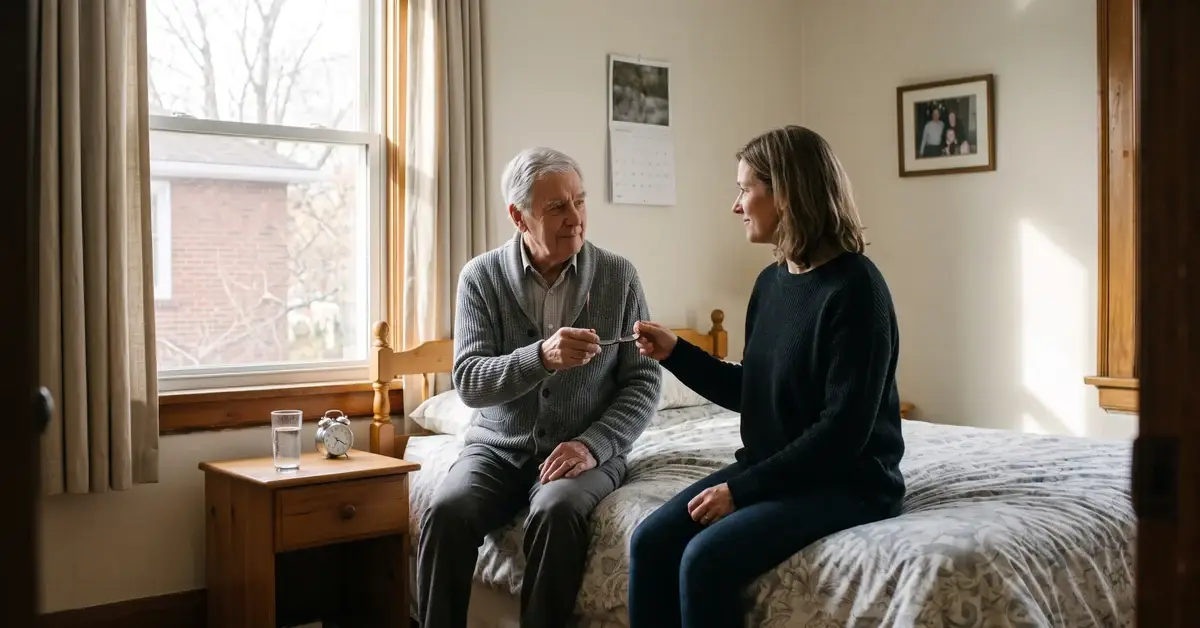
Your father was sharp on the phone the week before his surgery. Two days after he comes home, he asks what month it is, dozes through lunch, then wakes up convinced someone was in the kitchen overnight. By the next morning he seems almost himself again.
That pattern has a name, and it is worth knowing before discharge day rather than after.
Delirium is a sudden change in attention and thinking that develops over hours to a few days and tends to come and go through the day. That is how the Canadian Coalition for Seniors’ Mental Health (CCSMH) describes it in its delirium pocket card for clinicians, updated in 2024. Humber River Health’s patient leaflet (reviewed March 2024) puts it in plainer words: a sudden or worsening confusion that can follow an illness or surgery, or come on as a side effect of medicines, and that usually clears after a few days or weeks.
This post is for the family member who is trying to tell the difference between “tired from the hospital” and “something is wrong.” It does not replace the care team, and nothing here is a diagnosis.
Common in hospital, and often still there at discharge
Common enough that Ontario has a quality standard for it. Ontario Health’s Delirium quality standard, published in March 2021, describes delirium as very common in older people in hospital, with overall occurrence rates of 29% to 64%. It names intensive care (19% to 82%) and post-surgical care (11% to 51%) among the settings with the highest incidence rates. The standard cites a 2014 review in The Lancet by Inouye, Westendorp and Saczynski for those figures, and in that review the 29% to 64% range describes general medical and geriatric wards.
Ontario Health takes it seriously enough to run a multi-year campaign in hospitals across the province, Delirium Aware Safer Healthcare (DASH), and its campaign page (updated June 4, 2026) calls delirium “one of the leading causes of preventable hospital harms in Ontario.”
What those numbers mean at home is simple. A parent can be discharged while delirium is still clearing. The same standard says prolonged delirium, with symptoms that persist at or beyond discharge from hospital, may occur in 29% to 55% of patients.
Loud delirium, quiet delirium
When people picture hospital confusion, they picture the restless version: an older patient pulling at an IV line or trying to climb out of bed. CCSMH calls this hyperactive delirium.
The other kind is easy to miss. Hypoactive delirium looks like drowsiness and withdrawal. CCSMH’s card notes plainly that this type “can be easily missed,” and a March 2026 article on McMaster University’s Optimal Aging Portal, by Dr. Anthony J. Levinson, makes the same point about quiet delirium being just as urgent. At home, it can look like a parent who is simply worn out, sleeping more and answering in a word or two. Some people move between the two, which CCSMH calls mixed.
Signs the sources list that a family member at home is well placed to notice:
- trouble following a conversation or keeping attention on one thing
- confusion about the day, the time or where they are
- speech that wanders or does not make sense
- seeing or hearing things that are not there
- a change in sleep, such as awake at night and drowsy by day
- a personality change that is new since the hospital
The word that matters in every source is change. You know what your parent was like last month. The care team met them last Tuesday.
Delirium is not dementia, though one can hide the other
Dementia develops gradually over months and years. Delirium arrives over hours or days and fluctuates. That speed is the clue.
The two do overlap. CCSMH notes that people already living with dementia are more vulnerable, and can develop delirium from a relatively mild trigger. So a parent with a dementia diagnosis who suddenly gets much worse after a hospital stay should not have it written off as “the dementia progressing.” Ask. If your parent lives with dementia, our guide to living alone with dementia covers the longer-term planning, which is a different job from this one.
The first nights home, with no nurse down the hall
A hospital ward has a nurse at the desk at 3 a.m. A bungalow in Burlington does not.
The CCSMH card’s list of common causes includes several that travel home with a patient: a new medication, dehydration, an infection that is still resolving, glasses or hearing aids left in a bag. Recovery from orthopedic or cardiac surgery is on the list too. Put a drowsy, disoriented person alone in a house, add a night trip to the bathroom, and the confusion becomes dangerous through what happens during it. A fall in the hallway. A pill taken twice because the first dose was forgotten.
Delirium may also make it less likely that a person will ask for help, because asking requires recognizing that something is wrong.
Is a parent coming home from hospital soon? Call our care team at 1-888-755-3055 for a complimentary consultation by phone. Tell us the discharge date, the new medications and who will be staying over, and we will talk through whether an in-home medical alert fits the first weeks back.
What helps at home, in the sources’ own terms
None of this is treatment. It is the everyday support that CCSMH, Humber River Health and the McMaster portal all describe, adapted for a house instead of a ward.
- Glasses on, hearing aids in. CCSMH’s card lists aids for vision and hearing among its measures to prevent delirium. Unpack them the day your parent gets home.
- Fluids and regular meals. Both CCSMH and McMaster name hydration and nutrition. A glass of water beside the chair is a small, real thing.
- Day looks like day, night looks like night. Curtains open and up for meals in the daytime; dim and quiet at night. A clock and a calendar where your parent can see them.
- One current medication list. McMaster suggests keeping a full list, supplements included. Bring it to every follow-up appointment. Any question about a medicine goes to the doctor or pharmacist, not to a guess.
- A familiar voice. CCSMH encourages the presence of a family member or friend to help calm the person.
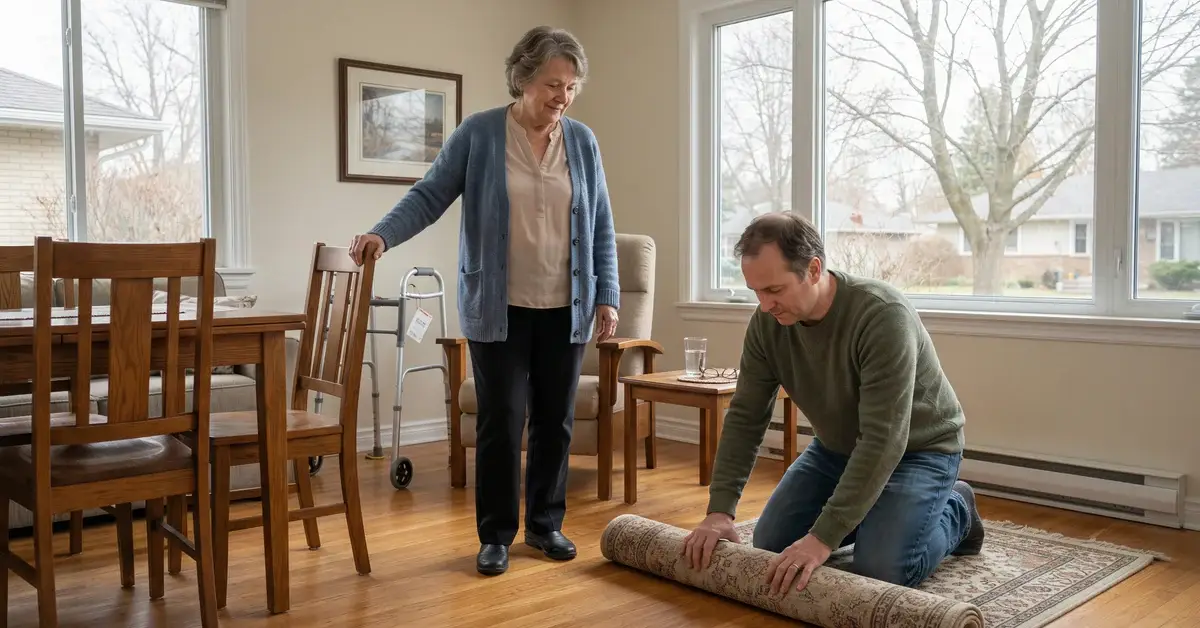
The discharge checklist itself (grab bars, night lights and a clear path to the bathroom) is laid out in our guide to coming home from the hospital. The questions to ask the team before your parent leaves are in our page on hospital readmission in seniors, including who is coordinating the plan and when the medications will be reviewed again.
When new confusion means call now
The McMaster article does not hedge: “Delirium is a medical emergency.” If you notice a sudden change in thinking or alertness that is new since your parent came home, contact their care team or doctor right away, or go to the nearest emergency department. Humber River Health’s leaflet says the same thing in hospital terms: tell the healthcare team right away.
If you cannot get your parent there safely, call 911.
You do not need to decide whether it is delirium. That is the clinician’s job. Yours is to say, clearly, “This is not how my mother was before she went in.”
No device detects confusion: what a medical alert still covers
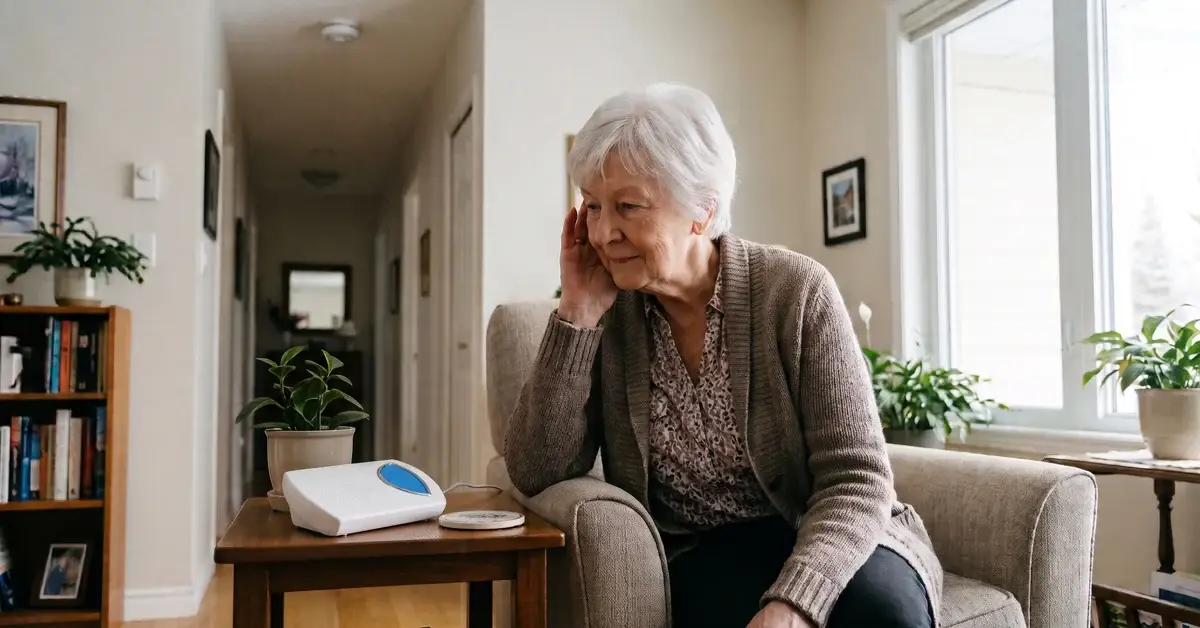
We should be plain about this. No medical alert device detects confusion, and a parent in the middle of delirium may not think to press a button at all. A help button is not a substitute for someone checking in during those first days.
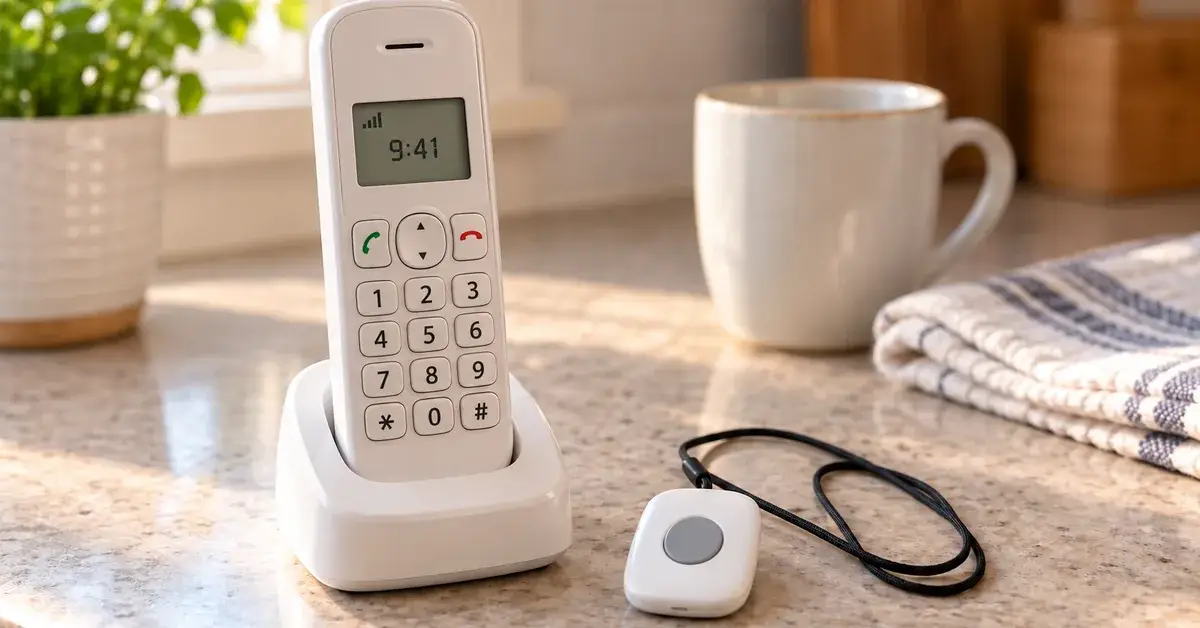
What it does cover is the moment your parent does recognize trouble: a stumble on the way to the bathroom at 2 a.m., feeling faint, or simply feeling frightened and alone. With our Home Freedom system, one press of the waterproof pendant (worn on a necklace or a wristband, including in the shower) connects through the base unit’s two-way speaker to our 24/7 monitoring centre in Canada. The button is rated for a 600 to 800 foot line-of-sight range from the base.
One part worth revisiting is the response plan. When service is set up, Bedford Medical Alert® records the details operators use on every call: medical information, medications, where a spare key is kept, and the order in which contacts are called. After a hospital stay, that plan should change with your parent. New prescriptions, say, or a neighbour who now has a key. Call us and we update it. If an alarm reaches the centre and nobody answers clearly, operators do not assume a false alarm; they follow a set procedure for silent calls and work through the plan, whether that means phoning the neighbour or sending emergency services. You can see each step in what happens when you press a medical alert button.
For a parent who is also at higher risk of falling after surgery, an optional fall detection pendant is available. It is worn as a necklace and is designed to sense the motion pattern of a fall and place a call automatically. It is a backup to the button, not a guarantee: no sensor on the market catches every fall.
A note on who we are
Bedford is Canadian-owned and operated, an OCSA member, and brings three generations of experience. We have supported hospital education programs and research initiatives from UHN Toronto Rehab to Trillium Health. We are not clinicians, and we will always send a medical question back to the people who are.
Getting the house ready for a parent’s first weeks home? See how our Home Freedom in-home medical alert systems connect to our 24/7 Canadian monitoring centre with one press, or call 1-888-755-3055 to talk it through with our care team.
Sources (read on 16 November 2026)
- Canadian Coalition for Seniors’ Mental Health, “Delirium: Assessment and Treatment of Older Adults” pocket card (updated 2024; based on the CCSMH national guidelines of 2006, updated 2014): ccsmh.ca
- Ontario Health, “Delirium: Care for Adults” quality standard (published March 2021; page updated November 9, 2026): ontariohealth.ca
- Inouye SK, Westendorp RG, Saczynski JS, “Delirium in elderly people”, The Lancet, 2014, volume 383, issue 9920, pages 911 to 922 (author manuscript on PubMed Central): pmc.ncbi.nlm.nih.gov
- Humber River Health, “Delirium: Information for Patients, Families, and Friends”, form 005031 (revised May 2021, reviewed March 2024): hrh.ca
- McMaster Optimal Aging Portal, Dr. Anthony J. Levinson, “When confusion strikes quickly: Recognizing and preventing delirium” (March 11, 2026): mcmasteroptimalaging.org
- Ontario Health, “Delirium Aware Safer Healthcare” (updated June 4, 2026): ontariohealth.ca
- Bedford Medical Alert, the Home Freedom and “what happens when you press a medical alert button” pages linked above (device features as published on the day of reading)