When a family calls us about an emergency necklace for a parent, the first questions are nearly always about hardware. How far does it reach? Is it safe in the shower? How often does it charge? Those are fair questions and they have real answers.
The question that decides whether the necklace ever does its job is quieter, and it usually surfaces months after the box is opened. Is the pendant still around her neck at three in the morning?
Bedford Medical Alert® brings three generations of experience to Canadian homes, and on this one point the published research and our own setup visits agree completely. A help button in a bedside drawer protects nobody. So this guide starts with wearability, then works outward to range, water, monitoring, and the questions worth asking any provider before money changes hands.
The Two Kinds of Emergency Necklace Sold in Canada
Nearly every pendant on the Canadian market is one of two designs, and confusing them is the most common buying mistake we see.
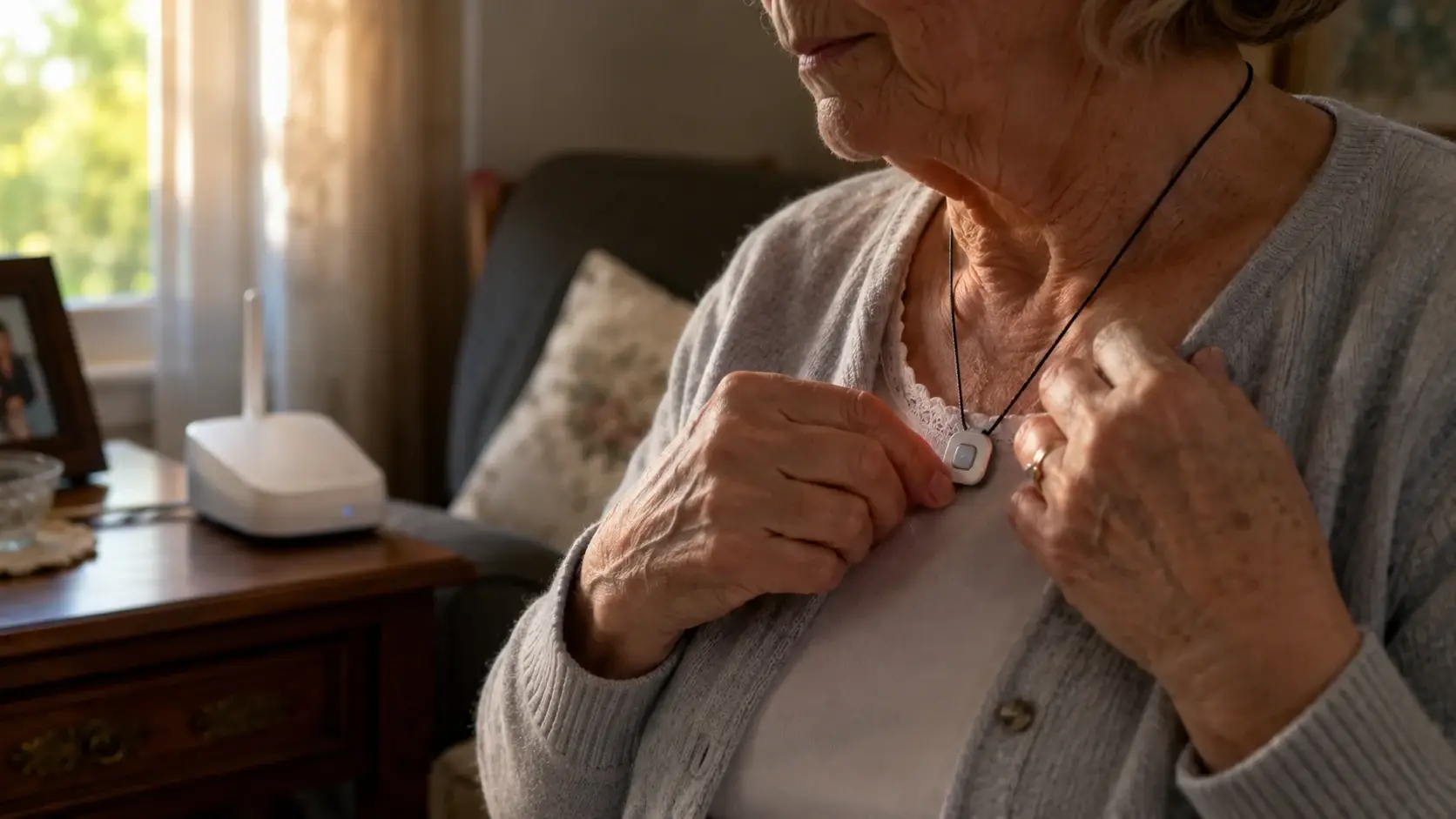
The first is an in-home pendant. The necklace is a small help button paired with a base station that sits in the house and carries the call through to a monitoring centre. Bedford’s Home Freedom system works this way. It suits someone whose days happen mostly at home, in the yard, or inside the building.
The second is a mobile GPS pendant. There is no base unit. The pendant carries its own cellular connection and location technology, so it works at the grocery store, on a walk, or in the passenger seat of a car. Bedford’s Go Anywhere Pendant is that stream, and the medical alert necklace Canada page covers its range, battery and fall detection in detail.
One product fact to know before you compare anything else: Bedford devices are not for use in the United States. They are built to work near the border, and near-border use is not a limitation.
If the open question is wearing style rather than device type, our guide to wearable medical alert options in Canada covers the wider comparison, including wrist-worn formats.
Why Pendants Come Off
This is the part of the category that product pages tend to skip. It is also the single most consistent finding in the research literature, replicated across three decades and half a dozen countries.
A 2010 study of community alarm subscribers in Germany, by Heinbuchner and colleagues, found that 24 percent of subscribers never wore their button at all, and only 14 percent wore it around the clock. Satisfaction with the service was high in that group and did not predict whether people wore the device.
A 2008 survey of 2,610 alarm users published in the Australasian Journal on Ageing, by De San Miguel and Lewin, mapped exactly where wearing breaks down. People wear the pendant reliably indoors and out in the garden. They wear it far less reliably in the shower, in the bath, and in bed at night.
And a 1995 survey of 106 subscribers in New York, by Levine and Tideiksaar in the Mount Sinai Journal of Medicine, surfaced something adult children should sit with: compliance was higher when the senior chose the device themselves, and lower when a family member made the purchase.
Fleming and Brayne’s 2008 study in the BMJ, following 110 people aged 90 and over, put the consequence plainly. Call alarms were widely available in that cohort and went unused in most of the falls that led to someone lying on the floor for a long stretch.
None of this means pendants fail. It means the pendant has to be chosen for the person who will wear it rather than for the person paying the invoice. Pick the lightest, least medical-looking option that still does what the household needs.
If the resistance runs wider than the necklace, and a parent is turning down help across the board, we wrote separately about recognizing self-neglect without taking over.
Not sure whether an in-home pendant or a mobile GPS pendant fits your parent’s week? Call us at 1-888-755-3055 and describe an ordinary day. We will tell you which stream fits, including when the in-home system is the better match.
Fit, Weight, and the Lanyard
Four things decide whether a necklace survives the first month.
Lanyard length. The pendant should sit where a hand naturally lands. Too long and it swings against a walker frame or a countertop; too short and it feels like a collar.
A breakaway clasp. Ask directly whether the lanyard releases under pressure. This matters for anyone who moves through narrow doorways, uses a walker, or has grandchildren who pull on things.
Weight and profile. A pendant that reads as jewellery gets worn. One that reads as a hospital tag gets tucked under a sweater, and a week later it is off.
A wrist alternative. Ask whether the same help button can be worn on the wrist. Bedford’s Go Anywhere Watch exists for this reason: for someone reluctant to wear an obvious alert pendant, a wrist device does not announce itself to visitors.
Water, Showers, and Night-Time
The De San Miguel and Lewin figures point at two moments worth planning for, and both are easy to plan for badly.
Ask for the device’s water rating in plain language. Splash-resistant, shower-safe, and submersible are three different things, and the difference lands hardest in the one room where wearing rates drop the most.
Then ask what happens overnight. Some people take the pendant off at bedtime out of habit, some because the lanyard bothers them, some because charging lives on the dresser. A longer lanyard, a wrist format, or a charging routine that keeps the device within arm’s reach of the bed can each solve it. The fix is usually small and specific to the room.
At a Bedford setup we walk through the day out loud, room by room, and note where the device will realistically be. That detail goes into the personalized response plan on file, not just an installation checklist.
How Far the Signal Reaches
For an in-home pendant, range depends on the base unit and on the building. Brick, concrete, and multiple storeys all cut into it. Ask the provider for the tested range, then test it yourself on day one: press from the far corner of the basement, from the back deck, from the garage. Better to learn the dead spots in week one than during an emergency.
For a mobile pendant, range is cellular coverage. Ask which network the device uses, then check that network at the addresses that actually matter. A cottage road, a daughter’s neighbourhood, the church parking lot.
What Happens After the Button Is Pressed
This is where a necklace stops being hardware.
Bedford is Canadian owned and operated, with monitoring staffed around the clock in Canada. A press routes the signal to an operator here, who works from the personalized response plan already on file for that person. Who to call first. What conditions matter. Which door has the lockbox. Whether a neighbour keeps a key. That plan is the reason two identical pendants can produce very different outcomes on the same street.
Ask any provider to describe that plan-building step in detail. If the answer is a phone tree with no personalization, the pendant is doing more work than the service behind it.
Bedford is an OCSA member, is trusted by clinicians across Canada, and has supported hospital education programs and research initiatives from UHN Toronto Rehab to Trillium Health. On Google, Bedford’s rating sits at 4.9 stars across hundreds of reviews.
A Short Note on Fall Detection
Automatic fall detection is a separate feature from the help button. In general terms it reads motion and orientation patterns and raises an alert when those patterns resemble a fall. The Go Anywhere Watch includes it. It is useful and it is not a guarantee: no sensor on the market catches every fall, and that is true of every brand, not just this one. We went deeper into the technology and the evidence in our post on fall detection devices in Canada.
For a household where nothing at all is going to be worn, Bedford’s Silver Shield takes a different route: a wall-mounted radar sensor with no cameras and no microphones, which alerts family and caregivers automatically under protocols the family sets. Silver Shield is not monitored by Bedford’s monitoring centre.
Questions Worth Asking Before You Pay
- Who answers the call, and where are they physically located? Bedford’s monitoring is in Canada, staffed around the clock.
- Is the equipment included in the subscription, or bought separately? Bedford includes it.
- What is the commitment? Bedford has no long-term contracts: plans typically run month to month after a three month minimum at the start, and there are no cancellation fees. We covered how no-contract medical alert plans work in Canada in more detail.
- What happens on a false alarm? Nobody should hesitate to press because they are worried about an accidental call. Ask how those are handled before you sign anything.
- Water rating, battery life, charging cadence, and what the low-battery warning looks and sounds like.
- Can the plan change as needs change, from in-home to mobile, or from a pendant to a wrist device, without starting over?
Ask those six questions of every provider you call, including us. The answers separate companies faster than any spec sheet does.
Ready to look at a pendant that will actually get worn? See the Go Anywhere fall detection pendant with GPS, or call 1-888-755-3055 and talk it through with someone in Canada. Equipment is included with the subscription, there are no long-term contracts, and setup is straightforward.