Call it a medical alert button, an emergency button for seniors or a panic button: the help button is the part of a medical alert system people picture first and ask about last. The calls we take almost never open with a question about how the signal travels. They open with something practical. Will it fit under a cardigan sleeve. Will it survive a shower. Can Dad wear it if he already has a watch on that wrist and refuses to give up the wrist.
So this post is about the button itself, the physical object someone in your family will actually wear or mount on a wall. Two neighbouring questions, which situations warrant a press and what happens in the seconds after one, already have their own pages. I link both below rather than repeat them here.
What a medical alert button actually is
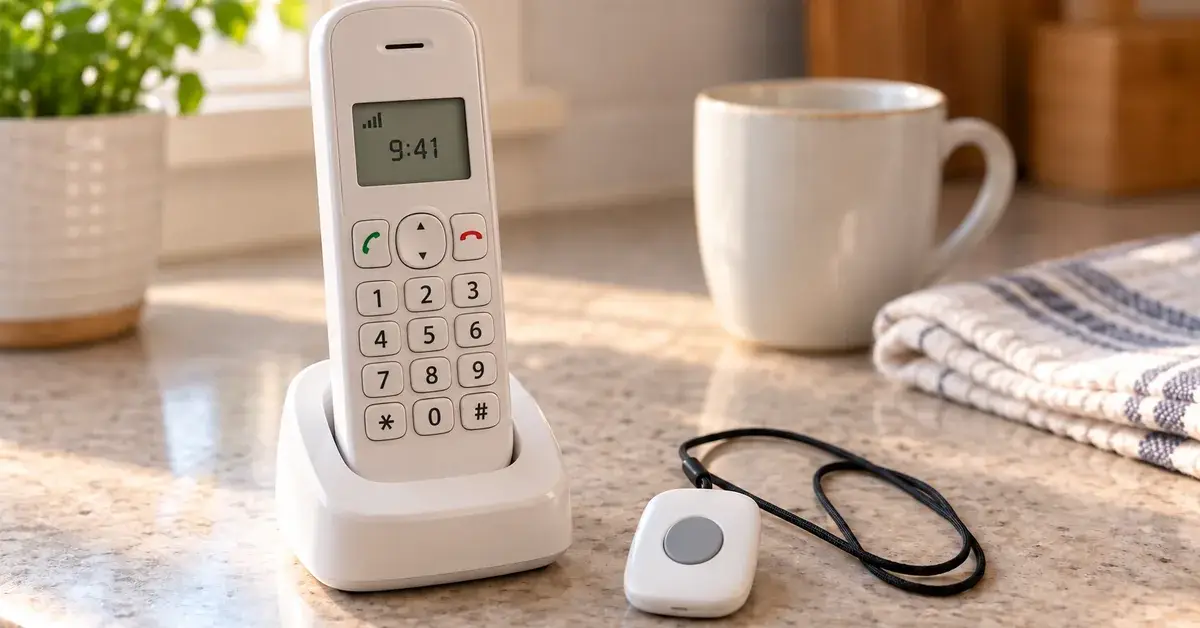
A medical alert button is a small radio transmitter. It is not a phone, and it is not a fitness tracker with an emergency feature bolted on. Pressing it sends a signal to either a base unit sitting in the home or, on a mobile device, straight out over a cellular network. That signal opens a voice connection to a monitoring centre staffed by people.
At Bedford Medical Alert®, that centre is in Canada and staffed around the clock. The distinction matters more than the plastic does, and I will come back to it.
One practical note before the shapes. The equipment comes included with the subscription rather than being sold to you as hardware. You are not buying a gadget and then hoping the company keeps supporting it three years from now. If a button fails or the form turns out to be wrong for the person wearing it, that is a service conversation, not a repurchase.
The four forms the button takes
Almost every question we get about “which button” is really a question about where it lives on the body, or whether it lives on the body at all.
The pendant
A pendant hangs at the chest on a cord or chain. It is the default for a reason: it sits where a hand naturally lands, it does not interfere with a walker or a cane grip, and it can be pressed by either hand. Our Home Freedom stream pairs an in-home pendant with a base unit for people who are mostly at home. The Go Anywhere Pendant is the mobile version, carrying its own cellular connection and GPS for people who still drive, garden, walk to the mail, or take the bus.
A pendant’s real weakness is that it comes off. Over the head, onto a nightstand, and there it stays.
The wristband
The same button, worn on a strap. Wristbands suit people who dislike anything around the neck, and people who take a necklace off to sleep. A wrist button tends to stay on through the day because it feels like a watch rather than like a medical device. It also sits closer to the floor if someone is down and reaching, which sounds like a small thing and is not.
The wall button
This is the form families forget exists. A wall button is fixed hardware, mounted where the risk concentrates: beside the toilet, inside the shower, at the head of the bed, at the bottom of the stairs. It costs nothing in dignity because nobody wears it.
Wall buttons solve the specific failure that worries me most, which is the wearable that was taken off. A pendant on the dresser helps no one at three in the morning. A button screwed to the bathroom wall is still there.
The watch
Our Go Anywhere Watch is for the person who will not wear anything that reads as medical. It tells the time, it looks like a watch, and it carries the help function inside. That resistance is real and worth designing around rather than arguing with. A watch someone wears every day beats a pendant they agreed to and then quietly stopped putting on.
Not sure which form fits the person you are shopping for? Call us at 1-888-755-3055 and we will talk it through by phone, at no charge, including the awkward part about whether they will actually wear it. Canadian-owned, Canadian monitored, no long-term contract.
The button is the simple half. Who answers is the hard half.
Two buttons can look identical in a photograph and behave completely differently once pressed, because what you are really buying is the response behind them.
Our operators work from a personalized response plan the family fills in when service starts: who to call and in what order, whether a neighbour has a key, which door the paramedics should use, what conditions matter. Bedford follows more intricate protocols than is typical in this category, and that is a deliberate choice rather than a feature list item. The full sequence, from press to voice contact to whoever arrives, is walked through step by step on our page about what happens when you press a medical alert button.
Families also ask what actually justifies a press. Chest pain qualifies. So does a stroke symptom, a smell of gas, a stranger at the door at night, and simply being on the floor and unable to get back up. That question has its own page, on when to press a medical alert button, including why falls are only part of the picture.
Some background on who is behind the button, since it is fair to ask. Bedford is Canadian-owned and operated and brings three generations of experience. We are an OCSA member, and we have supported hospital education programs and research initiatives from UHN Toronto Rehab to Trillium Health. Our Google rating sits at 4.9 stars.
Range, water, and the room where it matters
Two questions decide whether a button works in a specific house.
Range first. An in-home button talks to a base unit, so the practical question is not the number on a spec sheet but the shape of your home. Does the signal reach the basement laundry, the back garden, the detached garage, the far bedroom in a side-split. Ask about your actual layout, not the general figure. Mobile devices sidestep this by using the cellular network, though they trade in a battery that needs charging.
Water second. A meaningful share of the calls we take come from bathrooms, which is exactly where a wearable is most likely to have been removed. If the button is not rated to stay on in the shower, then the room with the hard surfaces is the room without coverage. This is the single strongest argument for adding a wall button rather than choosing between forms.
One product fact worth stating plainly: Bedford devices are not for use in the United States. They are built to work near the border, so a home in Windsor or Niagara is not a problem, but they are not a travel solution for a month in Florida.
Buttons that press themselves
Automatic fall detection is available on some wearables, and Silver Shield takes a different route entirely, using non-wearable mmWave radar mounted in the room to watch for a fall without a camera and without anything worn. Silver Shield is not staffed by our operators; it works to protocols the family sets, alerting the people they nominate automatically, and the 24/7 in its description refers to the sensor and its AI rather than to a monitoring centre.
In general terms, these systems look for the motion signature of a fall and raise an alert when they see one. No sensor on the market catches every fall, which is why the manual button remains the core of the product rather than a backup to the sensor.
Five questions worth asking before you buy
- What is included in the monthly price, and is the equipment part of it or a separate purchase?
- Where is the monitoring centre, and who is on the other end at four in the morning?
- What is the commitment, and what does it cost to stop?
- What is the range in a home shaped like mine?
- What happens on the days the button is not worn?
On the third question, here is ours, since vagueness there is how people get trapped. Plans typically run month-to-month after a three-month minimum at the start. There are optional savings if you commit to six or twelve months up front, and service reverts to month-to-month after that. There are no cancellation fees. If you want the streams laid out beside each other, our comparison of medical alert systems in Canada does that in one table.
Matching the form to the person
A quick way through it. Mostly home, comfortable with a necklace: an in-home pendant with a base unit. Dislikes necklaces, or takes one off to sleep: a wristband. Still out and about: a mobile pendant or the watch. Resistant to anything that looks medical: the watch, every time. Someone who has already proven they will not wear it: wall buttons in the bathroom and the bedroom, and stop fighting about the pendant.
Most households we set up end with more than one of these, which is usually the right answer. Easy Setup means the base recognizes the additional buttons without a technician visit.
Ready to put a help button in the house? Our Home Freedom in-home system pairs a pendant or wristband with a base unit and 24/7 Canadian monitoring, with the equipment included and no long-term contract. Call 1-888-755-3055 to talk it through, or to add a wall button to a system you already have.