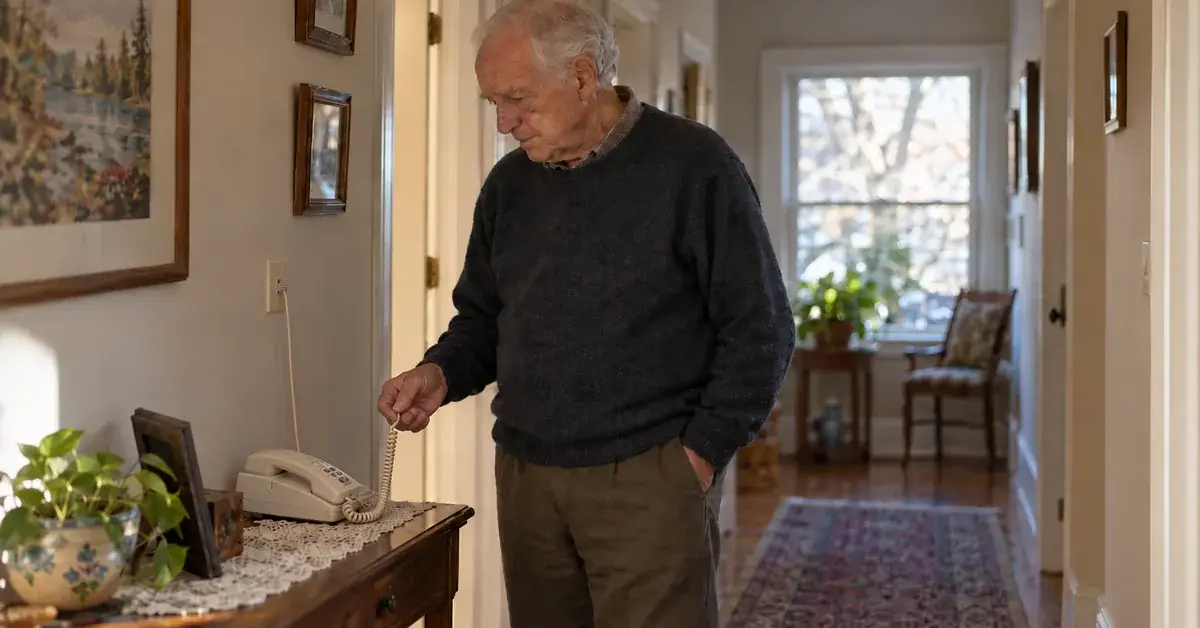
It usually starts on the highway. Three hours each way to fix a running toilet, sit in on a specialist appointment or check why your father has not been answering the phone. Somewhere around the third trip in a month, someone says it out loud: what if he lived ten minutes from us?
This post is for the families who have decided, or nearly decided, to close that distance. It covers the move itself, the health paperwork that follows a person from one address to another, and the first months in the new home, which is the part most plans skip.
If you are still weighing whether to move at all, our guide to long-distance caregiving in Canada covers how to care well from a few hundred kilometres away. And if the plan is for your parent to move into your house rather than near it, our page on living with an aging parent is the better starting point.
A home of their own, ten minutes from yours
This kind of move keeps your parent behind their own front door. Your parent still runs the household, chooses the groceries and decides who visits. What changes is how fast a familiar face can get there.
We think about that in minutes. When our team builds a response plan with a family, one of the first questions is who can reach the door, and how quickly, at two in the morning. A move across town or across a province changes that answer more than any device does.
Before the move: decide it with your parent
Whose move is this? The answer should be your parent’s, and it is easy to lose sight of that once the logistics start.
Your parent may be giving up a family doctor they have seen for decades, a neighbour who checks the mail, a coffee group, a familiar pharmacy counter. Ask what they will miss, and plan for at least one of those things to have a replacement in the new place before moving day. If the conversation is hard to start, the approach in our guide on how to talk to a parent about a medical alert works for this one too: questions first, one decision at a time, and your parent keeps the final say.
When you look at places together, measure what will matter in year three, not just on moving day:
- Drive time at rush hour, from your home and from your workplace. Ten minutes on a Sunday can be forty on a weekday.
- Stairs. A single-floor unit, or a building with an elevator, beats a charming walk-up.
- Walking distance to a pharmacy and a grocery store, so a missed bus or a winter week does not mean going without.
- The bathroom. Space for a grab bar, a tub your parent can step into, and a clear path from the bedroom at night.
Health coverage and the new family doctor
This is the paperwork families tend to discover late. Nothing here is financial or legal advice; the provincial pages govern, and they change.
If your parent is moving within the same province, their provincial health coverage carries on. The practical job is updating the address on file with the provincial health plan, and it is worth doing early, for a reason we get to below.
Moving across a provincial line is different, and the rules are set by the province your parent is moving to. Two examples show how far apart they can be:
Ontario. The provincial government’s OHIP page states that “there is no longer a waiting period for OHIP coverage,” and that eligible people have immediate coverage. To qualify, a person must make Ontario their primary residence, be physically in the province for 153 days in any 12-month period and for at least 153 of the first 183 days after moving in, and meet one of the page’s further requirements, such as Canadian citizenship (ontario.ca, page updated July 21, 2025).
British Columbia. The B.C. government’s Medical Services Plan page lists a wait period of the rest of the month in which a person becomes a resident, plus two more months, and asks new residents to apply as soon as they arrive rather than at the end of the wait. Someone moving from elsewhere in Canada should “keep your former health plan during the wait period” (gov.bc.ca, page updated June 4, 2026).
Other provinces and territories have their own rules. They change, and the official page for the destination province governs. Read it the week you set the moving date, not the week of the move, and keep a note of the date you read it.
Finding a family doctor. In Ontario, for example, Health Care Connect matches people with a family doctor, nurse practitioner or primary care team that is accepting new patients. You can register online or by calling 811, and you can register a whole family. Two requirements matter here: a valid Ontario health card, and a mailing address that matches the one on the health card (ontario.ca, page updated August 9, 2026). That is why the address update comes first. If the card still shows the old address, sort that out before you register. The same page is plain that registering does not guarantee an immediate match, so start early.
While the search is on, two things bridge the gap. Ask the current doctor’s office how to have records sent once a new clinic is found. And ask the current pharmacist, before the last refill, how to move prescriptions to a pharmacy near the new home.
Planning a move for a parent who will be living alone in the new place? Call our care team at 1-888-755-3055 for a complimentary consultation by phone. We will ask about the new home, the phone line there and who will be nearby, and tell you plainly which setup fits. Bedford is Canadian-owned, and our monitoring centre is based in Canada and staffed 24/7.
The first weeks in the new place
A new home is unfamiliar in ways that only show up at night. The bathroom is on the other side of the bed. The light switch is on the wrong wall. The step down into the living room is somewhere it was not for the last forty years.
A short first-week list:
- Walk the night route together. Bedroom to bathroom, with the overhead lights off. Put night lights wherever your parent hesitated.
- Unpack the bathroom and bedroom first. The kitchen can wait a day. Put everyday dishes and the kettle at counter height, not on the top shelf the movers chose.
- Make the new address easy to say. Under stress, people give the address they have used for decades. Write the new address, the unit number, the buzzer code and the nearest cross street on a card by the phone, and on the fridge.
- Sort out the keys. Decide who holds a spare and how a paramedic or a neighbour would get in if your parent could not reach the door.
- Meet one neighbour and the building contact. A superintendent who knows your parent’s name is worth more than a lot of equipment.
Ten minutes away, but not every minute
Proximity has a way of quietly becoming the whole plan. You are ten minutes away, so you will handle it. Then you are at a work conference in Calgary, or in bed with the flu, or at a 6 a.m. hockey practice with your phone in the car.
Write down who responds when you cannot: a sibling, a neighbour, a friend from the new building. Put two names on that list, not one. What happens to your parent’s care if something happens to you deserves its own written plan as well, and the time to make it is while everyone is well.
Where a monitored alert fits in the new home
A medical alert does not prevent falls, and it is not a substitute for the people around your parent. What it covers is the stretch of time when your parent needs help and nobody is in the room.
With a Bedford Medical Alert® system, pressing the button reaches our monitoring centre in Canada, at any hour. The operator who answers works from a response plan set up in advance: who gets called first, who is next, and when to send paramedics. Your parent chooses the names on that list. After a move, the order often changes, because the person ten minutes away is now you.
If your parent already has a Bedford system, the same device can be used in the new home. The one thing we ask is that you tell us about the move, so that we can update the address on file and the care profile before the first night there. Over the years, through moves and changes in health, a different device or a different response protocol is often the better fit, and a move is a natural moment to ask us whether the current setup still suits. A parent who will keep a second address has a page of their own: cottages, farms and two addresses.
Home Freedom is our in-home system: a base unit and a waterproof pendant or wristband your parent can wear in the shower. The wireless button works up to 800 feet from the base. New apartments often have no landline, and that is not a problem; we offer units for landline or VoIP and units that run on the cellular LTE network, with no Wi-Fi required. Our page on whether you need a landline for a medical alert explains the options in more detail. Setup is Easy Setup, and the equipment is included with the subscription.
Some households add automatic fall detection, an optional upgrade worn as a pendant, for the fall where a person cannot or does not press. It senses the motion patterns typical of a fall, and no sensor on the market catches every fall, so the button stays the main way to call for help. For a parent who will be exploring a new neighbourhood on foot, our Go Anywhere pendant and watch carry the button outside the house, with GPS to help locate them.
On terms: plans typically run month to month after a three-month minimum at the start, with optional six or twelve month initial terms if the savings suit you. Service reverts to month to month afterwards, and there are no cancellation fees.
Bedford brings three generations of experience to this work, is a member of the Ontario Community Support Association, and has supported hospital education programs and research initiatives from UHN Toronto Rehab to Trillium Health. If all of this is new, our main page is the place to start.
Moving a parent closer and want help in place from the first night? Home Freedom puts a help button within reach anywhere in the new home, with Easy Setup, equipment included and 24/7 monitoring from Canada. Call 1-888-755-3055 and tell us about the new place and who lives nearby; we will build the response plan around them.
Sources
- Government of Ontario, “Apply for OHIP and get a health card,” page updated 21 July 2025: ontario.ca
- Government of British Columbia, “Coverage wait period for the Medical Services Plan (MSP),” page updated 4 June 2026: gov.bc.ca
- Government of Ontario, “Find a family doctor or nurse practitioner” (Health Care Connect), page updated 9 August 2026: ontario.ca